Red light therapy is not a cooking recipe, but dose matters almost as much as it does in the kitchen. Too little, and nothing much happens. Too much, and the result may not be better. It may simply be too much light for the tissue to use.
This is why dose is one of the most important topics in red and near-infrared light therapy. Wavelengths, LED count, wattage, and panel size all matter, but they only become useful when the device delivers the right amount of light to the right area for the right amount of time.
This guide explains dose in plain language: the basic calculation, the useful dose window, common ranges for different applications, and the small details that often change real-world results. The goal is not to turn every user into a physicist. It is to help teams and users avoid two common mistakes: underdosing and overdoing it.
Why Dose Matters More Than Bright LEDs
Many people judge a red light therapy device by how bright it looks. That is understandable, but not very reliable.
Brightness is what your eyes see. Dose is what the tissue receives.
A panel may look powerful, but if the treatment distance is too far, the actual irradiance at the skin may be much lower than expected. Another device may look less dramatic but deliver a stable, well-measured output at the recommended distance. In therapy, the second one may be more useful.
Dose is usually expressed as joules per square centimeter, written as J/cm². It describes how much light energy is delivered to a specific area.
Several factors affect dose:
- Irradiance, or power density, usually measured in mW/cm²
- Session time, usually measured in seconds or minutes
- Distance between the device and the skin
- Wavelength, such as 630nm, 660nm, 810nm, 830nm, or 850nm
- Tissue target, such as skin, wound area, muscle, tendon, or joint
- Device design, including beam angle, LED layout, and output stability
This is why a simple statement like “use it for 15 minutes” is not enough by itself. Fifteen minutes at 20 mW/cm² is very different from 15 minutes at 100 mW/cm².
The Basic Dose Formula
The standard dose formula is simple:
Dose (J/cm²) = Irradiance (mW/cm²) × Time (seconds) ÷ 1000
For example:
If a device delivers 50 mW/cm² at the treatment distance and the user treats the area for 200 seconds, the dose is:
50 × 200 ÷ 1000 = 10 J/cm²
That means the target area receives 10 joules of energy per square centimeter.
This formula shows why time and irradiance cannot be separated. A weaker device may need a longer session. A stronger panel may need a shorter session. If distance changes, the calculation changes too.
A practical dose calculation table looks like this:
| Irradiance at Skin | Session Time | Approx. Dose |
| 25 mW/cm² | 5 minutes | 7.5 J/cm² |
| 50 mW/cm² | 5 minutes | 15 J/cm² |
| 50 mW/cm² | 10 minutes | 30 J/cm² |
| 100 mW/cm² | 5 minutes | 30 J/cm² |
| 100 mW/cm² | 10 minutes | 60 J/cm² |
A powerful panel can reach a high dose quickly, so high output needs careful protocol design.
The Dose Window: More Is Not Always Better
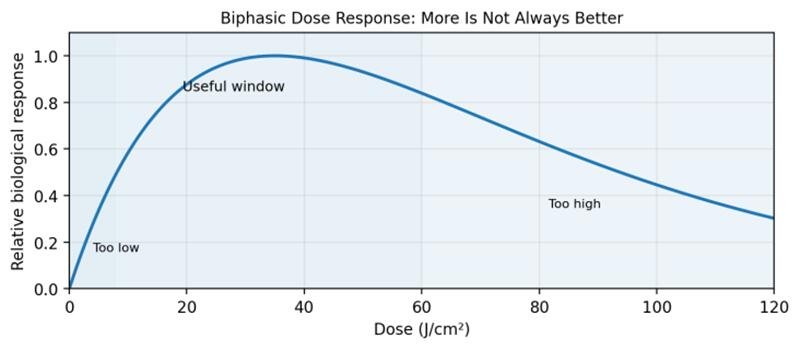
Figure 1. A practical dose window: too little may do too little; too much may reduce the response.
Red and near-infrared light therapy follows a biphasic dose response, often linked to the Arndt-Schulz principle. In plain English, it means this:
- Too little light may not do enough.
- A suitable dose may support a helpful biological response.
- Too much light may reduce the effect or create irritation.
For many applications, the useful window is moderate. The supplied literature notes say effects may begin to reverse beyond around 60 J/cm², while very high exposures above 100-200 J/cm² may carry more risk. These numbers are not universal limits for every device and user, but they are a useful reminder: light therapy is not a contest to see who can tolerate the longest session.
Skin and inflammation protocols often work best in lower dose ranges. Deep joint or pain applications may need higher surface doses because near-infrared light loses energy as it travels through tissue.
So the smart question is not “What is the maximum dose?”
The better question is: “What is enough for this target?”
Practical Dose Ranges by Application
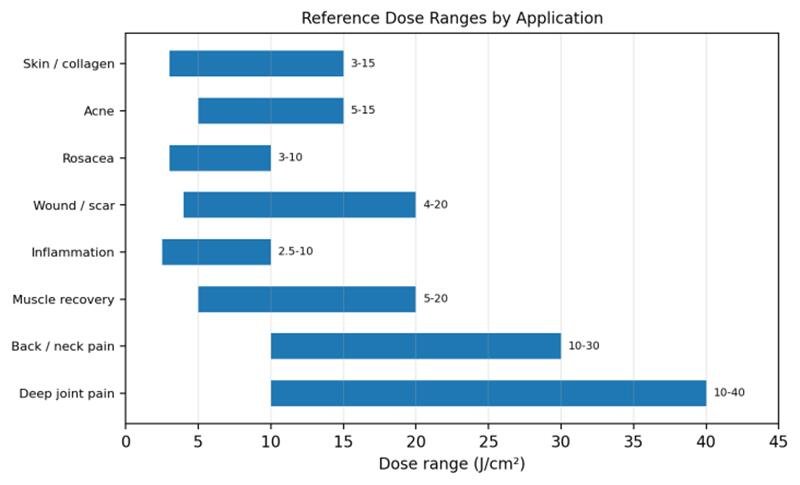
Figure 2. Reference dose ranges vary by tissue depth and application goal.
Different tissues need different dose ranges. Skin is shallow. Deep joints are not. Acne, collagen support, wound healing, inflammation, and pain relief do not use the same protocol.
The table below gives practical reference ranges based on the supplied clinical literature notes.
| Application | Main Wavelengths | Common Dose Range | Typical Frequency | Expected Timeframe |
| Anti-aging, wrinkles, collagen support | 630-660nm red light | 3-15 J/cm² | 5 times/week | 8-12 weeks |
| Acne support | 630-660nm red light | 5-15 J/cm² | Daily or 5 times/week | 6-8 weeks |
| Rosacea-prone skin support | 630-660nm red light | 3-10 J/cm² | 3-4 times/week | 6-12 weeks |
| General wound/scar support | 630-670nm + 830-850nm | 4-20 J/cm² | 5 times/week | Depends on wound type |
| Diabetic foot ulcer protocols | 660nm | 3-8 J/cm² | Daily | Clinical supervision needed |
| Burns and wound care | 660-850nm | 3-21 J/cm² | Daily | Clinical supervision needed |
| Acute inflammation | 660nm or 830nm | 2.5-10 J/cm² | Case-dependent | Often lower dose preferred |
| Chronic inflammation/arthritis | 810nm | Around 10 J/cm² | Protocol-dependent | Several weeks |
| Knee or joint pain | 810-850nm | 10-40 J/cm² | 5 times/week | 2-8 weeks |
| Neck, back, or waist pain | 810-850nm | 10-30 J/cm² | 5 times/week | 4-8 weeks |
| Muscle soreness and sports recovery | 810-850nm | 5-20 J/cm² | After exercise | Immediate to 48 hours |
| TMJ, tendon, or point treatment | 660-850nm | 2.5-10 J/cm² per point | Often daily | Case-dependent |
These ranges are not a substitute for a medical protocol. They are practical reference windows for understanding how dose changes by application.
Skin, Acne, and Surface-Level Use
Skin applications usually do not need very high doses. The target is shallow, and red light wavelengths around 630-660nm are commonly used.
For collagen support, fine lines, texture, and anti-aging routines, 3-15 J/cm² is commonly used. Sessions often last 10-15 minutes, with about five sessions per week over 8-12 weeks.
For acne-prone skin, 5-15 J/cm² is common, with 10-20 minute sessions. Protocols may use daily treatment or five sessions per week over 6-8 weeks.
For rosacea-prone or reactive skin, lower exposure is usually more sensible: 3-10 J/cm², 8-12 minutes, and three to four sessions per week.
For masks, small panels, handheld devices, and facial systems, comfort and consistency are more important than raw intensity. If the skin becomes hot, irritated, or unusually red, reduce time, increase distance, or pause.
Wound Repair, Scars, and Inflammation
Wound repair and scar support often use both red and near-infrared light. Red light helps with superficial tissue interaction, while near-infrared light can support deeper tissue coverage.
For general wound and scar routines, the supplied dose notes suggest 630-670nm plus 830-850nm, with a dose range of 4-20 J/cm², usually around 10-15 minutes per session and five times per week.
For diabetic foot ulcers, a lower range such as 3-8 J/cm² at 660nm is noted, often with daily application under clinical supervision. For burn wounds, 660-850nm and 3-21 J/cm² are listed as reference ranges.
The source notes also mention a 2023 report by Fekrazad et al., where 660nm at 4 J/cm² was associated with faster wound closure, fibroblast migration, and M2 macrophage polarization. The lesson is not that one number solves every wound. It is that wound protocols often work in carefully controlled, moderate ranges.
Inflammation is similar. Higher is not always better.
For acute inflammation, 660nm or 830nm at 2.5-10 J/cm² is listed as a useful range. For chronic inflammation and arthritis, 810nm around 10 J/cm² is noted. The document also mentions rheumatoid arthritis protocols using 810nm at 10 J/cm², three times per week for 12 weeks, with reductions in pain scores and inflammatory factors.
For product teams, anti-inflammatory positioning should not be built only around power. A device designed for inflammation needs controlled output, clear timing, and user guidance.
Pain Relief and Deeper Tissue Targets
Pain relief often depends more heavily on near-infrared wavelengths, especially 810-850nm. These wavelengths can reach deeper tissue than visible red light.
The supplied notes describe near-infrared penetration as approximately 2-4 cm, depending on tissue and conditions. Tissue absorbs and scatters light, so the surface dose often needs to be higher when the target is deeper.
For knee arthritis and joint pain, 10-40 J/cm² is listed as a reference range, with 15-20 minute sessions, five times per week, over 2-8 weeks.
For neck, waist, and back pain, the reference range is 10-30 J/cm², often with 15-20 minute sessions and five times per week.
For muscle soreness and sports recovery, 5-20 J/cm² is common, often after exercise. Effects may be felt the same day or within 48 hours, depending on the user.
For tendon, TMJ, or point-based treatment, 2.5-10 J/cm² per point is noted.
Device format matters. A facial mask is not the right tool for deep knee pain. A handheld device can work for points, while a larger panel or wrap may suit broader areas.
Distance, Irradiance, and Measurement Accuracy
Dose calculations are only useful if the irradiance number is real.
This is where many product claims become confusing. A device may state a high irradiance value, but the measurement distance may not be clear: at the LEDs, at 6 inches, at 12 inches, in the center only, or across the full treatment area?
Distance changes everything. The same panel can deliver very different irradiance at 15 cm and 30 cm. A user who doubles the distance may receive far less light than expected.
For product pages and manuals, dose information should always include treatment distance. Without distance, the number is incomplete.
Measurement tools also matter. The source notes warn that solar irradiance meters may overestimate near-infrared output. For more reliable dose planning, spectrometer-based data is better, especially when comparing red and near-infrared output.
For brands and manufacturers, this affects trust. If a product claims high output but cannot show credible irradiance and spectral data, the protocol becomes guesswork.
A safer and more professional device should provide:
- Wavelength data
- Irradiance at specified distances
- Treatment time guidance
- Recommended frequency
- Eye safety instructions
- Application-specific protocol notes
- Clear warnings for contraindicated users
Good dose guidance turns a light device into a usable therapy tool.
A Practical Protocol Framework
A useful dose guide does not need to be complicated. It should help users make better decisions.
- Define the target
Is the goal skin, acne, wound support, inflammation, pain, joint care, or muscle recovery?
- Choose the right wavelength
Use 630-660nm red light for surface-level skin and superficial tissue work. Use 810-850nm near-infrared light for deeper tissue, pain, joint, and muscle routines. Use combined red + NIR when both surface and deeper targets matter.
- Check the device irradiance
Do not rely only on wattage or LED count. Use measured irradiance at the intended treatment distance.
- Calculate the dose
Use the formula: irradiance × time ÷ 1000.
- Stay within the useful range
Match the dose to the application. Skin and inflammation often need lower ranges. Deeper pain and joint applications may need higher surface doses.
- Start conservatively
Sensitive users, facial applications, and first-time users should start with lower exposure and increase gradually.
- Track response
Look for comfort, consistency, and realistic progress. If irritation appears, reduce time, increase distance, or take rest days.
- Avoid pretending one protocol fits everyone
Different skin types, body areas, device outputs, and health conditions require different protocols.
The same logic applies to product development. A panel, mask, belt, cap, or full-body system should be designed around wavelength, output, coverage, distance, and intended use.
FAQ
- What is the most important number in red light therapy dosing?
The most useful number is dose, expressed as J/cm². It combines irradiance and time, so it tells you how much light energy reaches a specific area.
- Is a higher dose always better?
No. Red and near-infrared therapy follows a biphasic response. Too little may be ineffective, but too much may reduce benefits or cause irritation.
- What dose is commonly used for skin care?
For skin applications such as collagen support, wrinkles, acne, and redness, common ranges are usually around 3-15 J/cm², depending on the specific concern and device output.
- Why do deeper pain protocols need higher surface doses?
Near-infrared light loses energy as it passes through tissue. For deeper targets such as knees, joints, or back muscles, the surface dose often needs to be higher to deliver enough usable light deeper inside.
- Can I calculate dose only from session time?
No. Time alone is not enough. You also need irradiance at the treatment distance.
- Why does treatment distance matter so much?
Irradiance drops as distance increases. A panel used at 15 cm and the same panel used at 30 cm can deliver very different doses.
- Are solar power meters good enough for measurement?
They can be useful for rough comparisons, but they may overestimate near-infrared output. Spectrometer-based measurements are more reliable for serious dose planning.
- What wavelength should be used for muscle recovery?
810-850nm near-infrared wavelengths are commonly used because they reach deeper tissue better than visible red light.
- What is a safe starting approach?
Start with moderate distance, shorter time, and a lower range. Increase gradually if tolerated.
- Should every device use the same protocol?
No. Masks, panels, belts, caps, and full-body systems differ in output and coverage. Protocols should match the device and application.
Final Thoughts
A good dose guide is not there to make red light therapy look complicated. It is there to stop people from using a powerful device like a guessing game.
The basic idea is simple: choose the right wavelength, measure real irradiance, calculate dose, respect the treatment distance, and avoid the “more is better” trap.
For product teams, this is where better devices begin. A reliable red and near-infrared therapy product should not only look impressive on a product page. It should provide clear wavelength data, stable output, practical protocol guidance, and safety information that real users can understand.
Light therapy is powerful when the dose makes sense. Otherwise, it is just a very bright way to hope for the best.
Source note: This article was prepared from the supplied literature summary on red and near-infrared therapy dose ranges. It is intended for educational product-content planning, not as medical advice.