Red light therapy can look convincing until a buyer compares the research with the actual product. A promising paper may involve a different device, dose, population, or outcome. That gap can create weak product decisions and risky marketing claims. I use a structured evidence-matching process to separate relevant findings from attractive but unsupported conclusions.
Red light therapy may support particular outcomes under particular studied conditions, but the evidence does not justify a universal yes-or-no answer. I assess whether the population, intended purpose, device configuration, delivered dose, treatment schedule, and measured outcome match the proposed product. A positive study only supports the conditions that researchers actually tested.

I manufacture red and near-infrared devices rather than practice medicine, so I approach this question from product definition, sample testing, quality control, and supplier evaluation. The useful question is rarely “Does it work?” The useful question is “How closely does this product match the evidence behind its intended use?”
Why Isn’t Red Light Therapy One Treatment?
I often see buyers discuss red light therapy as if every panel, mask, belt, and full-body system delivers the same intervention. That shortcut creates a problem. Two devices can display similar wavelength numbers while producing very different exposure conditions at the treatment surface.
I treat red light therapy as a family of light-based interventions rather than one uniform treatment.1 Wavelength, irradiance, exposure time, treatment distance, illuminated area, pulse settings, session frequency, and device format can all affect the delivered dose. Evidence from one configuration may not transfer to another configuration.
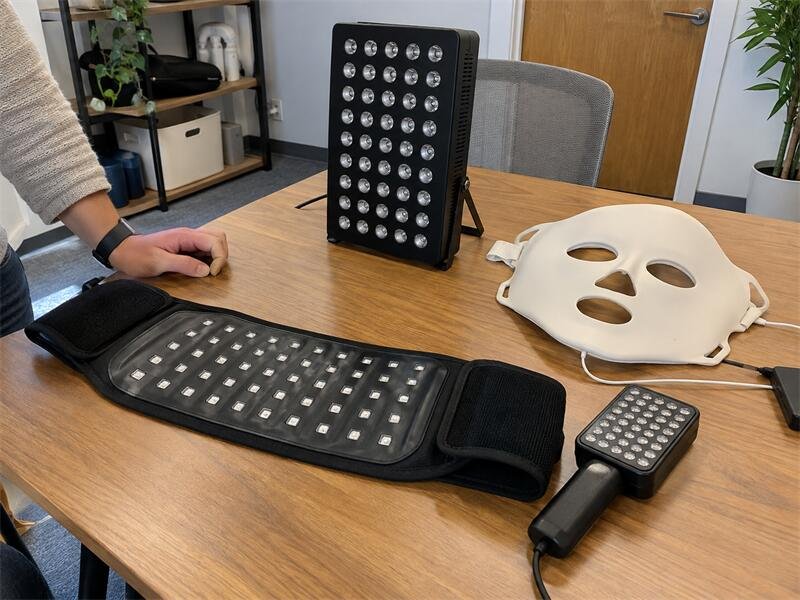
A wavelength label tells me only part of the story
A supplier might describe two products as “660 nm and 850 nm devices.” That description does not tell me whether both products deliver comparable light to the target area. I still need to check:
- The wavelength tolerance or measured spectral range
- The irradiance at a defined distance
- The size and uniformity of the illuminated area
- The optical power distribution across that area
- The continuous or pulsed operating mode
- The session duration and recommended frequency
- The distance between the product and the treatment surface
- The physical contact, angle, and fit of a wearable product
A facial mask and a standing panel may use similar LED wavelengths, but I would not assume that a study involving one supports claims for the other. The mask sits close to the skin and follows facial contours. The panel may operate from several centimeters away and cover a larger area. Those differences affect exposure.
Dose needs context
I can estimate energy density with a basic relationship:
> Energy density (J/cm²) = irradiance (W/cm²) × exposure time (seconds)2
However, I do not treat that calculation as proof of a biological or clinical result. The calculation also becomes less straightforward when the device pulses, changes output by mode, has uneven coverage, or loses intensity with distance.
In one anonymized project discussion, a buyer compared our sample with a paper that reported a particular energy density. The buyer initially wanted us to copy the paper’s session time. Our measurement showed that the sample’s irradiance at the proposed distance differed from the study device. A copied treatment time would therefore not deliver a comparable exposure.
That conversation did not tell us whether the product would produce the studied outcome. It told us something more basic: we could not claim alignment with the study until we reconciled the actual exposure conditions.
What Does “Red Light Therapy Works” Mean?
I ask buyers to define “works” before we compare products or papers. Without a defined purpose and outcome, the word can mean anything from a temporary subjective change to a measured clinical endpoint. Vague language makes almost any positive finding look more transferable than it is.
When I evaluate whether red light therapy works, I define the target population, intended purpose, treatment setting, expected outcome, measurement method, and time frame. I then ask whether the observed change was meaningful, consistent, and relevant to the planned product. A statistical difference alone may not answer the buyer’s commercial question.3
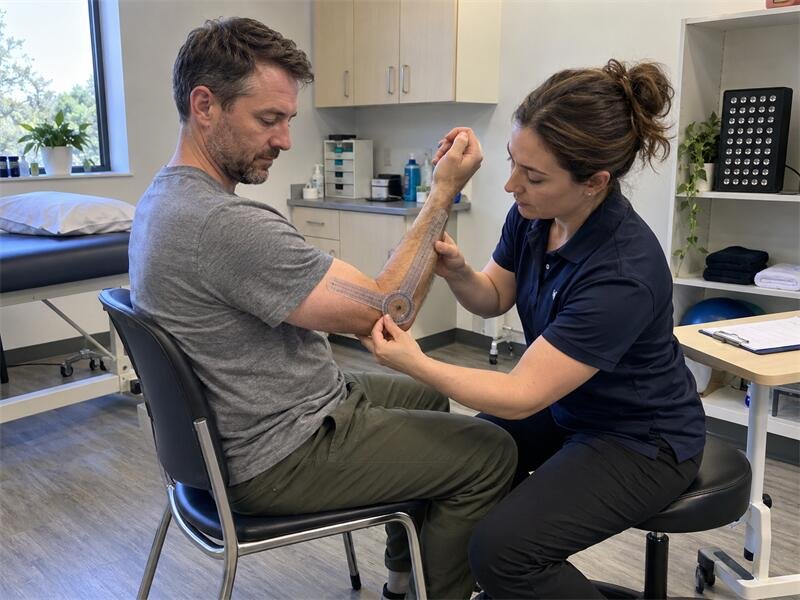
I define the outcome before reviewing the result
A study can measure many things. Researchers may record laboratory markers, imaging results, clinician ratings, self-reported scores, range of motion, skin appearance, or another endpoint. These outcomes are not interchangeable.
For procurement and product planning, I usually write the intended outcome in one sentence:
> “We want to evaluate a device for [specific population], used for [specific purpose], under [specific protocol], with improvement assessed by [specific outcome] after [specific period].”
This sentence prevents a product team from drifting into broader claims as the project develops.
I separate surrogate outcomes from buyer-facing benefits
A change in a laboratory marker can support further research, but I would not automatically convert it into a consumer-facing benefit. Biological measurements may show that something happened without proving that users experienced a meaningful improvement.4
I also distinguish between these result types:
| Result type | What I can reasonably take from it | What I should not assume |
|---|---|---|
| Laboratory or cellular result | A possible biological response under tested conditions | A proven human benefit |
| Device output test | The sample emits measured light within tested parameters | The device creates a clinical outcome |
| Small human study | A preliminary outcome in the studied group | Universal effectiveness |
| Controlled clinical study | Evidence tied to its population, protocol, and endpoints | Transfer to every device or use |
| User testimonial | Context about experience or usability | Causation or guaranteed results |
During product discussions, I have heard customer feedback such as “users liked the warmth” or “the treatment fitted well into a recovery routine.” I value that feedback for usability decisions. I do not treat it as proof that the device caused a health outcome.5
This distinction matters because a product can be easy to use and commercially attractive while still requiring careful limits around benefit statements.
How Should I Read Red Light Therapy Studies?
I know that a research abstract can make a product decision feel simple. The abstract usually presents the headline result, but it may leave out the details that determine relevance. I therefore compare the complete study conditions with the proposed device and use scenario.
I read red light therapy studies by matching six elements: target population, intended use, study device, delivered dose, treatment protocol, and measured outcome. If one or more elements differ materially from the planned product, I treat the study as indirect evidence rather than direct support for the proposed positioning.
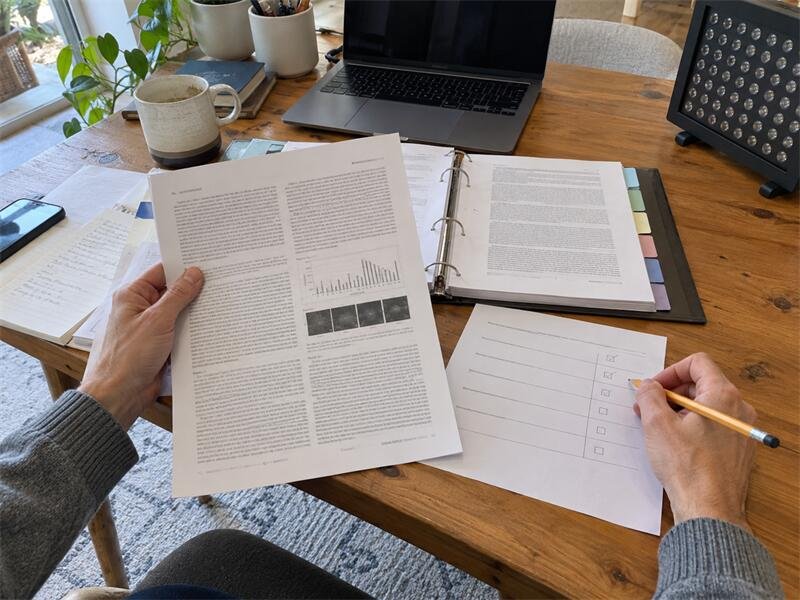
My six-part study check
I use the following questions during research review:
-
Who participated? I check age range, condition or baseline status, sample size, exclusion criteria, and treatment setting.
-
What was the intended purpose? I distinguish general wellness, cosmetic use, recovery support, and condition-specific treatment. I do not blend these categories.
-
Which device did the researchers use? I look for device format, LED or laser source, wavelength information, contact method, beam area, and treatment distance.
-
What dose did participants receive? I check reported irradiance, exposure duration, energy density, treated area, pulse mode, and measurement method.
-
What protocol did the study follow? I record sessions per week, total treatment period, co-interventions, supervision, and adherence.
-
What outcome did researchers measure? I check whether the endpoint was objective, clinician-assessed, self-reported, or laboratory-based. I also check when researchers measured it.
Study quality still matters
A close parameter match does not rescue weak research.6 I also review:
- Whether the study had a suitable comparison group
- Whether randomization and blinding were practical and described
- Whether researchers reported dropouts and adverse events
- Whether the sample size was justified
- Whether researchers pre-specified the main outcomes
- Whether the paper reported all relevant results
- Whether funding sources and conflicts were disclosed
- Whether independent studies found comparable results
I also watch for comparisons that are technically “controlled” but commercially unhelpful. For example, a study might compare light exposure with no intervention, while the real purchasing decision involves light therapy versus an established service or competing device.
I am not a clinical research authority, so I refer study-specific medical interpretation to qualified clinicians or research professionals. My role is to identify whether the equipment and protocol described in a paper meaningfully resemble the product under evaluation.
Which Evidence Layers Matter?
I sometimes receive a test report followed by the question, “Does this prove the therapy claim?” The short answer is no. A plausible mechanism, a correctly functioning device, and evidence of a human outcome answer different questions. A strong product review keeps those evidence layers separate.
I separate evidence into three layers: biological plausibility, device performance, and clinical outcomes. Biological research may explain why an effect could occur. Device testing verifies measurable output and consistency. Clinical evidence evaluates outcomes in people. I do not use any one layer as a substitute for the other two.
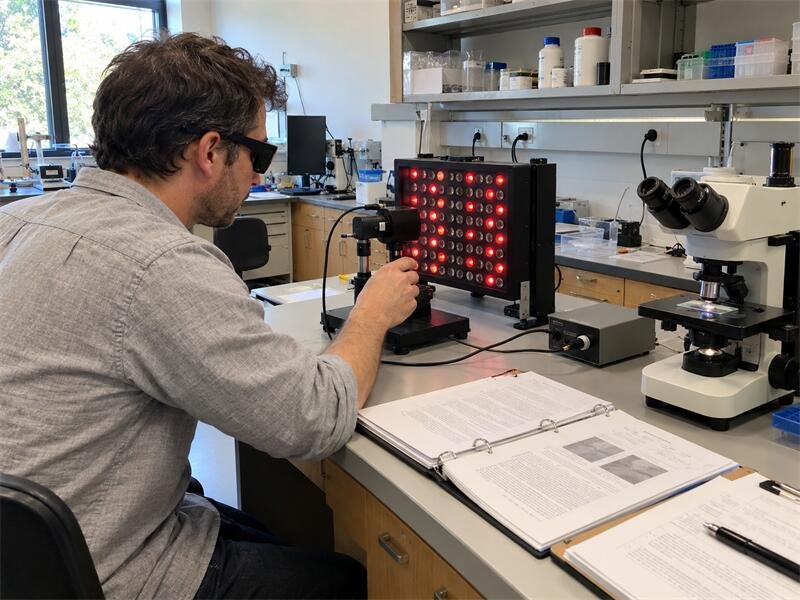
Layer 1: Biological plausibility
Photobiomodulation research discusses several proposed cellular and physiological pathways.7 These discussions can help researchers form hypotheses and choose study parameters. However, I do not present a proposed mechanism as proof that a finished product delivers a claimed benefit.
Mechanistic evidence can fail to transfer because:
- Laboratory conditions differ from real-world use
- Tissue models do not represent a complete human response
- Exposure parameters may differ from the commercial device
- A measurable cellular response may not create a meaningful user outcome
- Different populations may respond differently
Layer 2: Device performance
Manufacturing and laboratory tests can answer practical questions:
- Does the device emit within the specified spectral range?
- What irradiance does it produce at defined distances?
- How uniform is the output across the treatment area?
- Does output change as the device warms?
- Do timer and control functions operate correctly?
- How much variation appears between units or production batches?
- Do electrical, material, and structural tests meet the agreed specification?
These tests matter. A product cannot reproduce a research protocol if it does not deliver a controlled and measurable output. Still, a passed optical or electrical test only proves performance against the test criteria. It does not prove a clinical benefit.
Layer 3: Clinical evidence
Human outcome evidence addresses whether an intervention affected a defined population under a defined protocol. I give more weight to relevant controlled studies, replicated findings, appropriate outcome measures, and evidence reviews that assess study quality.8
I also check whether the commercial product is substantially similar to the studied intervention. If the product changes the wavelength combination, distance, treatment area, dose, or schedule, I document the gap.
The three layers work together. Plausibility helps frame a question, device testing confirms what the product delivers, and clinical research evaluates what happened to people. I need all three for a defensible evidence discussion, but I keep their conclusions separate.
How Do I Match a Red Light Therapy Device to Evidence?
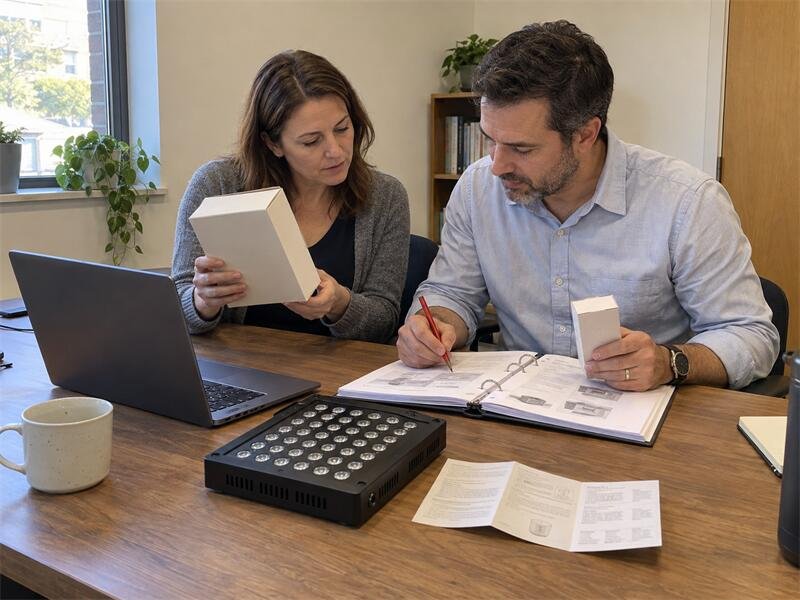
I have seen product teams begin with a popular research paper and then choose the nearest-looking device. That process runs backward. A similar enclosure or LED color does not establish technical equivalence. I compare measured product specifications with the research protocol before discussing claim support.
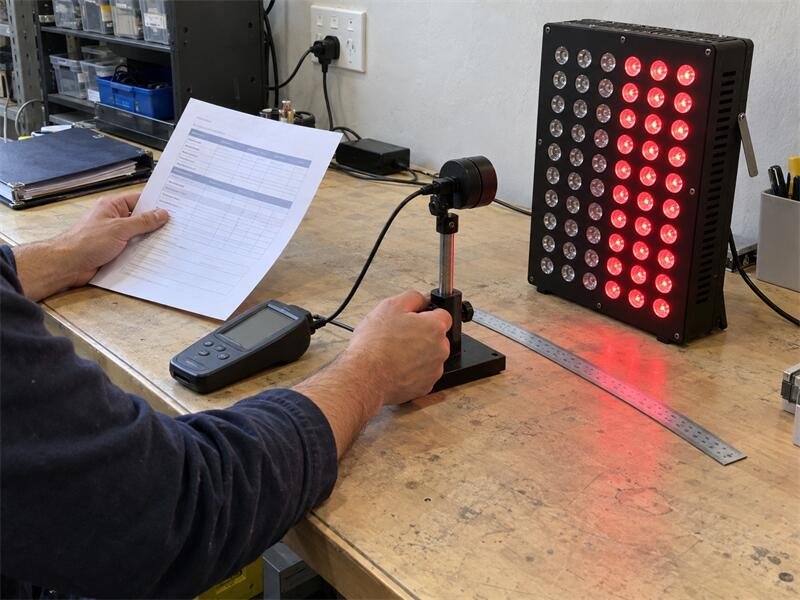
I match a red light therapy device to evidence by building a side-by-side parameter table. I compare wavelength, irradiance, treatment distance, exposure time, energy density, coverage, pulse mode, session frequency, and device format. I document every mismatch and decide whether testing, product changes, or narrower positioning is required.
A practical comparison table
I often begin with a table like this:
| Comparison point | Research condition | Proposed product | Buyer action |
|---|---|---|---|
| Population | Who researchers enrolled | Intended customer group | Ask a qualified reviewer whether the groups align |
| Device format | Panel, mask, laser, wearable, or other format | Actual commercial design | Document structural and application differences |
| Wavelength | Reported peak or range | Measured production output | Review a current spectral test |
| Irradiance | Value at a stated distance | Value at the intended use distance | Verify the measurement method |
| Session time | Minutes per treatment | Programmed or recommended time | Calculate exposure and check protocol fit |
| Coverage | Reported treatment area | Actual illuminated area | Review uniformity mapping |
| Schedule | Sessions and total period | Proposed directions | Avoid unsupported extrapolation |
| Outcome | Study endpoint | Planned benefit statement | Keep wording within the evidence |
I test samples before relying on catalog values
Supplier specifications provide a starting point, but procurement teams should ask how the values were measured. Irradiance can vary with distance, meter type, sampling position, warm-up time, and whether the supplier reports a peak, center-point, or area average.9
At MedLight, our manufacturing work can include sample development, parameter checks, assembly review, and production quality controls. For a buyer’s project, I would expect both parties to agree on:
- Measurement distance and fixture
- Meter or laboratory method
- Sampling points across the treatment area
- Acceptable unit-to-unit tolerance
- Warm-up and operating conditions
- Inspection frequency during production
- Records retained for batch review
I once reviewed a sample where the center reading looked suitable, but edge measurements showed that the exposure area was less uniform than the buyer expected. The issue did not automatically make the device unacceptable. It changed how we defined the usable treatment zone and what engineering work the project required.
I also check batch consistency
A research match based on one strong sample has limited procurement value if production units vary widely. I therefore include consistency in the supplier evaluation.
Buyers can request:
- A written product specification
- Approved reference samples
- Incoming material controls
- In-process inspection criteria
- Finished-product optical and functional tests
- Batch sampling rules
- Change-control procedures
- Corrective-action records when failures occur
These controls do not prove therapy outcomes. They help ensure that the manufactured product continues to deliver the output that the buyer evaluated.
How Strong Can a Product Claim Be?
I know that marketing teams want short, confident messages. Research rarely fits neatly into a six-word package, though. If a claim becomes broader than the evidence, the product may create regulatory, distributor, marketplace, and customer-service risks that extend well beyond the first sale.
I match claim strength to evidence strength and product similarity. Limited or mixed evidence may guide product selection, but it does not support guaranteed, universal, or cross-application claims. I keep benefit statements specific to the intended population, tested device conditions, treatment protocol, measured outcome, and applicable market requirements.
I use a claim ladder
A claim ladder helps a product team see when wording outruns support:
| Claim level | Example style | Main review need |
|---|---|---|
| Product description | “A red and near-infrared LED panel” | Accurate technical documentation |
| Performance statement | “Provides measured output at a defined distance” | Valid device testing |
| Experience statement | “Designed for hands-free sessions” | Usability and design verification |
| General benefit statement | “Supports a recovery routine” | Relevant substantiation and market review |
| Specific outcome claim | “Reduces a defined symptom in a defined group” | Strong, directly relevant evidence |
| Treatment or prevention claim | Condition-specific medical wording | Qualified clinical and regulatory review |
The exact classification and permitted wording can vary by product, intended use, sales channel, and country.10 I do not assume that wording accepted in one market will be acceptable in another.
I remove predictable overclaims
I become cautious when I see words such as:
- Guaranteed
- Permanent
- Clinically proven for everyone
- Works for every condition
- No risks or side effects
- Equivalent to a studied medical device
- FDA approved, when the exact status and product scope have not been verified
I also avoid using CE-related documents, FCC test records, an ISO certificate, or an FDA-related document as general proof of effectiveness.11 These items have different purposes and scopes. Buyers should verify the document owner, issuing body where applicable, model coverage, standards, dates, product classification, and relevance to the target market.
At MedLight, we can coordinate project documentation and discuss CE, FCC, FDA, ISO, or other stated requirements with a customer. However, the applicable path depends on the product, intended use, claims, and destination. I recommend that buyers obtain qualified regulatory and legal review before finalizing labels, instructions, websites, distributor materials, or medical claims.
A restrained claim is not weak marketing. It can show that a brand respects its customers and knows where the evidence ends.
Red Light Therapy FAQs
1. Does red light therapy work for everyone?
No evidence base allows me to say that red light therapy works for everyone. Results can depend on the population, intended purpose, device output, dose, protocol, adherence, and measured outcome. I recommend reviewing evidence for the specific use and referring individual medical suitability questions to a qualified healthcare professional.
2. Does a higher irradiance mean a better device?
I do not judge a device by the highest irradiance number alone. Higher output changes the delivered exposure and may not match the relevant study protocol.12 I also check distance, uniformity, treatment time, heat management, coverage, controls, measurement methods, and production consistency.
3. Are 660 nm and 850 nm always the best wavelengths?
I do not treat any wavelength combination as universally best. A suitable choice depends on the intended purpose, evidence, device format, treatment depth assumptions, dose, and market positioning. Buyers should compare measured spectral output with relevant research instead of relying only on common catalog configurations.
4. Can I use one study to support an entire product line?
I would not use one study to support masks, panels, belts, beds, and handheld devices without a detailed comparison. Each format can create different exposure conditions. I would assess each product’s device parameters, protocol, intended population, and outcome before deciding whether the study has direct or indirect relevance.
5. Does a spectral test prove that the product works?
A spectral test can show which wavelengths a sample emitted under the test conditions. It does not establish a human health outcome. I use spectral testing as part of device verification, while I use relevant clinical evidence to evaluate outcome claims.
6. How can I verify a supplier’s irradiance figures?
I ask the supplier for the measurement distance, meter or laboratory method, warm-up condition, sampling points, operating mode, and whether the value represents a peak or area average. For important projects, I recommend independent testing and written acceptance criteria for production batches.
7. Can customer testimonials prove effectiveness?
I treat testimonials as contextual feedback, not causal proof. A customer can describe comfort, convenience, routine, or a personal experience, but the account usually lacks controls and standardized measurements. Brands should avoid turning individual feedback into guaranteed or universal benefit claims.
8. What should I request before placing a bulk order?
I would request an approved specification, sample test data, model-specific compliance documents, packaging files, quality criteria, inspection procedures, warranty terms, change-control rules, production lead time, and batch sampling plan. I would also verify that the final device remains aligned with the intended evidence and positioning.
9. Do CE, FCC, FDA, or ISO documents prove clinical benefit?
I do not treat these documents as automatic proof of clinical benefit. Their purpose, scope, ownership, and applicability differ. Buyers should verify each document against the exact model, manufacturer, intended use, target market, and current regulatory requirements with qualified professionals.
10. When should I involve a clinical or regulatory specialist?
I recommend specialist review early when a product uses condition-specific language, targets higher-risk populations, changes a studied protocol, enters a new country, or may fall within medical-device rules. Early review can prevent expensive redesigns, packaging changes, delayed listings, and unsupported claims.
Conclusion: Does Red Light Therapy Work?
Red light therapy does not fit into a tidy yes-or-no box, no matter how much a marketing headline wants it to. I evaluate the specific population, purpose, device, dose, protocol, and outcome, then separate biological plausibility from device testing and clinical evidence. For B2B procurement, I also verify sample performance, batch consistency, documentation, and claim boundaries. If you are defining an OEM, ODM, or private-label product, contact MedLight to compare your intended use with practical device specifications, testing needs, and manufacturing controls.
Footnotes
"Review of light parameters and photobiomodulation efficacy", https://pmc.ncbi.nlm.nih.gov/articles/PMC8355782/. Photobiomodulation reviews identify wavelength, irradiance, fluence, exposure duration, treatment geometry, and session schedule as distinct parameters that can influence an intervention; this establishes heterogeneity across protocols but does not prove that every parameter difference changes a clinical outcome. Evidence role: general_support; source type: paper. Supports: Reviews and reporting guidelines describe photobiomodulation as a parameter-dependent class of interventions rather than a single standardized treatment.. Scope note: The literature supports protocol heterogeneity generally, not the effectiveness of a particular commercial device. ↩
"Report of the International Commission on Radiological ...", https://nvlpubs.nist.gov/nistpubs/Legacy/hb/nbshandbook62.pdf. Radiometric definitions express radiant exposure as the time integral of irradiance; when irradiance remains constant, this is equivalent to irradiance multiplied by exposure time, whereas pulsed or time-varying output requires integration over the actual emission profile. Evidence role: definition; source type: institution. Supports: Radiometry references define radiant exposure as the time integral of irradiance, which reduces to irradiance multiplied by time when output is constant.. Scope note: The simplified equation assumes constant irradiance and does not by itself account for pulsing, spatial nonuniformity, or biological response. ↩
"The difference between clinical significance and statistical ...", https://pmc.ncbi.nlm.nih.gov/articles/PMC11673624/. Clinical research methodology distinguishes statistical significance from clinical or practical importance: a statistically detectable difference may be too small, uncertain, or context-dependent to matter to patients or decision-makers. Evidence role: definition; source type: education. Supports: Clinical research methodology distinguishes a low probability value from the magnitude, relevance, or practical importance of an effect.. ↩
"Table of Surrogate Endpoints That Were the Basis of Drug ...", https://www.fda.gov/drugs/development-resources/table-surrogate-endpoints-were-basis-drug-approval-or-licensure. Regulatory guidance distinguishes surrogate endpoints from direct measures of patient benefit and notes that a biomarker can indicate biological activity without reliably predicting improvement in how patients feel or function; this principle is general and does not invalidate every surrogate used in photobiomodulation research. Evidence role: general_support; source type: government. Supports: Regulatory and methodological sources explain that surrogate endpoints require validation and may not reliably predict how patients feel, function, or survive.. Scope note: The relevance depends on whether a particular surrogate has been validated for the outcome and population under study. ↩
"Health Products Compliance Guidance", https://www.ftc.gov/business-guidance/resources/health-products-compliance-guidance. Advertising guidance states that consumer testimonials do not replace competent evidence for objective health claims, while causal inference generally requires controls against alternative explanations; testimonials can document reported experience but cannot independently establish treatment causation. Evidence role: general_support; source type: government. Supports: Advertising guidance and causal-inference principles treat testimonials as insufficient substantiation for objective health claims.. ↩
"Chapter 7: GRADE Criteria Determining Certainty of ...", https://www.cdc.gov/acip-grade-handbook/hcp/chapter-7-grade-criteria-determining-certainty-of-evidence/index.html. Cochrane and GRADE frameworks treat study limitations—including problems with randomization, missing data, outcome measurement, and selective reporting—as reasons to reduce confidence in an effect estimate, regardless of how closely a later product resembles the tested intervention. Evidence role: expert_consensus; source type: research. Supports: Established evidence-assessment frameworks reduce confidence when studies have risks involving randomization, missing data, outcome measurement, or selective reporting.. Scope note: These frameworks evaluate confidence in research findings generally and do not determine technical equivalence between two devices. ↩
"Light, Cytochrome C Oxidase, and Nitric Oxide—Review of the ...", https://pmc.ncbi.nlm.nih.gov/articles/PMC7495914/. Mechanistic reviews of photobiomodulation discuss several candidate pathways, including absorption by cellular photoacceptors, altered mitochondrial and redox signaling, nitric-oxide-related effects, and ion-channel responses; these remain mechanistic models and do not by themselves demonstrate a clinical benefit from a finished device. Evidence role: mechanism; source type: paper. Supports: Mechanistic reviews discuss mitochondrial chromophores, redox signaling, nitric oxide, ion channels, and downstream cellular responses as proposed pathways.. Scope note: The proposed pathways vary in evidentiary maturity and cannot directly substantiate a product-level outcome claim. ↩
"Understanding the Levels of Evidence in Medical Research", https://pmc.ncbi.nlm.nih.gov/articles/PMC12064251/. Evidence-appraisal frameworks assign greater confidence when findings come from appropriately controlled studies with low risk of bias, relevant outcomes, direct applicability, and consistency across independent investigations; study design alone, however, does not guarantee high-certainty evidence. Evidence role: expert_consensus; source type: research. Supports: Evidence-appraisal frameworks emphasize comparison groups, risk-of-bias assessment, consistency across studies, directness, and appropriate outcomes.. Scope note: The appropriate hierarchy can vary with the research question, especially for harms, mechanisms, and device-performance measurements. ↩
"The dark art of light measurement: accurate radiometry for low ...", https://pmc.ncbi.nlm.nih.gov/articles/PMC4851696/. Optical metrology sources show that irradiance measurements depend on detector spectral response, measurement geometry, distance, spatial sampling, and source stability; consequently, a center-point or peak reading is not necessarily equivalent to an area-averaged exposure. Evidence role: mechanism; source type: research. Supports: Optical metrology and photobiomodulation reporting literature document how detector response, distance, beam nonuniformity, sampling method, and output stability affect irradiance measurements.. Scope note: The magnitude of each measurement effect depends on the device optics and the measurement system used. ↩
"How to Determine if Your Product is a Medical Device", https://www.fda.gov/medical-devices/classify-your-medical-device/how-determine-if-your-product-medical-device. Official medical-device frameworks determine classification and regulatory obligations partly from a product's intended use or intended purpose, claims, and risk, and these requirements differ across jurisdictions; the applicable status therefore requires assessment of the specific product and market. Evidence role: general_support; source type: government. Supports: Official regulatory sources connect classification and compliance obligations to intended use or intended purpose, claims, risk, and market-specific legal frameworks.. Scope note: This general regulatory principle does not determine the classification or lawful wording of any particular red-light device. ↩
"Device Approvals and Clearances", https://www.fda.gov/medical-devices/products-and-medical-procedures/device-approvals-and-clearances. FDA authorization terminology, FCC equipment authorization, CE marking, and ISO-based certification address different regulatory, conformity, quality-system, or technical requirements and are not interchangeable evidence of clinical effectiveness; some medical-device pathways may consider clinical evidence, but the meaning depends on the exact authorization and product scope. Evidence role: definition; source type: government. Supports: Official sources define FDA authorization terminology, FCC equipment authorization, CE marking, and standards certification as processes with different legal and technical purposes rather than interchangeable proof of therapeutic benefit.. Scope note: The documents must be evaluated individually because certain regulatory decisions can include clinical evidence even though the document label alone does not establish broad effectiveness. ↩
"Biphasic Dose Response in Low Level Light Therapy - PMC", https://pmc.ncbi.nlm.nih.gov/articles/PMC2790317/. Photobiomodulation dose-response reviews describe parameter-dependent and sometimes biphasic responses, indicating that greater irradiance or radiant exposure is not invariably associated with a greater biological effect; this pattern is not uniform across all tissues, outcomes, or protocols. Evidence role: mechanism; source type: paper. Supports: Photobiomodulation literature reports parameter-dependent and sometimes biphasic dose responses, under which more intense or greater exposure is not invariably more effective.. Scope note: Biphasic-response evidence is heterogeneous and does not identify a universally optimal irradiance. ↩