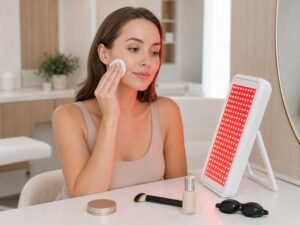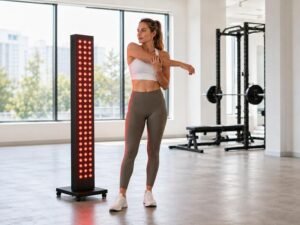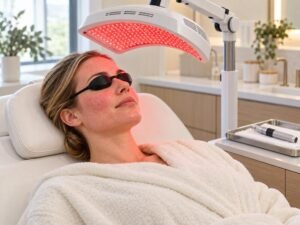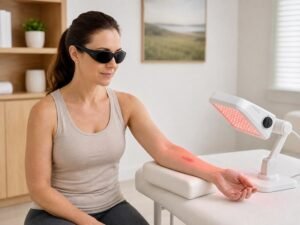
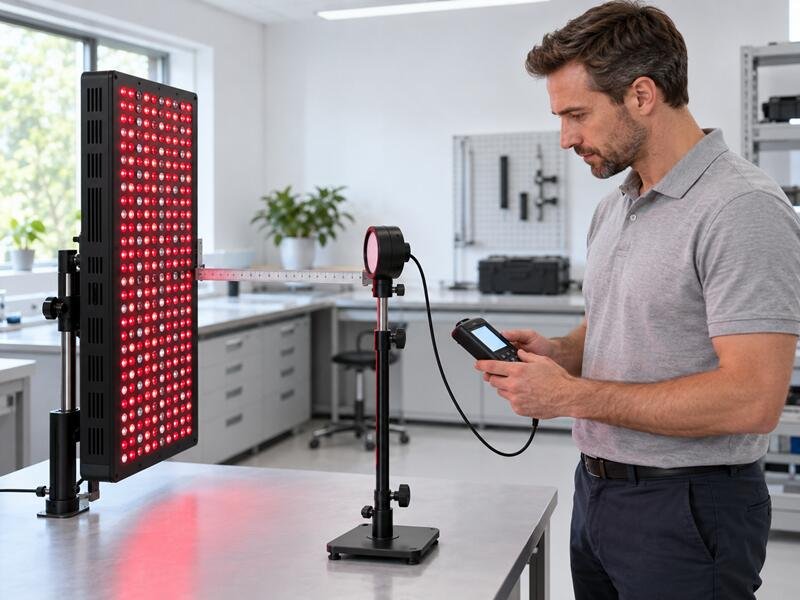
Red light therapy works through an interaction between light and biological tissue, but procurement becomes messy when suppliers present wavelength, irradiance, dose, and distance as unrelated selling points. Large numbers can look impressive while hiding unsuitable coverage or unclear testing. I use a task-first framework to connect these specifications with the product’s intended application.
Red light therapy uses selected red or near-infrared wavelengths to deliver optical energy to a target area. Wavelength describes the light spectrum, irradiance describes power per unit area, and dose combines irradiance with exposure time.1 Distance affects both irradiance and coverage, so buyers should compare specifications only under clearly stated and sufficiently aligned test conditions.
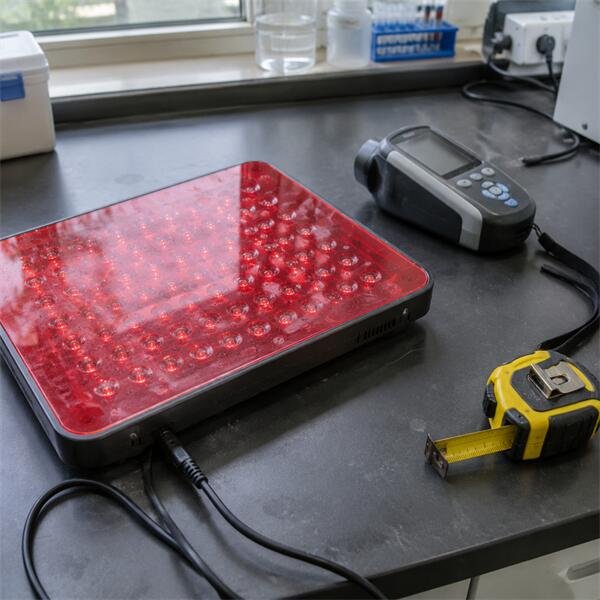
I have participated in requirement discussions where one apparently simple irradiance question turned into a much longer conversation about panel size, working distance, treatment area, and session workflow. That conversation was useful. It moved the decision away from the biggest number and toward a specification that could actually be tested.
How Does Red Light Therapy Work at Device Level?
A buyer can quickly become buried in discussions about cells, mitochondria, and photobiomodulation. Those topics matter, but they do not automatically reveal whether a device is suitable for a clinic, recovery facility, or consumer product line. The commercial problem requires a more practical starting point.
At device level, red light therapy works by producing light within defined wavelength bands and delivering it across a treatment area at a measurable irradiance. The resulting radiant exposure depends on output, time, distance, coverage, and operating mode. These engineering parameters describe light delivery, but they do not prove clinical efficacy by themselves.2
I start with the intended task
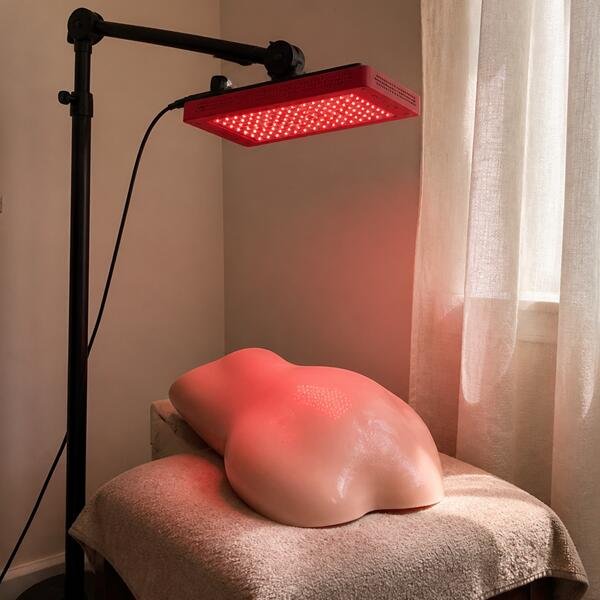
I first ask what the product needs to do in normal operation. A facial mask, flexible knee wrap, desktop panel, and full-body system cannot be judged through the same parameter alone.
A useful requirement discussion covers:
- Target area: face, scalp, joint, back, or full body
- Product format: panel, mask, belt, mat, bed, or handheld device
- Normal working distance: direct skin contact, a few centimetres, or farther away
- Expected workflow: home session, clinic turnover, or supervised professional use
- Exposure area: concentrated local output or broad, even coverage
- Target market: consumer wellness, beauty, recovery, or another regulated category
- Proposed claims: wording that may affect testing and regulatory classification
Photobiomodulation literature discusses how photons may interact with cellular chromophores and influence downstream biological processes. Cytochrome c oxidase is frequently discussed as a possible photoacceptor, although the mechanisms are more complex than a single pathway. A review by Hamblin describes these proposed mechanisms and also shows why simplistic marketing explanations should be treated cautiously (AIMS Biophysics, 2017).
From a procurement perspective, I separate biological hypotheses from device-output verification. A spectral report can support a wavelength statement. An irradiance test can support an output statement under recorded conditions. Neither document, on its own, establishes a therapeutic outcome.
> A parameter tells me what was measured. It does not tell me every result that a user will experience.
This distinction helps buyers avoid two common errors: rejecting a suitable configuration because another model has a bigger number, or accepting an unsuitable device because its specifications sound scientific.
Which Wavelengths Suit Red Light Therapy Products?
Wavelength lists have grown steadily longer on product pages. That trend can make a four- or seven-wavelength device appear automatically superior to a simpler configuration. In practice, each additional wavelength affects LED selection, control design, testing, cost, and the accuracy of product claims.
Red light therapy products commonly use visible red wavelengths and near-infrared wavelengths, often including values near 630, 660, 810, 830, or 850 nanometres.3 Buyers should select wavelength combinations according to the intended product format, available evidence, optical design, target market, and claims rather than treating a longer wavelength list as proof of better performance.
Nominal wavelength is only the first detail
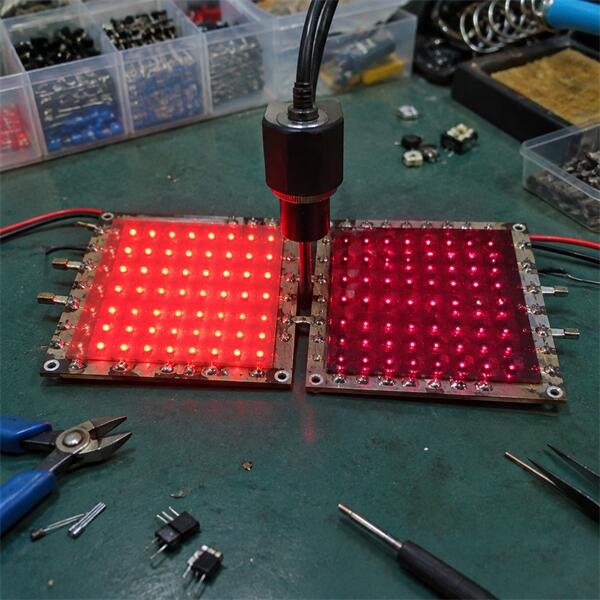
An LED marked “660 nm” does not emit every photon at exactly 660 nm.4 LEDs usually produce a spectral band around a peak wavelength. Therefore, I ask suppliers to clarify:
- The nominal or peak wavelength
- The permitted wavelength tolerance
- The spectral bandwidth, when relevant
- The ratio of different LED types in a mixed array
- Whether channels operate together or independently
- Whether the report covers a sample, a component, or the finished assembly
Common product wavelengths have different commercial roles, but I would not rank them without an application context.
| Wavelength example | Spectrum area | Common product use | Buyer verification point |
|---|---|---|---|
| 630 nm | Visible red | Masks, beauty products, panels | Peak and tolerance |
| 660 nm | Visible red | Panels, belts, mats, handheld products | Array ratio and spectral report |
| 810 nm | Near-infrared | Panels and targeted products | Actual LED specification |
| 830 nm | Near-infrared | Masks, panels, professional systems | Channel design and evidence basis |
| 850 nm | Near-infrared | Panels, wraps, beds, mats | Output and thermal management |
These examples reflect common commercial configurations. They do not establish that one wavelength is universally preferable.
More wavelengths create more verification work
A mixed array may divide electrical power and physical LED positions among several wavelengths. If a supplier states one total irradiance figure, that number may not reveal the contribution from each spectral band. A buyer may therefore request:
- Total measured irradiance
- Irradiance by independently controlled channel, if available
- LED count and layout by wavelength
- Spectrometer output
- Measurement distance and sensor position
- Drive settings used during testing
During configuration reviews, I have seen buyers focus on whether a particular wavelength appears in the brochure while overlooking how many LEDs actually provide it. I now treat the wavelength list as the beginning of the discussion, not the end.
How Should Red Light Therapy Irradiance Be Compared?
Irradiance often becomes the headline figure in supplier comparisons. The trouble starts when one result was measured at the panel centre from 5 centimetres and another was averaged across a large area from 15 centimetres. The two numbers may be accurate yet commercially incomparable.
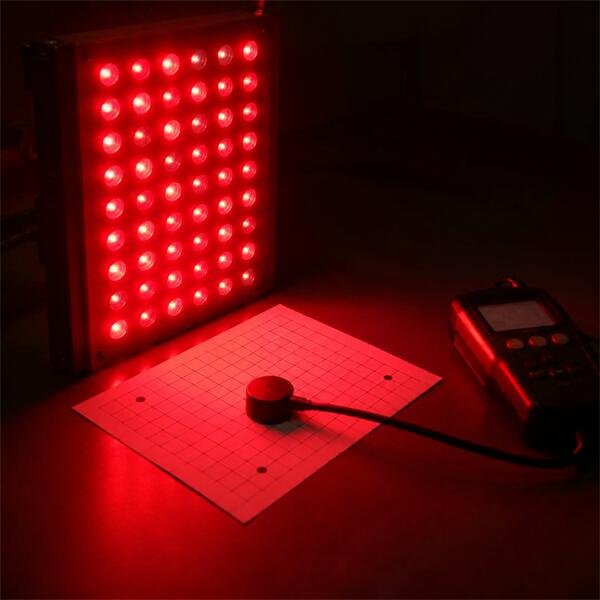
Red light therapy irradiance is radiant power received per unit area, usually stated in milliwatts per square centimetre. Buyers should compare results only when measurement distance, sensor position, operating mode, warm-up condition, instrument, and coverage method are disclosed. A centre-point maximum should not be treated as an average across the treatment area.
Ask whether the figure is maximum, average, or minimum
An LED array rarely produces identical irradiance at every point.5 The centre may be stronger than the edges, and spacing between LEDs can create local peaks. Diffusers, lenses, reflectors, and working distance can change this distribution.
I prefer a measurement grid for larger products. A basic grid may record values at:
- The centre
- Four corners
- Four edge midpoints
- Additional points for large panels or beds
The resulting report can show the minimum, maximum, average, and variation. That information says more about usable coverage than a single centre reading.
| Supplier statement | What remains unclear | Better procurement request |
|---|---|---|
| “200 mW/cm²” | Distance and location | State distance, point, mode, and instrument |
| “High power output” | No measurable definition | Provide irradiance data with units |
| “Full-body coverage” | Uniformity and boundaries | Provide measurement area and grid |
| “Laboratory tested” | Lab identity and method | Request the report and test setup |
| “Medical-grade LEDs” | Undefined commercial phrase | Request component and finished-product records |
Instruments and setup matter
Optical sensors have spectral response characteristics and measurement limits. A broadband radiometer, spectrometer, and thermal power sensor do not necessarily produce interchangeable results.6 Fixture alignment, ambient light, sensor angle, warm-up time, and active operating mode may also affect the result.
For supplier qualification, I ask for enough detail to make the test repeatable:
- Instrument manufacturer and model
- Calibration status or calibration record
- Measurement distance from the defined product surface
- Sensor orientation
- Test-point diagram
- Active wavelengths and intensity setting
- Product warm-up time
- Input voltage or power condition
- Ambient test conditions, when material
This does not require every buyer to run an optical laboratory. It requires the supplier to explain how the number was produced. If application-specific accuracy matters, I recommend review by a qualified optical testing professional or independent laboratory.
How Do Red Light Therapy Dose and Time Relate?
Dose creates confusion because people often use the word loosely. Some brochures present irradiance as dose, while others publish a dose without stating exposure time. That omission can turn a valid calculation into an unusable purchasing claim.
For a constant output, radiant exposure is calculated by multiplying irradiance by exposure time. If irradiance is expressed in watts per square centimetre and time in seconds, radiant exposure is expressed in joules per square centimetre. Buyers should verify the units, output stability, operating mode, and scientific basis before using a calculated dose in product documentation.
The basic calculation
For constant irradiance:
Radiant exposure (J/cm²) = Irradiance (W/cm²) × Time (seconds)
Because product data often use mW/cm², the irradiance must first be converted:
Irradiance (W/cm²) = Irradiance (mW/cm²) ÷ 1,000
For example, a measured irradiance of 50 mW/cm² equals 0.05 W/cm². If that output remained constant for 120 seconds, the calculated radiant exposure would be:
0.05 W/cm² × 120 seconds = 6 J/cm²
This is a mathematical example, not a treatment recommendation. It does not account for individual biology, reflection, tissue geometry, device movement, output variation, pulsing, or differences in clinical protocols.
The terminology follows standard radiometric concepts. Buyers can also consult the International Commission on Illumination’s terminology resources and relevant photobiomodulation literature when preparing technical files (CIE International Lighting Vocabulary).
Why calculated and delivered exposure may differ
The basic formula assumes stable output and a fixed geometry. Real products can introduce variables:
- A user may move closer to or farther from a panel.
- A flexible wrap may not maintain uniform contact.
- Output may change as the device warms.7
- Pulsed operation may reduce average output relative to peak output.
- A timer may count total session time while channels cycle.
- Body contours may create different distances across the target area.
I therefore ask whether published dose values are calculated, directly measured, or derived from another source. I also check whether the same irradiance value appears at the actual recommended operating distance.
A universal dose cannot be selected from product specifications alone.8 Brands that plan to publish protocols or outcome claims should involve qualified scientific, clinical, and regulatory professionals. Product settings, substantiation, intended use, and target-market rules must agree.
Why Does Distance Change Red Light Therapy Performance?
Distance is sometimes printed in small type while irradiance receives large, colourful typography. That order should probably be reversed. A power-density figure without a measurement distance is rather like a delivery quote without a destination: technically interesting, but difficult to use.
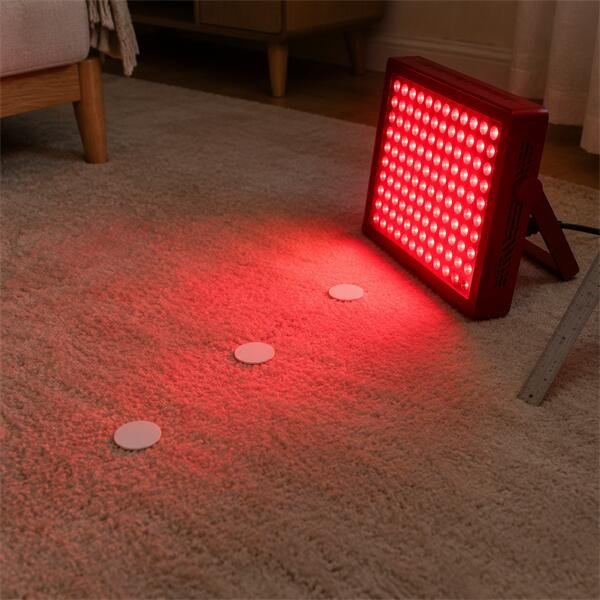
Distance affects red light therapy irradiance, illuminated area, and uniformity. Moving away from an LED array often lowers measured irradiance while increasing beam overlap and coverage.9 Because panels contain multiple emitters and optical components, buyers should request measurements at practical working distances instead of relying on a simple inverse-square calculation.
LED arrays are not simple point sources
The inverse-square law describes how irradiance from an ideal point source decreases with distance in free space.10 A red light therapy panel is not an ideal point source. It contains many LEDs distributed across an area, often with lenses, reflectors, or diffusers.
At short distances, the sensor may sit in the near field of individual emitters. Beam overlap can change rapidly as distance increases. As a result, a neat inverse-square calculation may not predict the measured output of the complete array.
I prefer actual measurements at distances that reflect expected use. A panel comparison might include:
| Test distance | Why it may matter | Data to record |
|---|---|---|
| 0 cm or contact | Relevant to wraps and mats | Contact geometry and heat |
| 5 cm | Close-range local use | Peak and uniformity |
| 15 cm | Common panel evaluation point | Grid average and coverage |
| 30 cm | Wider treatment area | Output and edge performance |
| Custom distance | Product-specific workflow | Full documented setup |
These distances are examples, not universal standards.
Distance can involve a trade-off
At a short distance, the device may produce a higher centre reading but less even coverage. At a greater distance, overlapping beams may improve uniformity while reducing irradiance. The preferred balance depends on the task.
For example:
- A small targeted device may prioritize a compact treatment area.
- A full-body panel may require wider and more even coverage.
- A mask must account for changing distances caused by facial contours.
- A bed or overhead system needs a defined body position and exposure geometry.
- A wearable wrap needs repeatable placement rather than a free-space distance.
When I review a sample, I want the operating instructions, stated irradiance, test distance, and physical product design to tell the same story. If they do not, I raise the mismatch before packaging and claims are finalized.
How Can Buyers Specify Red Light Therapy in an RFQ?
An RFQ that asks only for wavelength, wattage, and price invites answers that are hard to compare. Suppliers may interpret the same request differently, which creates extra email, uncertain quotations, and surprises during sampling. A short but structured specification makes procurement much calmer.
A red light therapy RFQ should define the application, product format, treatment area, wavelength configuration, working distance, irradiance test method, operating controls, target market, order volume, and required documents. Buyers should request raw or tabulated test conditions rather than accepting isolated headline figures or unverified certification logos.

Build the request around verification
I recommend dividing the RFQ into five parts.
-
Commercial context
- Target market
- Sales channel
- Estimated order quantity
- Planned launch date
- OEM, ODM, or private-label scope
-
Product definition
- Product format and dimensions
- Intended treatment area
- Expected working distance
- Session controls
- Installation or wearing method
-
Optical requirements
- Requested wavelengths and tolerances
- Channel configuration
- Irradiance range at a stated distance
- Measurement grid or coverage area
- Continuous or pulsed operating mode
-
Quality requirements
- Approved sample process
- Incoming component checks
- In-process inspection
- Finished-product functional testing
- Batch records and change control
-
Compliance documents
- Applicable test reports
- Declarations and certificate copies
- Lab and report identification
- Model numbers covered
- Packaging, labels, and manual requirements
I treat CE, FCC, FDA, and ISO references as items to verify, not decorative badges. Their relevance depends on the product category, intended use, claims, market, and responsible economic operator. A buyer should check the issuing or testing body, model scope, standards, dates, and whether the document applies to the finished product being ordered.
Use a weighted comparison
A scoring table can prevent the lowest quotation or highest irradiance figure from dominating the decision.
| Evaluation area | Example weight |
|---|---|
| Application and specification fit | 25% |
| Test-data completeness | 20% |
| Quality-control capability | 20% |
| Compliance-document fit | 15% |
| Commercial terms and lead time | 10% |
| Communication and change control | 10% |
The weights should change with the project. A new ODM product may place more weight on engineering and change control. A repeat private-label order may place more weight on consistency, delivery, and packaging accuracy.
At MedLight, we can discuss application requirements, wavelength and output configurations, samples, manufacturing controls, packaging, and market-specific documentation needs. I still recommend independent professional review when a project involves clinical protocols, regulated claims, or application-specific optical validation.
Frequently Asked Questions About Red Light Therapy Specifications
1. Is higher irradiance always better for red light therapy?
No. Higher irradiance can shorten the time needed to reach a calculated radiant exposure, but it may also affect comfort, heat, uniformity, and operating workflow. I compare irradiance at the intended distance and across the relevant area rather than ranking products by the highest centre-point value.
2. What is the difference between irradiance and dose?
Irradiance describes radiant power arriving per unit area, commonly in mW/cm². Dose, more precisely called radiant exposure in this context, includes time and is commonly expressed in J/cm². A dose claim is incomplete unless its irradiance, duration, distance, and operating conditions are stated.
3. Is 660 nm better than 850 nm?
Neither wavelength is universally better. They occupy different parts of the spectrum and may be selected for different product designs, evidence bases, and intended applications. I evaluate the target area, device format, optical configuration, claims, and supporting documentation before choosing one or combining both.
4. Can I compare two panels using their advertised wattage?
Not reliably. Electrical input power, LED nominal wattage, optical output, and irradiance are different quantities.11 I request measured irradiance, working distance, coverage data, active mode, and test method. Electrical wattage remains useful for power, thermal, and installation planning.
5. Does red light therapy follow the inverse-square law?
The law applies cleanly to an ideal point source, but a multi-LED panel is an extended source with overlapping beams and optical components. I prefer measured results at practical distances. A theoretical estimate should not replace finished-product testing, especially at short working distances.
6. What irradiance measurement distance should suppliers use?
No single distance suits every device. The test distance should reflect the expected operating position. I often ask for several distances when evaluating panels. Contact products need another method because their geometry, skin contact, compression, and heat conditions differ from free-space measurement.
7. How can I check irradiance uniformity?
I request a measurement grid covering the claimed treatment area. The report should identify each test point and show minimum, maximum, and average values. A heat map can help, but I still want the underlying numbers, instrument information, distance, and operating conditions.
8. Does a CE or FCC logo prove product performance?
No. A logo does not establish optical performance, clinical efficacy, or full regulatory suitability.12 I verify the supporting documents, covered model, standards, laboratory information, dates, and applicant. I also confirm whether the documents match the target market, product category, and intended claims.
9. Should pulsed output be compared with continuous output?
Only with clearly defined parameters. I ask for pulse frequency, duty cycle, peak irradiance, average irradiance, waveform, and measurement method. Two devices with the same peak value may deliver different average optical energy. The selected mode also needs a justified application and documentation basis.
10. What should I approve before mass production?
I approve the specification, golden sample, wavelength configuration, irradiance test conditions, controls, appearance, labels, packaging, manuals, accessories, inspection criteria, and applicable documents. I also record acceptable tolerances and change-control requirements. This work is less glamorous than a big launch, but it usually produces fewer expensive surprises.
Conclusion: How Should Buyers Evaluate Red Light Therapy?
Red light therapy should be evaluated as a connected system rather than a contest between isolated numbers. I start with the task, product format, target area, and operating workflow. I then connect wavelength, irradiance, dose, distance, coverage, and exposure time under stated test conditions. Comparable data, approved samples, quality controls, and verified documents matter more than oversized brochure claims.
If you are defining an OEM, ODM, or private-label product, send MedLight your target market, application, format, working distance, and expected order plan. We can help translate those requirements into a testable product specification before the numbers start wearing superhero capes.
Footnotes
"[PDF] introduction to optical radiometry", https://tsapps.nist.gov/publication/get_pdf.cfm?pub_id=104704. The CIE International Lighting Vocabulary defines irradiance as incident radiant flux per unit area and radiant exposure as the time integral of irradiance; in photobiomodulation discussions, “dose” is often used informally for radiant exposure. Evidence role: definition; source type: institution. Supports: Standard radiometric terminology distinguishes wavelength, irradiance, and radiant exposure and defines radiant exposure as the time integral of irradiance.. ↩
"How to Study and Market Your Device | FDA", https://www.fda.gov/medical-devices/device-advice-comprehensive-regulatory-assistance/how-study-and-market-your-device. FDA materials distinguish nonclinical performance testing from clinical evidence used to assess device safety and effectiveness, supporting the conclusion that optical-output measurements alone do not establish therapeutic efficacy; this is general medical-device guidance rather than a determination about any particular red-light device. Evidence role: general_support; source type: government. Supports: Regulatory evidence frameworks distinguish bench or analytical performance testing from evidence supporting clinical safety and effectiveness.. Scope note: The guidance is a general regulatory framework and does not directly evaluate the devices discussed in the article. ↩
"Red (660 nm) or near-infrared (810 ...", https://dash.harvard.edu/bitstreams/7312037e-8d87-6bd4-e053-0100007fdf3b/download. Reviews of photobiomodulation studies report extensive use of visible-red and near-infrared light, including wavelengths near 630, 660, 810, 830, and 850 nm; study frequency provides context for these examples but does not by itself establish their prevalence in the commercial market or comparative superiority. Evidence role: general_support; source type: paper. Supports: Reviews of photobiomodulation research identify visible-red and near-infrared bands, including wavelengths near those listed, as frequently studied configurations.. Scope note: Research usage is only a proxy for commercial prevalence and does not show that any listed wavelength is optimal. ↩
"Color and Spectrum | Department of Energy", https://www.energy.gov/cmei/ssl/color-and-spectrum. Semiconductor LED emission is characterized by a spectral power distribution with finite bandwidth around a peak wavelength, rather than by monochromatic emission at one exact wavelength. Evidence role: mechanism; source type: education. Supports: LED emission has a spectral power distribution with finite bandwidth around a peak or dominant wavelength.. ↩
"<title>Color uniformity of the light distribution from several cluster ...", https://www.academia.edu/12703423/_title_Color_uniformity_of_the_light_distribution_from_several_cluster_configurations_of_multicolor_LEDs_title_. Modeling and measurement studies of multi-LED arrays show that irradiance varies across the illuminated plane as a function of emitter spacing, individual beam profiles, secondary optics, and working distance; the magnitude and pattern of variation remain specific to each array design. Evidence role: mechanism; source type: paper. Supports: Optical studies of LED arrays show that emitter placement, beam profiles, optics, and distance create spatially varying irradiance distributions.. Scope note: General LED-array research supports the mechanism but does not quantify uniformity for any product described in the article. ↩
"Detector metrology | NIST", https://www.nist.gov/programs-projects/detector-metrology. Radiometric metrology references identify detector spectral responsivity, calibration, measurement geometry, bandwidth, and spectral-mismatch correction as material sources of variation, so results from broadband radiometers, spectroradiometers, and thermal detectors are not automatically interchangeable. Evidence role: mechanism; source type: research. Supports: Detector spectral responsivity, calibration, bandwidth, geometry, and the quantity being measured can affect optical measurement results.. ↩
"[PDF] LED Luminaire Reliability: Impact of Color Shift - Department of Energy", https://www.energy.gov/sites/prod/files/2017/04/f34/lsrc_colorshift_apr2017.pdf. Solid-state-lighting research shows that LED junction temperature can affect radiant output, efficiency, and spectral characteristics as a device reaches thermal equilibrium; the direction and magnitude of change depend on the LED package, drive conditions, and thermal design. Evidence role: mechanism; source type: government. Supports: LED junction temperature can affect radiant output, efficiency, spectrum, and stability during operation.. Scope note: The general temperature dependence of LEDs does not establish material drift in every finished red-light device. ↩
"Review of light parameters and photobiomodulation efficacy - PubMed", https://pubmed.ncbi.nlm.nih.gov/30550048/. Photobiomodulation reviews describe parameter-dependent and sometimes biphasic dose-response relationships involving wavelength, irradiance, exposure time, treatment schedule, tissue, and indication, which supports caution against deriving a universal exposure from product specifications alone; the evidence does not exclude indication-specific protocols supported by clinical studies. Evidence role: expert_consensus; source type: paper. Supports: Photobiomodulation outcomes depend on multiple interacting parameters and may exhibit biphasic dose-response behavior, limiting simple universal dosing rules.. Scope note: The literature supports protocol dependence but does not prove that standardized doses cannot be established for particular indications. ↩
"[PDF] EXPLOITING LUMINESCENCE EMISSIONS OF SOLAR CELLS ...", https://hammer.purdue.edu/articles/thesis/EXPLOITING_LUMINESCENCE_EMISSIONS_OF_SOLAR_CELLS_FOR_INTERNET-OF-THINGS_IOT_APPLICATIONS/14515662/1/files/27808725.pdf. Optical analyses of multi-LED arrays show that increasing working distance changes the superposition of individual emitter beams, generally broadening coverage and potentially improving uniformity while reducing local irradiance; the precise relationship depends on beam angle, array dimensions, lenses, and measurement plane. Evidence role: mechanism; source type: paper. Supports: Studies of LED arrays show that working distance changes both irradiance magnitude and spatial uniformity through beam spreading and overlap.. Scope note: The stated trade-off is design-dependent and cannot substitute for measurements of a particular finished array. ↩
"Power Per Unit Solid Angle - HyperPhysics", http://hyperphysics.phy-astr.gsu.edu/hbase/vision/photom.html. For an ideal isotropic point source in free space, conservation of power over spherical surfaces gives irradiance proportional to the inverse square of distance; this approximation does not apply unchanged to nearby extended sources. Evidence role: definition; source type: education. Supports: For an isotropic point source, power is distributed over a spherical area proportional to the square of distance, producing inverse-square irradiance.. ↩
"[PDF] Understanding LM-79 Reports - Better Buildings Solution Center", https://betterbuildingssolutioncenter.energy.gov/sites/default/files/attachments/understanding_lm79_reports.pdf. Radiometric and solid-state-lighting references distinguish electrical input power from emitted radiant flux and from irradiance incident on a surface, with conversion efficiency, optical losses, beam distribution, area, and distance determining the relationships among them. Evidence role: definition; source type: government. Supports: Electrical input power, emitted radiant flux, and incident irradiance are separately defined quantities connected by conversion efficiency and optical geometry.. ↩
"Equipment Authorization | Federal Communications Commission", https://www.fcc.gov/engineering-technology/laboratory-division/general/equipment-authorization. Official European Commission, FCC, and FDA materials describe their respective marks, authorizations, registrations, and listings as mechanisms with defined legal scopes, not as general proof of optical performance, clinical efficacy, or suitability for every intended use; the exact implication depends on the jurisdiction, product classification, conformity route, and claim being made. Evidence role: general_support; source type: government. Supports: Official regulatory materials define CE marking, FCC equipment authorization, and FDA registration or authorization as scope-specific compliance mechanisms rather than universal endorsements of product performance or efficacy.. Scope note: Because CE, FCC, and FDA frameworks differ, no single official source establishes the complete regulatory status of a particular product in every market. ↩