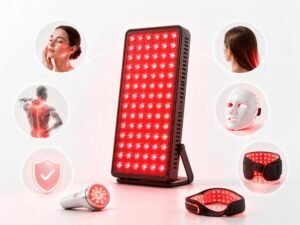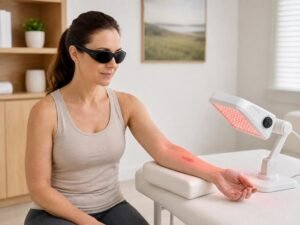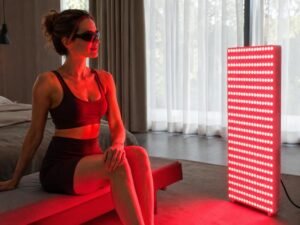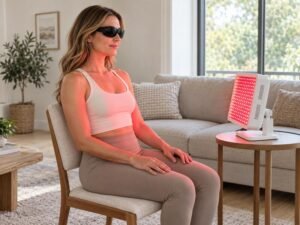
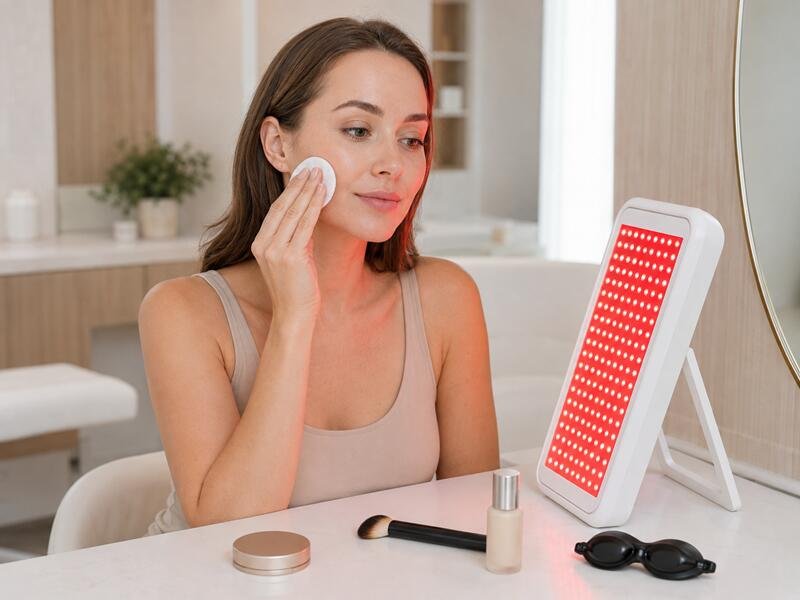
“Fresh brows. Flawless highlight. A red light therapy panel sitting there judging you from across the room. And the age-old dilemma rises like a phoenix from your beauty blender: full face on, or bare skin and dignity?“
Turns out, your skin is the pickiest VIP at this party — and it has a strict no-makeup door policy. Red light therapy works by driving specific wavelengths of light directly into skin tissue, where they get to work on your cells like a very motivated personal trainer. That meticulously layered foundation, the concealer pulling a double shift, the contour routine with its own Wikipedia entry? They don’t politely step aside. They block, scatter, and absorb the very photons your skin is waiting for. The result: a beautifully lit face that is, therapeutically speaking, getting absolutely nothing done.
Whether you’re a brand owner crafting clinical protocols, a distributor supplying aesthetics clinics, or a procurement manager asking “but will clients actually follow instructions?” — this deceptively simple question has real consequences for product efficacy, client satisfaction, and your brand’s reputation. So let’s get into it properly: with science, zero judgment, and a healthy respect for a good skincare routine.
How Red Light Therapy Actually Works
Red light therapy (RLT) — also known as photobiomodulation (PBM) — uses specific wavelengths of light, typically in the 630-700 nm (red) and 800-1100 nm (near-infrared) ranges, to penetrate the skin and interact with mitochondria inside cells.
The core mechanism works through photon absorption by cytochrome c oxidase, a key enzyme in the mitochondrial electron transport chain. Once absorbed, that energy sets off a chain of cellular responses:
- Increased ATP (adenosine triphosphate) production — the cell’s energy currency
- Reduction of oxidative stress and inflammation
- Stimulation of collagen and elastin synthesis
- Enhanced cell proliferation and tissue repair
- Improved local blood circulation
The word that matters most here is penetration. For any of this to happen, photons need to actually reach the target cells. Anything sitting on the surface of the skin — including cosmetics — sits directly in that optical pathway. And that pathway matters more than most people realize.
Why Makeup Gets in the Way
Makeup products — foundations, primers, sunscreens, BB creams, powders — are specifically engineered to interact with light. That’s what makes them work cosmetically. Pigments absorb and scatter visible light to create coverage, match skin tone, and add luminosity.
From a photonics standpoint, that creates three real problems:
Light Absorption
Dark pigments — especially foundations containing iron oxides — absorb red and near-infrared wavelengths before they ever reach the dermis.
Light Scattering
Particles in powders and pigments scatter photons in all directions, reducing how deep and how accurately light can reach target tissue.
Chemical Reactions
Some cosmetic ingredients can react unpredictably when exposed to concentrated photonic energy, generating heat or free radicals at the skin surface.
Put all three together and you get reduced treatment efficacy — and a potential, though uncommon, risk of skin irritation depending on the formulation. For clinic operators and brand owners, this isn’t a minor footnote. It affects how you market device efficacy and how you write usage protocols.
Wavelengths vs. Cosmetic Layers: What the Science Shows
Not all products cause the same amount of interference. Here’s a breakdown by product type:
| Makeup Type | Light Interference Level | Primary Concern | Verdict |
|---|---|---|---|
| Full-coverage foundation | High | Heavy pigment load blocks wavelengths | ❌ Remove |
| Tinted moisturizer / BB cream | Moderate | Partial absorption, reduced efficacy | ⚠️ Ideally remove |
| Chemical sunscreen (SPF) | Moderate to High | UV filters may absorb in visible range | ❌ Remove |
| Mineral sunscreen (zinc oxide) | Moderate | Physical particles scatter light | ⚠️ Remove if possible |
| Setting powder | Low to Moderate | Scattering from fine particles | ⚠️ Wipe off recommended |
| Clear moisturizer / serum | Minimal | Generally transparent to wavelengths | ✅ Acceptable |
| Conductive gel (clinical use) | Minimal | Designed to enhance light coupling | ✅ Compatible |
The pattern is consistent: the darker, denser, and more opaque the product, the more photon delivery drops. Photobiomodulation research is clear on the importance of good optical coupling between the device and the skin surface. Anything that compromises that coupling compromises outcomes — full stop.
What This Means for Brand Owners and Distributors
For brand owners, distributors, and procurement managers, this isn’t just a skincare curiosity — it has direct implications for product positioning, usage protocol design, and customer satisfaction rates.
📋 Usage Protocol Documentation
Any device you sell or distribute should come with clear pre-treatment instructions. Protocols that specify “cleansed, product-free skin” aren’t just best practice — they protect your brand from complaints about poor results. If a client uses your panel over a full face of foundation and sees no improvement, they’ll blame the device, not their makeup. That’s a return request and a bad review waiting to happen.
🏷️ Product Positioning Strategy
If your target market is MedSpas and aesthetics clinics, skin prep is already standard practice. But if you’re entering the consumer retail space — at-home panels, portable masks, handheld wands — user behavior is much harder to control. Your marketing materials and onboarding content need to address this clearly and proactively, before the client ever turns the device on.
🔬 Device Specification Considerations
Higher-irradiance devices may partially compensate for surface losses, but it’s not a reliable fix. Devices with well-chosen wavelengths (660 nm for surface work, 850 nm for deeper tissue) and sufficient power density (≥ 20 mW/cm²) will consistently outperform on clean skin. When sourcing or specifying devices, prioritize optical output quality — not just how the device looks on a spec sheet.
📦 A Practical OEM/ODM Opportunity
Consider bundling your RLT device with a complementary gentle cleanser or pre-treatment pad as part of a branded protocol kit. It increases average order value, reinforces correct usage behavior, and creates a more premium product experience — while directly solving the makeup barrier problem before it becomes a complaint.
The Right Pre-Treatment Routine
Whether you’re advising clinic operators, writing user manuals, or building onboarding content for end users, here is the recommended pre-treatment workflow:
-
Cleanse thoroughly
Use a gentle, non-comedogenic cleanser to remove all makeup, sunscreen, and excess oils. Micellar water followed by a foaming or gel cleanser gives you thorough removal without stripping the skin.
-
Pat dry and wait briefly
Let the skin dry completely. Excess moisture can scatter light, though far less than cosmetics. One to two minutes is enough.
-
Apply pre-treatment serums if needed (optional)
Clear, non-pigmented serums — hyaluronic acid or a lightweight vitamin C in a transparent base — are generally fine before treatment. They don’t meaningfully block wavelengths and can support skin receptivity after the session. Anything opaque, tinted, or heavy should wait until after.
-
Run the treatment
Follow the device protocol. Keep the recommended distance — typically 6-12 inches for panels — and stick to the recommended session duration, generally 10-20 minutes depending on device power and application area.
-
Apply skincare post-treatment
Right after a session is actually one of the best times to apply serums, moisturizers, and SPF. The enhanced cellular activity and temporarily increased skin permeability mean active ingredients may absorb more effectively in this window.
Are There Any Real Exceptions?
It’s a fair question — and the straightforward answer is: yes, with significant caveats.
⚡ Near-Infrared (NIR) at 850 nm+
NIR wavelengths penetrate significantly deeper — up to 50mm into tissue — and are less affected by surface cosmetics than red wavelengths. A modest amount of light-colored makeup may cause only minor attenuation for NIR. That said, this doesn’t mean NIR sessions with makeup are fine. There is still meaningful loss, and clean skin remains the right approach across the board.
💡 Scalp, Body, and Wearable Applications
For scalp treatments targeting hair growth, body panels for muscle recovery or pain relief, or wearable belts targeting joints and back muscles — cosmetic interference is largely irrelevant. These areas aren’t typically covered in makeup. The makeup question is primarily a facial and décolletage concern.
✅ Truly Clear Products: Lip Gloss, Clear Mascara, Lash Tint
Non-pigmented, fully clear cosmetics — certain lip treatments or lash serums — have negligible optical interference. That said, eye protection (goggles included with the device) should always be worn during facial treatments, regardless of eye makeup status.
Device Selection Checklist for Buyers
When evaluating or sourcing red light therapy devices for your brand, the makeup-on-skin use case reveals some useful device quality indicators. Keep these in mind during supplier conversations:
RLT Device Evaluation Checklist for Buyers
- Irradiance data provided: Your supplier should provide independent, third-party irradiance measurements (mW/cm²) at specified distances — not just rated wattage, which tells you very little on its own.
- Dual wavelength capability: Devices offering both 660 nm (red) and 850 nm (NIR) cover both superficial and deep tissue applications, giving you much broader clinical and commercial flexibility.
- Usage protocol documentation included: A good supplier helps you develop pre- and post-treatment protocols, including skin prep instructions. This is essential for consistent results and managing what your end users actually experience.
- Eye protection included: Compliance for facial use requires proper eye protection. Confirm this is part of the standard package or clearly specified as a required accessory.
- CE / FCC certification: These certifications confirm electromagnetic compliance and product safety for your target markets in Europe and North America.
- OEM customization of user manual: The ability to localize and customize usage instructions in your brand voice, language, and protocol system is a practical necessity — not a nice-to-have.
- Return / warranty policy defined: A clear after-sales policy protects you from device defect claims being confused with improper use complaints — such as a client running a session over a full face of makeup and then returning the device.
Common Questions, Straightforward Answers
Can I do red light therapy with foundation on?
Does wearing SPF sunscreen affect red light therapy results?
Is it safe to use red light therapy with makeup on, even if it reduces efficacy?
Can I apply a serum or moisturizer before red light therapy?
Does darker skin tone affect how red light therapy penetrates the skin?
How long should I wait after removing makeup before starting a session?
Can I wear eye makeup during a red light therapy facial treatment?
Does red light therapy help with skin issues caused by heavy makeup use?
Can I apply makeup immediately after a red light therapy session?
Are there any makeup or skincare products specifically formulated to be compatible with red light therapy?
The Bottom Line
The short answer to “can you do red light therapy with makeup on?” is technically yes — but you really shouldn’t, and the reasons go well beyond surface level.
For buyers, distributors, and brand owners, this question points to a larger challenge: managing treatment efficacy, user behavior, and product perception at scale. The device you source is only as effective as the protocol your customers follow. And that protocol starts before the session even begins — with clean skin, no cosmetics, and the right device emitting the right wavelengths at the right power density.
At MedLight, we help brands get this right from the start — from device specification and wavelength optimization to protocol documentation and OEM packaging that communicates proper use clearly. If you’re building or expanding a red light therapy product line, the difference between a satisfied customer and a return request is often in the details.