Photobiomodulation vs red light therapy can look like a simple terminology question, but product teams quickly encounter wavelengths, irradiance figures, dose claims, and inconsistent test distances. When suppliers present these numbers without context, comparisons become misleading. I recommend starting with the intended application and then checking every specification under clearly stated conditions.
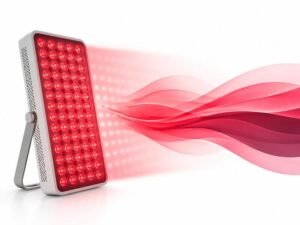
Photobiomodulation is the broader technical term for using non-ionizing light to influence biological processes, while red light therapy commonly describes consumer or commercial devices that use red and often near-infrared wavelengths. For product selection, the name matters less than the device format, wavelength, irradiance, coverage, distance, exposure time, safety, and intended-use claims.
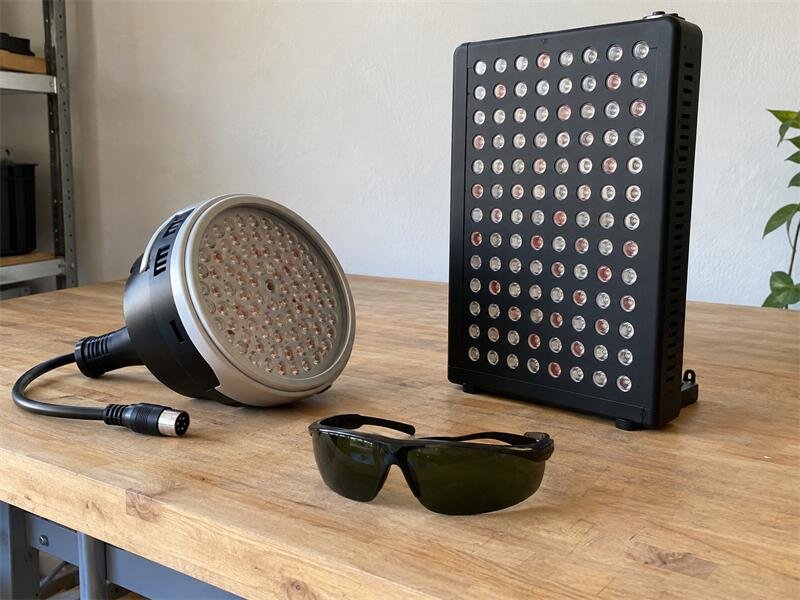
I have participated in requirement discussions where one impressive number almost took over the entire conversation. It happens easily. However, a specification sheet is not a scoreboard. Product teams make better decisions when they connect each parameter to a real task, operating workflow, and target market.
What Does Photobiomodulation vs Red Light Therapy Mean?
The terminology creates a practical problem. A buyer may request a “PBM device,” while a supplier may offer a “red light therapy product” with similar wavelengths. If neither side defines the intended meaning, the project can begin with assumptions and end with unsuitable claims, documentation, or configurations.
Photobiomodulation, often shortened to PBM, is a technical umbrella term. Red light therapy is a more familiar commercial term that often refers to products using visible red and near-infrared light. The terms may overlap, but product teams should define the actual wavelength range, output, format, application, and regulatory positioning instead of relying on the label.
Why the words are not interchangeable in every document
The term photobiomodulation appears frequently in scientific literature. Researchers and professional groups have used it to replace older or less precise terms such as “low-level laser therapy.” A 2015 nomenclature paper by Anders and colleagues described PBM as the therapeutic use of non-ionizing light sources, including lasers, LEDs, and broadband light, in the visible and infrared spectrum.
Red light therapy is usually a market-facing description. Depending on the seller, it may describe:
- Red wavelengths only
- A combination of red and near-infrared wavelengths
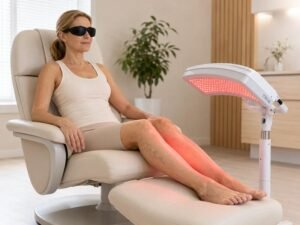
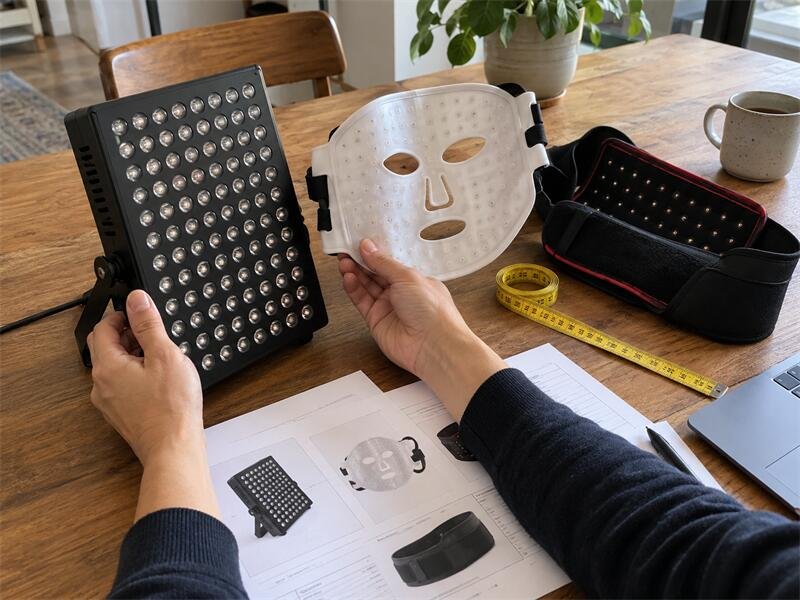
- LED panels, masks, beds, belts, or handheld devices
- Products positioned for general wellness, beauty, recovery, or professional use
I would not assume that two products are technically similar because both carry the same name. I would request their actual specifications.
| Evaluation point | Photobiomodulation | Red light therapy |
|---|---|---|
| Typical context | Scientific, technical, or professional | Consumer, wellness, beauty, or commercial |
| Light source | LEDs, lasers, or other non-ionizing sources | Commonly LEDs |
| Wavelength description | Defined by study or application | Often presented as product features |
| Regulatory meaning | Depends on intended use and claims | Also depends on intended use and claims |
| Purchasing value of the term alone | Limited | Limited |
The terminology does not prove clinical performance. It also does not establish a regulatory classification. Buyers should verify the product’s intended use, labeling, technical file, test reports, and applicable market-entry requirements with qualified regulatory professionals.
Is Photobiomodulation vs Red Light Therapy Mainly a Naming Issue?
A naming difference may seem harmless, but the chosen term can affect product positioning, instructions, advertising, and compliance review. A brand that copies scientific language onto a consumer product may create claims that its technical evidence does not support. That can turn a marketing shortcut into an expensive revision.
Photobiomodulation vs red light therapy is partly a terminology issue, but it also concerns product definition. Teams should align the name with the device design, target user, intended use, supporting evidence, and jurisdiction. A technically advanced label cannot replace appropriate testing, claim substantiation, or regulatory review.
Product language should follow the intended use
I start by asking what the product is expected to do and where it will be sold. I do not start by selecting the most technical-sounding category name.
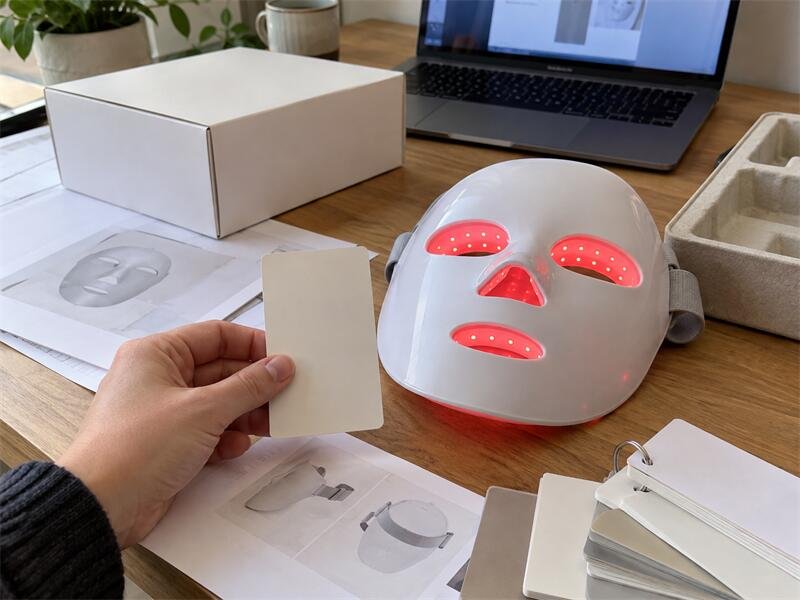
A product intended for a beauty brand may need a different design and documentation package from a device intended for a rehabilitation clinic. Both products might contain LEDs at similar nominal wavelengths, but their requirements can differ in several areas:
- Permitted claims
- User instructions
- Risk controls
- Electrical and photobiological safety
- Labeling and symbols
- Quality documentation
- Applicable registration or certification routes
The phrase “red light therapy” also needs care. The word therapy may have regulatory implications depending on the claims, product presentation, and sales country. A team should not decide its classification from the product name alone.
For example, the U.S. Food and Drug Administration distinguishes general wellness products from products making claims related to diagnosing, treating, curing, mitigating, or preventing disease. Other markets use their own definitions and classification rules. Product teams should obtain market-specific advice before finalizing packaging or promotional language.
I treat a product name as the front door, not the whole building. The engineering specification and intended-use statement show what is actually inside.
A useful product-definition document should state:
- The intended user
- The intended environment
- The body area or treatment area
- The expected operating distance
- The proposed session workflow
- The target market
- The proposed claims
- The required evidence and compliance documents
This definition gives engineering, procurement, marketing, and compliance teams the same starting point.
How Should Teams Frame Photobiomodulation vs Red Light Therapy Products?
Product teams often begin with wavelength counts or maximum power. That approach can produce a device that looks strong on a comparison chart but works poorly in its intended setting. A panel for a clinic room and a flexible knee wrap do not solve the same task, even if both contain red and near-infrared LEDs.
Teams should define photobiomodulation vs red light therapy products from the use scenario outward. They should specify the treatment area, product form, operating distance, session workflow, user controls, target cost, and market requirements before selecting wavelengths and output. The application should control the specification, rather than the largest available number.
Start with the job the product must perform
In customer requirement discussions, I often ask a basic question: What does the user need to do with the device? That question sounds almost too simple, but it changes the project.
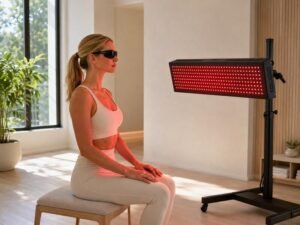
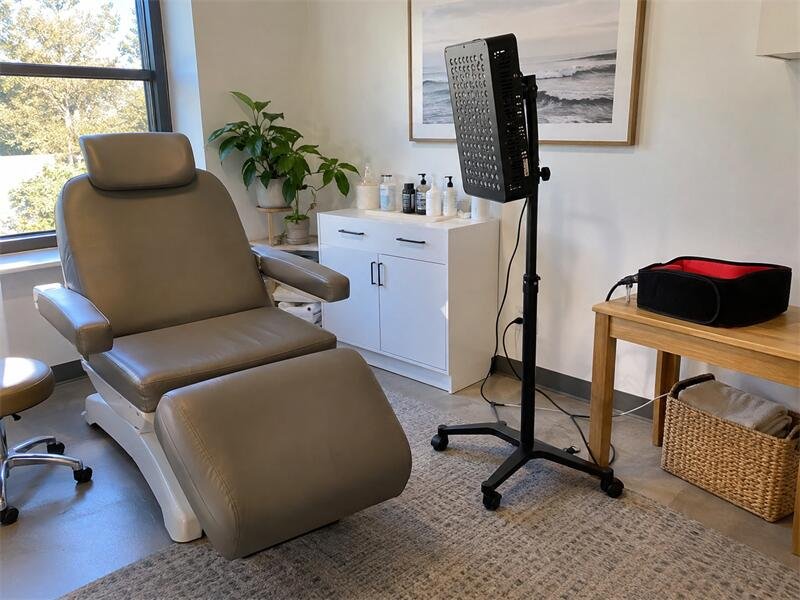
A clinic may value broad coverage, repeatable positioning, easy cleaning, and durable controls. A home wellness brand may prioritize storage, simple operation, packaging size, and acceptable heat. A wearable product may need flexibility, secure contact, cable strain relief, and battery-life planning.
The following framework keeps the specification grounded:
| Use factor | Questions for the product team |
|---|---|
| Treatment area | Is the target the face, scalp, joint, torso, or full body? |
| Product format | Should the device be a panel, mask, wrap, mat, bed, or handheld unit? |
| Positioning | Will it contact the body or operate at a distance? |
| Workflow | How long can setup and use reasonably take? |
| Environment | Will it be used at home, in a clinic, or in a wellness facility? |
| User controls | Are presets, timers, dimming, or wavelength selection needed? |
| Cleaning | Which surfaces need routine cleaning or disinfection? |
| Commercial model | Is the product sold at retail, distributed, or used as facility equipment? |
Larger is not automatically more suitable
A full-body system may provide extensive coverage, but it also affects shipping, installation, power supply, heat management, and floor-space planning. A compact panel may fit a small treatment room more easily. A wearable may support targeted use but require closer review of fit and output uniformity.
I recommend writing a use-case specification before requesting quotations. It should describe must-have requirements, optional features, and unacceptable trade-offs. That document reduces the risk that suppliers quote different product categories under the same RFQ.
Which Wavelengths Should Product Teams Specify?
Wavelength discussions can become a shopping list. Suppliers may advertise two, five, or seven wavelengths as though a longer list guarantees a better product. That conclusion is not justified. Every wavelength choice affects LED sourcing, optical layout, control design, heat, test methods, cost, and the evidence required for product claims.
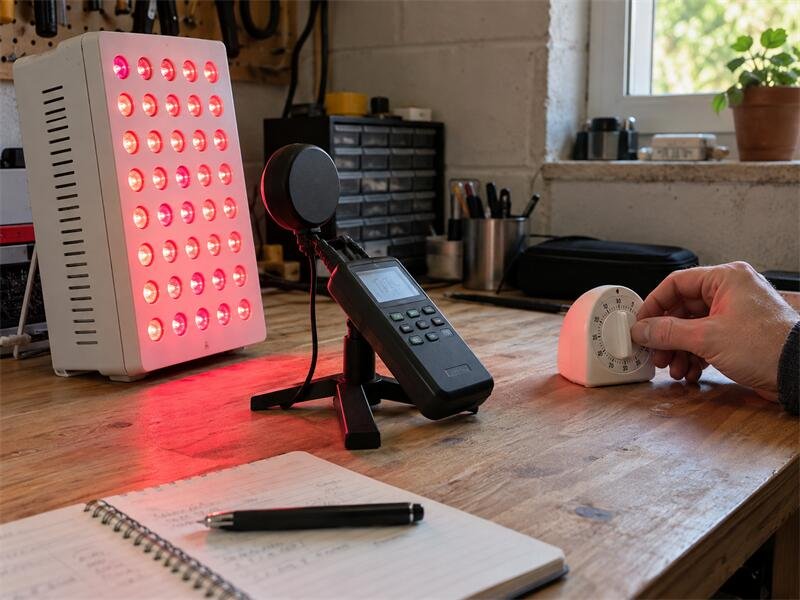
Product teams should choose wavelengths according to the intended application, supporting literature, device format, and regulatory position. Common red and near-infrared bands include values around 630–670 nm and 810–850 nm, but nominal LED values, tolerances, spectral width, and output ratios must be documented before products are compared.
Nominal wavelength is only one part of the specification
An LED described as 660 nm does not emit every photon at exactly 660 nm. LEDs typically have a spectral distribution around a peak wavelength. Product teams should clarify whether a supplier is reporting peak wavelength, dominant wavelength, or another value.
A wavelength specification may include:
- Nominal or peak wavelength
- Permitted tolerance
- Spectral bandwidth
- LED quantity by wavelength
- Electrical driving conditions
- Relative output by wavelength
- Whether wavelength channels can operate separately
- Measurement equipment and test method
A device with 660 nm and 850 nm LEDs may not divide its optical output equally between the two bands. Equal LED counts also do not necessarily mean equal optical power. Different LED types can have different efficiency, beam angle, and driving characteristics.
More wavelengths create more verification work
Additional wavelengths can support a defined product concept, but they can also complicate procurement and manufacturing. The team may need to control more component variants, confirm the physical LED map, check channel operation, and verify spectral output during sample approval.
During technical-document reviews, I look for alignment between four items:
- The approved bill of materials
- The LED layout drawing
- The control logic
- The measured spectral data
If those items conflict, the marketing specification may not reflect the manufactured product.
Product teams should also avoid making efficacy conclusions from wavelength alone. Biological effects depend on multiple variables, and clinical claims require suitable evidence. A wavelength label is a device specification, not an outcome guarantee.
How Do Irradiance and Dose Differ?
Irradiance and dose are often placed side by side as if they were interchangeable. They are not. A high irradiance figure may look attractive, but it says little about delivered energy unless the exposure time, area, distance, and measurement conditions are known. Confusing these quantities can distort both product selection and marketing.
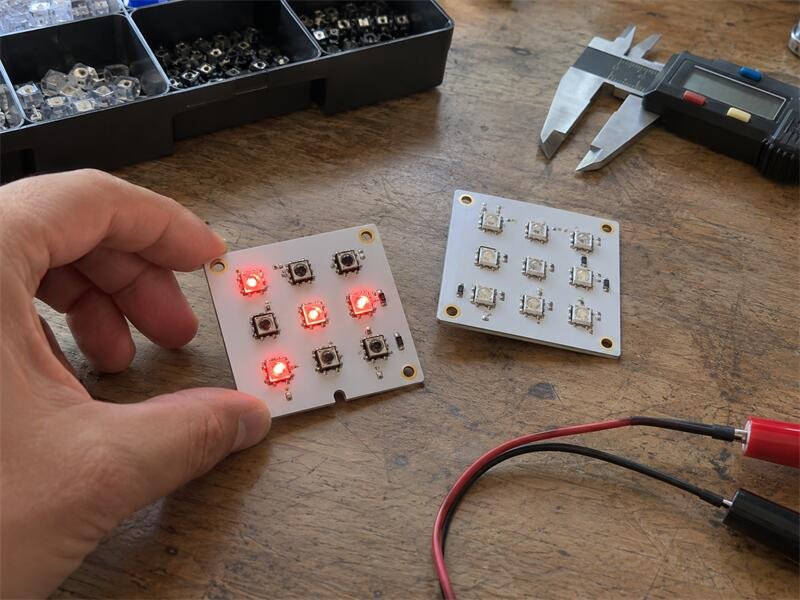
Irradiance describes optical power received per unit area, commonly reported in mW/cm². Radiant exposure, often called dose or fluence, describes energy per unit area, commonly reported in J/cm². Under stable and uniform conditions, radiant exposure equals irradiance multiplied by exposure time after the units are correctly converted.
The basic relationship
For a simplified constant-output case:
Radiant exposure (J/cm²) = Irradiance (W/cm²) × Time (seconds)
Because suppliers often state irradiance in mW/cm², the value must first be converted to W/cm².
For example, a measured irradiance of 20 mW/cm² equals 0.020 W/cm². If that level remains stable for 300 seconds, the arithmetic result is:
0.020 W/cm² × 300 s = 6 J/cm²
This calculation only demonstrates the unit relationship. It does not prescribe an appropriate protocol or prove how much energy reaches a biological target. Real products can have nonuniform output, pulsing, thermal changes, distance variation, and measurement uncertainty.
Questions hidden behind one irradiance figure
Whenever I see an irradiance claim, I ask:
- At what distance was it measured?
- Was the reading taken at the center or averaged over an area?
- Was one point measured or was a measurement grid used?
- Which meter or detector was used?
- Was the device warmed up first?
- Were all wavelength channels active?
- Was the output continuous or pulsed?
- Was the stated value a peak, average, or calculated figure?
- How uniform was the output across the treatment area?
A single center-point reading can overstate the practical exposure across a large panel. Conversely, an area average may hide localized hot spots. Product teams need both useful output and acceptable distribution.
I recommend that teams verify formulas, terminology, and scientific interpretation against independent sources, such as photobiomodulation literature and established radiometry references. Application-specific dose decisions should involve appropriately qualified scientific, clinical, and regulatory professionals.
Why Does Distance Change Photobiomodulation vs Red Light Therapy Comparisons?
Distance is easy to omit from a product listing. Unfortunately, it is also essential. If one supplier reports irradiance at the surface and another reports it at 15 centimetres, their headline figures cannot be compared directly. The missing distance can make an ordinary product look extraordinary.
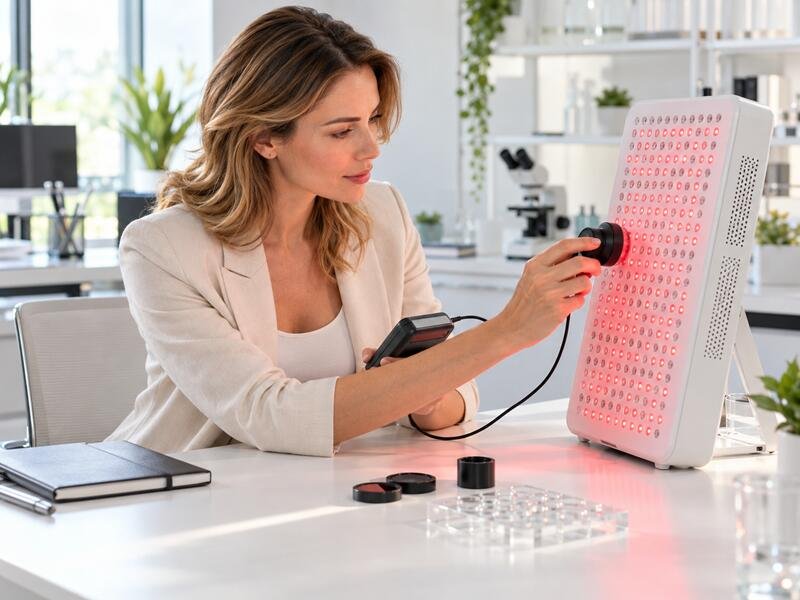
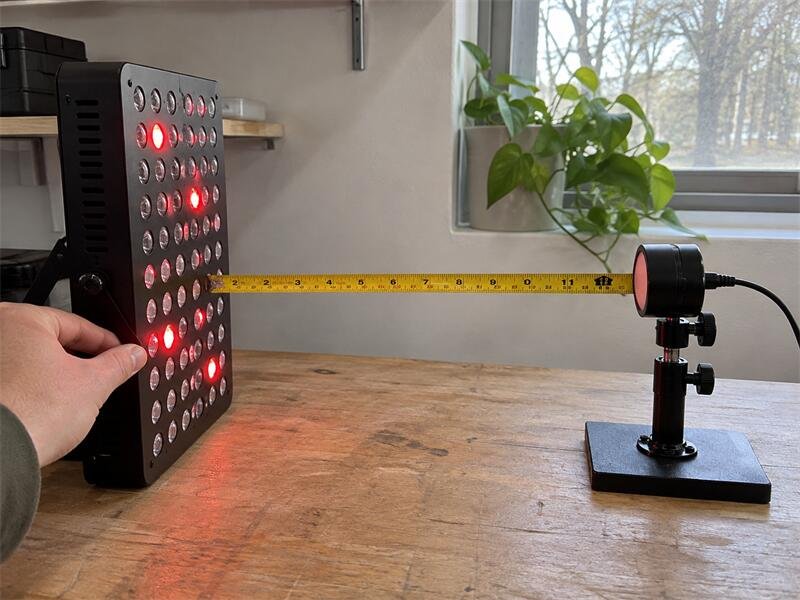
Distance affects measured irradiance, beam overlap, coverage, and output uniformity. Product teams comparing photobiomodulation vs red light therapy devices should require results at stated operating distances. They should also confirm the measurement position, active wavelength channels, instrument, warm-up state, and whether the reported value is a center reading or area average.
Light distribution changes as distance changes
As the user moves away from an LED array, irradiance usually decreases. At the same time, beams from adjacent LEDs may overlap more, which can improve coverage uniformity across part of the treatment field.
The simple inverse-square law is often mentioned in light discussions. However, buyers should not apply it mechanically to every LED panel. A large array at short working distances does not behave like an ideal point source. Lenses, reflectors, LED spacing, panel dimensions, and surrounding surfaces can all affect the result.
That is why measurement beats assumption.
A practical sample test can use a defined grid:
- Set the device in its normal operating mode.
- Allow a documented warm-up period.
- Fix the sensor at a defined distance.
- Record readings at the center, corners, and intermediate points.
- Repeat the process at other relevant distances.
- Document active channels, meter model, date, and ambient conditions.
- Compare the results with the approved acceptance criteria.
| Test item | Example reporting format |
|---|---|
| Distance | 0 cm, 10 cm, 15 cm, or intended operating distance |
| Measurement area | Center point or defined grid |
| Output mode | Red only, NIR only, or combined |
| Instrument | Manufacturer and model |
| Warm-up | Defined duration |
| Result | Individual readings, average, range, and variation |
| Product identity | Model, sample number, and firmware version |
I have seen buyers ask whether a lower reading automatically means a weaker product. I usually bring the discussion back to coverage and workflow. A usable configuration balances output, area, distance, comfort, session time, and repeatability. One peak number cannot describe that balance.
How Should Buyers Compare Photobiomodulation vs Red Light Therapy Suppliers?
Supplier comparison becomes difficult when every quotation uses a different test method. One document may provide calculated LED power, another may show a handheld meter reading, and a third may state “irradiance” without distance. If a buyer places those values in one spreadsheet, the spreadsheet creates false precision rather than clarity.
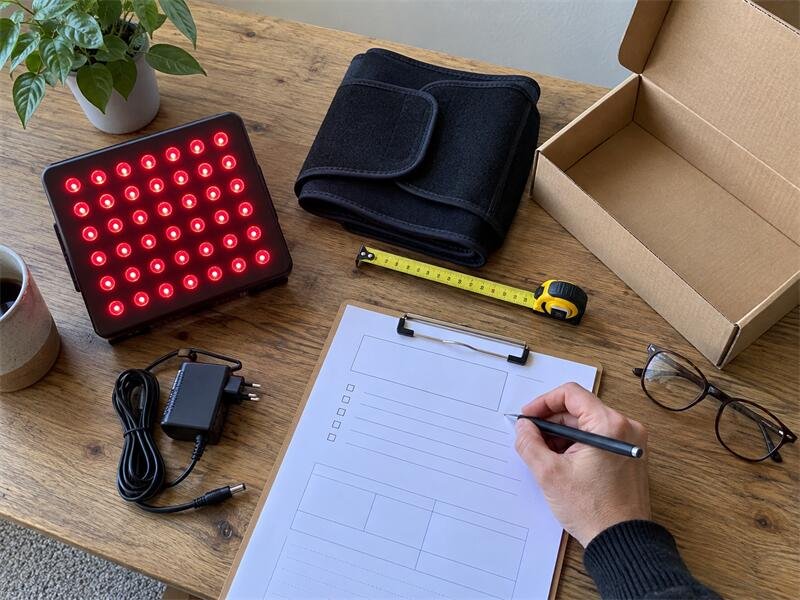
Buyers should compare photobiomodulation vs red light therapy suppliers through aligned specifications and test conditions. Each supplier should disclose wavelength data, measurement distance, position, instrument, operating mode, coverage, sample identity, and acceptance method. Buyers should also evaluate quality control, change management, documentation, capacity, and after-sales risk.
Compare like with like
I use a normalization table before drawing conclusions:
| Comparison item | Supplier A | Supplier B | Buyer requirement |
|---|---|---|---|
| Product format | 600 mm panel | 900 mm panel | Defined dimensions |
| Wavelengths | 660/850 nm | 630/660/810/850 nm | Application-based |
| Test distance | 15 cm | Not stated | Must be stated |
| Measurement position | Center | Not stated | Grid preferred |
| Irradiance type | Single point | Claimed average | Defined method |
| Coverage | Not stated | Panel dimensions only | Illuminated-area data |
| Instrument | Identified | Not identified | Model required |
| Safety reports | Copies offered | Logo shown online | Documents verified |
This approach often reveals that the most important issue is not which number is larger. The important issue is whether the number is traceable and relevant.
Product quality extends beyond optical output
Procurement teams should also examine:
- Component traceability
- Incoming inspection
- In-process checks
- Final functional inspection
- LED channel verification
- Thermal management
- Electrical safety controls
- Software or firmware version control
- Golden-sample management
- Packaging validation
- Nonconformance handling
- Engineering-change notification
Certifications should be treated as documents to verify, not badges to admire. Buyers should check the certificate holder, product model, standards, issuing body, report references, dates, and scope. CE or FCC documentation may be relevant, but applicability depends on the product and market. FDA and ISO references also require careful interpretation.
For electrical, photobiological, or application-specific safety, buyers should engage qualified laboratories and regulatory professionals. Supplier documents support due diligence, but they do not replace a formal market-entry assessment.
What Should a Photobiomodulation vs Red Light Therapy RFQ Include?
A vague RFQ produces quotations that are difficult to compare. Suppliers fill the gaps with their standard configurations, preferred test methods, and assumptions about packaging or compliance. The lowest price may then represent a different product. Buyers can prevent that problem by defining the request in operational terms.
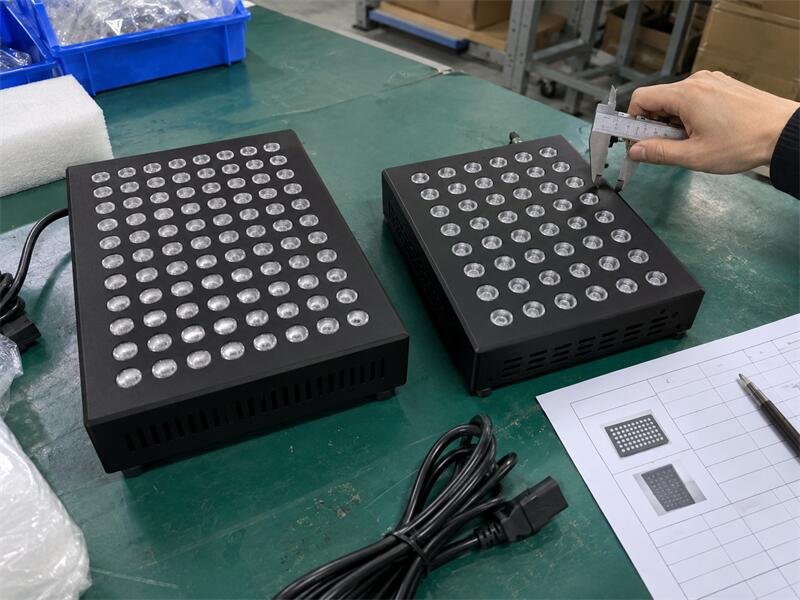
A photobiomodulation vs red light therapy RFQ should state the application, product format, target market, wavelength requirements, working distance, irradiance test method, coverage, controls, safety expectations, customization, quantity, quality criteria, and documentation. It should also separate mandatory requirements from preferences and request disclosure of assumptions or exceptions.
A practical RFQ structure
I recommend including the following sections:
-
Business and market context
State the sales country, user group, channel, and expected positioning. -
Product format
Define dimensions, mounting, portability, treatment area, and operating environment. -
Optical configuration
Request wavelengths, tolerances, channel ratios, LED layout, beam angle, and control modes. -
Performance testing
State the required distances, grid positions, instrument details, warm-up period, and reporting units. -
Mechanical and electrical requirements
Include materials, input voltage, connectors, controls, noise, heat limits, and cable needs. -
Customization
Identify logo, color, housing, software, packaging, instructions, and accessories. -
Quality requirements
Define golden-sample approval, inspection criteria, acceptable tolerances, and change-control rules. -
Compliance documents
List the target-market documents for review without assuming that one certificate covers every model. -
Commercial information
Request sample cost, tooling cost, MOQ, tiered pricing, lead time, capacity, payment terms, and warranty handling. -
Project milestones
Define requirement confirmation, sample review, corrective work, pilot run, mass production, and shipment.
Ask suppliers to record deviations
An RFQ should give suppliers a place to state exceptions. A supplier may not meet one requirement exactly but may offer a workable alternative. Clear deviations are more useful than a simple “yes” beside every line.
I also recommend keeping an approved-specification revision number. When teams change wavelength ratios, timers, accessories, or packaging during sampling, the final purchase order should point to the latest approved version. That small administrative step can prevent large production disputes.
Photobiomodulation vs Red Light Therapy FAQs
1. Is photobiomodulation the same as red light therapy?
The terms overlap, but they are not always identical. Photobiomodulation is a broader technical term used in scientific and professional contexts. Red light therapy is a common commercial term for devices using red and often near-infrared LEDs. Buyers should compare actual specifications, intended use, and supporting documents rather than names alone.
2. Is near-infrared light still considered red light therapy?
Many commercial red light therapy products combine visible red and near-infrared wavelengths. Near-infrared light is not visible red light, but the market often groups both under the same product category. Product documentation should state each wavelength clearly instead of relying on the category name.
3. Does higher irradiance mean a better device?
No. Higher irradiance does not automatically mean better suitability or better outcomes. Buyers should consider working distance, coverage, uniformity, exposure time, heat, comfort, and intended use. They should also check how the irradiance was measured before comparing it with another device.
4. How is light dose calculated?
For constant and uniform output, radiant exposure in J/cm² equals irradiance in W/cm² multiplied by time in seconds. The calculation requires correct unit conversion. Real devices may have pulsing, nonuniform output, and changing conditions, so teams should verify the method and avoid treating a calculated dose as proof of efficacy.
5. Why must suppliers state the measurement distance?
The distance affects irradiance and beam coverage. A reading at the device surface cannot be compared fairly with a reading taken at 15 centimetres. Suppliers should report distance, position, active channels, instrument, warm-up conditions, and whether the result represents a point or an area average.
6. Are more wavelengths always better?
No. Additional wavelengths may suit a defined design, but their presence alone does not prove better performance. Each added wavelength affects sourcing, controls, testing, cost, and documentation. Teams should choose wavelength combinations according to the application and independently reviewed evidence.
7. Can two irradiance values be compared directly?
Teams can compare them only when the test conditions are sufficiently aligned. They should check distance, measurement position, detector, output mode, warm-up period, coverage, and reporting method. If those details are missing, the comparison may be misleading even when both values use mW/cm².
8. Which certification should a buyer request?
The required documents depend on the product, intended use, electrical design, claims, and sales market. CE, FCC, FDA, ISO, electrical safety, and photobiological safety references have different meanings. Buyers should verify each document and consult qualified testing or regulatory professionals before market entry.
9. Should buyers test a sample before mass production?
Yes. A sample allows the buyer to check dimensions, controls, wavelengths, output distribution, heat, assembly, packaging, and user workflow. The team should document approved results and retain a golden sample or equivalent approval record for comparison during pilot and mass production.
10. What is the most important question to ask a supplier?
I would ask, “Under exactly what conditions was this specification measured?” That question exposes missing distance, instrument, position, operating mode, and averaging details. It also shows whether the supplier can connect a marketing number to a repeatable quality-control method.
Conclusion: How Should Product Teams Make the Final Comparison?
Photobiomodulation vs red light therapy is not a contest between two labels or the largest numbers on a product page. I recommend starting with the application, then defining wavelength, coverage, distance, irradiance, exposure time, workflow, quality controls, and target-market requirements. Buyers should compare data only under aligned test conditions and verify certification documents rather than accepting logos at face value.
A specification sheet should answer questions, not perform magic tricks. If your team is planning an OEM, ODM, or private-label red and near-infrared product, contact MedLight to discuss the use case, sample requirements, test conditions, and path toward controlled production.