At some point during a trade show or a supplier presentation, someone likely told you that red light therapy “supports vitamin D.” It sounded good. Your clients care a lot about vitamin D. You made a note. Now, months later, you’re putting together a product launch and wondering whether you can actually say that — or whether your legal team is about to cost you a significant amount of money.
You’re asking the right question. The wellness industry has been blurring the line between wavelengths, biological mechanisms, and marketing copy for years — and regulators are paying closer attention. The difference between a compliant product story and a warning letter from the FDA comes down to a few hundred nanometers.
This article gets straight to the point. Whether you’re building a private label line, expanding a distribution portfolio, or answering a medspa client’s question, here’s what you need: the science, the positioning that holds up, and the sourcing decisions that protect your brand.
Why Vitamin D Matters in Wellness Markets
Vitamin D deficiency affects an estimated 1 billion people worldwide, spanning every demographic your customer base serves — from clinic patients to spa guests to athletes in recovery programs. Deficiency is linked to a wide range of health issues including compromised bone density, weakened immune function, poor mood regulation, and slower muscle recovery.
For brands in the medical aesthetics, wellness, and fitness recovery markets, vitamin D sits at the intersection of multiple value propositions your clients already care about: immune health, skin quality, anti-aging, and performance recovery. That’s why the pull toward products that can address vitamin D concerns is understandable — and why getting this right matters.
Buyer Insight: End users regularly ask wellness providers about improving their vitamin D levels, especially in northern climates with limited sun exposure. Having an accurate, well-grounded answer builds trust — and positions your brand as one that doesn’t just repeat what sounds good.
Vitamin D3 (cholecalciferol) is primarily synthesized in the skin when it’s exposed to ultraviolet B (UVB) radiation from sunlight — specifically in the 280-315 nm wavelength range. That single biological fact shapes everything about how red light therapy fits into this conversation.
How Red Light Therapy Works
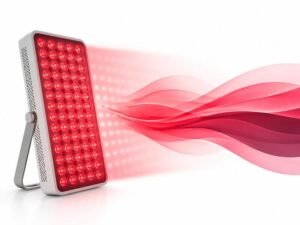
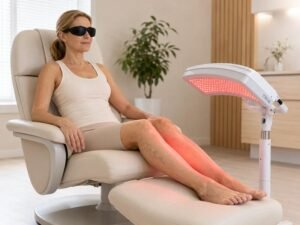
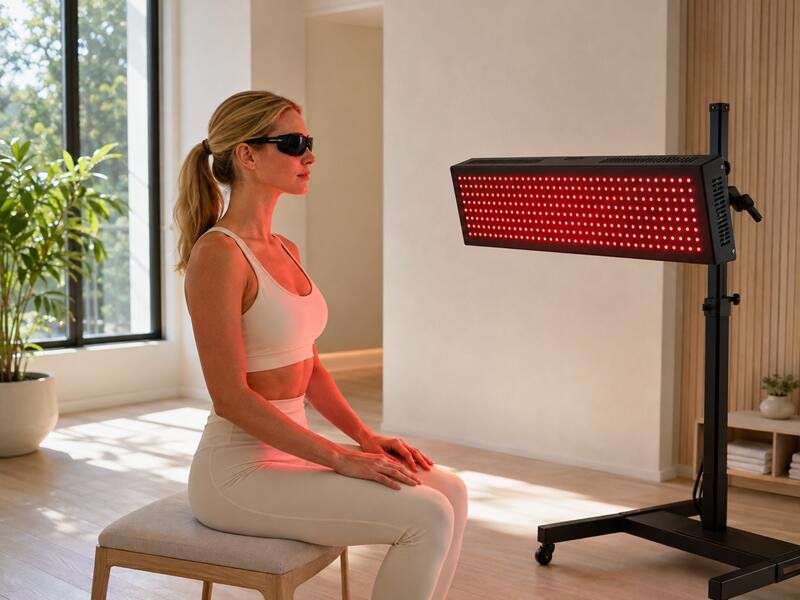
Red light therapy — also called photobiomodulation (PBM) or low-level laser/light therapy (LLLT) — operates primarily in two wavelength ranges:
Red Light
630-700 nm — Penetrates superficial skin layers. Primary benefits include enhanced skin collagen production, wound healing, surface-level inflammation reduction, and facial rejuvenation.
Near Infrared (NIR)
800-1100 nm — Penetrates deeper into muscle and joint tissue. Benefits include pain relief, muscle recovery acceleration, mitochondrial ATP production, and improved circulation.
The biological mechanism behind red light therapy is primarily the absorption of photons by cytochrome c oxidase — a key enzyme in the mitochondrial respiratory chain. This stimulates increased ATP production, reduces oxidative stress, and modulates nitric oxide levels, triggering a cascade of beneficial cellular responses.
The critical point for this discussion: red and near-infrared light (630-1100 nm) falls entirely outside the UVB spectrum (280-315 nm). The mechanisms behind red light therapy’s benefits are fundamentally different from UVB-driven vitamin D synthesis.
Red Light vs. UVB: Key Differences
The Direct Answer
Red light therapy does not directly stimulate vitamin D synthesis in the skin. Vitamin D3 production requires UVB radiation (280-315 nm). Standard red light therapy devices emit wavelengths of 630-850 nm — well outside this range. No photobiomodulation process converts red or near-infrared light into the UVB-equivalent biological signal needed to trigger vitamin D3 production in keratinocytes.
This distinction matters for anyone building product messaging. Making direct claims that your red light device “boosts vitamin D” — without scientific qualification — would be both factually incorrect and a compliance liability in regulated markets including the EU, UK, and United States.
| Factor | UVB Light Therapy | Red Light Therapy (RLT) |
|---|---|---|
| Wavelength Range | 280-315 nm (UVB) | 630-850 nm (Red / NIR) |
| Direct Vitamin D Synthesis | Yes | No |
| DNA Damage Risk | Possible at high doses | None documented |
| Skin Penetration | Superficial (epidermis) | 1-10 cm (tissue depth) |
| Primary Applications | Psoriasis, vitamin D deficiency | Pain, recovery, skin rejuvenation, fat loss, hair growth |
| Regulatory Classification | Often medical device (Class II) | Wellness / Class I or II depending on claims |
Indirect Links to Vitamin D Function
While red light therapy cannot directly synthesize vitamin D, emerging research and clinical observation point to several indirect pathways through which regular sessions may support overall vitamin D metabolism and function. This is where a nuanced, evidence-grounded brand story becomes commercially valuable — without crossing into territory your legal team would flag.
Mitochondrial Function and Vitamin D Receptor Sensitivity
Red light therapy enhances mitochondrial activity via cytochrome c oxidase stimulation. Vitamin D receptors (VDRs) are present throughout the body’s cells, and optimized cellular energy metabolism may improve the sensitivity and expression of these receptors — meaning whatever vitamin D a user already has may be utilized more efficiently.
Reduced Chronic Inflammation Through Shared Pathways
Vitamin D deficiency and chronic low-grade inflammation are closely linked. Red light therapy has demonstrated consistent anti-inflammatory effects through the modulation of pro-inflammatory cytokines (TNF-α, IL-6). By reducing baseline inflammation, RLT may create a more favorable physiological environment for vitamin D to perform its immunomodulatory role.
Better Energy and Mood May Mean More Time Outside
Clinical and anecdotal evidence suggests regular RLT use supports improved mood, energy levels, and exercise motivation — partly due to reduced cortisol and improved mitochondrial performance. Users who feel better are more likely to be physically active outdoors, which increases natural UVB exposure and vitamin D synthesis as a downstream effect.
Circadian Rhythm Support and Hormonal Balance
Morning red light exposure has been studied for its role in supporting healthy circadian rhythms by activating wakefulness pathways. A well-regulated circadian system supports balanced cortisol and melatonin levels, which positively influence immune function — an area where vitamin D plays a significant complementary role.
Healthier Skin May Convert UVB More Effectively
Red light therapy is clinically documented to improve skin barrier function, collagen density, and microcirculation. Healthier, well-vascularized skin is better equipped to convert 7-dehydrocholesterol to previtamin D3 upon UVB exposure. This creates a logical case for combining RLT with measured, safe sun exposure as part of a holistic wellness protocol.
A Note for Buyers on the Research: These indirect pathways are supported by existing mechanistic research, but large-scale randomized controlled trials specifically measuring RLT’s effect on serum vitamin D levels remain limited as of 2024. Brand messaging should reflect this — positioning RLT as a complementary wellness tool rather than a direct vitamin D intervention.
Compliant Messaging: Do’s and Don’ts
Getting the science right gives you a more defensible marketing position — not a weaker one. Here is how leading brands and distributors are successfully framing red light therapy in relation to the vitamin D conversation:
Messaging That Holds Up
- “Supports your body’s natural recovery and energy processes”
- “Complements your vitamin D and supplement routine”
- “Designed to support the cellular systems that vitamin D depends on”
- “Part of a holistic light-based wellness protocol”
- “Clinically documented benefits for skin, recovery, and immune support”
Messaging to Avoid
- “Red light therapy boosts vitamin D production”
- “Replace your vitamin D supplement with red light”
- “Clinically proven to increase vitamin D levels”
- Any direct, unqualified disease or deficiency treatment claim
- Citing UVB-specific studies to support red light claims
The brands doing this well lead with red light therapy’s well-documented benefits — pain relief, skin rejuvenation, muscle recovery, anti-aging — and frame vitamin D as a complementary health goal within the same holistic wellness lifestyle their customers are already pursuing. This approach builds credibility with sophisticated buyers and keeps you clear of regulatory risk.
Regulatory Risks to Know
⚠ Regulatory Exposure from Incorrect Claims
In the United States, the FDA monitors health claims for wellness devices. In the EU, the Medical Devices Regulation (MDR 2017/745) governs how light therapy devices are classified and marketed. Making unsubstantiated claims that a red light device “increases vitamin D” could result in:
- Reclassification of your device from wellness to medical device category
- Warning letters, product seizures, or import holds
- Liability exposure from end users who act on incorrect health claims
- Damage to brand credibility with clinic and medspa buyers who expect scientific accuracy
Buyers sourcing devices from OEM/ODM manufacturers should ensure all marketing materials, device labels, and user manuals are reviewed against the regulatory requirements of their target market before distribution. A compliant, well-documented device is a long-term asset. A device with inflated claims is a liability that compounds over time.
Device Sourcing Criteria
Whether you’re sourcing for a medspa chain, a sports recovery brand, or a dermatology distribution network, these technical and commercial criteria should guide your device selection:
Pre-Launch Checklist
Run through this checklist before finalizing your sourcing decision and going to market:
Pre-Launch Verification Checklist
For sourcing teams and product leads
-
Wavelength and irradiance specifications verified with third-party test reports
Spectral output data, irradiance at 6/12/24 inches
-
CE and/or FCC certification obtained and verified with original documentation
Check certifying body credentials and test lab report numbers
-
All marketing materials reviewed for compliant health claim language
No direct vitamin D production claims; emphasize documented therapeutic benefits
-
OEM/ODM agreement includes IP protection and NDA coverage
Protect your brand design, product specifications, and market data
-
Production sample testing completed before full order commitment
Test against your own checklist, not just manufacturer specifications
-
Supply chain lead times and inventory buffer strategy confirmed
Minimum 90-day forward visibility on delivery schedules
-
After-sales support and warranty policy clearly documented
Replacement LED panels, repair support, and defect rate SLA confirmed
-
User manual and training materials prepared for your target end-user segment
Clinicians, spa staff, and home users have different education needs
Frequently Asked Questions
Common questions about red light therapy and its relationship to vitamin D.
Does red light therapy directly increase vitamin D levels in the body?
What is the difference between red light therapy and UVB light therapy for vitamin D?
Can red light therapy support vitamin D function indirectly?
Is it safe to use red light therapy alongside vitamin D supplementation?
Why do some red light therapy brands claim their devices help with vitamin D?
What wavelengths are most effective for red light therapy, and do any overlap with vitamin D synthesis?
How does red light therapy affect immune function compared to vitamin D?
Can red light therapy help people who are vitamin D deficient?
Are there any red light therapy devices that also emit UVB for vitamin D synthesis?
How should I respond when a medspa or clinic client asks if red light therapy replaces the need for vitamin D supplements?
Key Takeaways
The Short Version
Let’s be clear: red light therapy does not make vitamin D. Your panels are effective — but they’re not the sun. Claiming otherwise won’t just create regulatory problems; it will also quietly erode trust with the buyers who actually read the science. Every brand owner needs to be comfortable with this fact before writing a word of product copy.
That said, the vitamin D angle isn’t irrelevant — the connection is real, just indirect. RLT supports mitochondrial function, reduces inflammation, and keeps skin in better condition, which creates a physiological environment where vitamin D can do its job more effectively. It fits naturally into a broader wellness story without requiring any claim you can’t back up.
The practical approach: lead with what red light therapy genuinely delivers, bring vitamin D into a broader holistic wellness narrative, and you’ll find that buyers who know the category respond well — because in this market, accuracy is a competitive advantage.