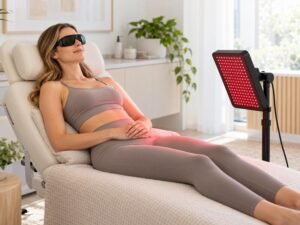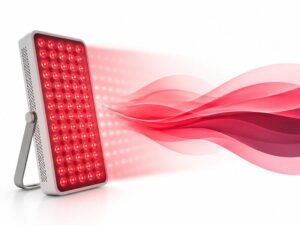
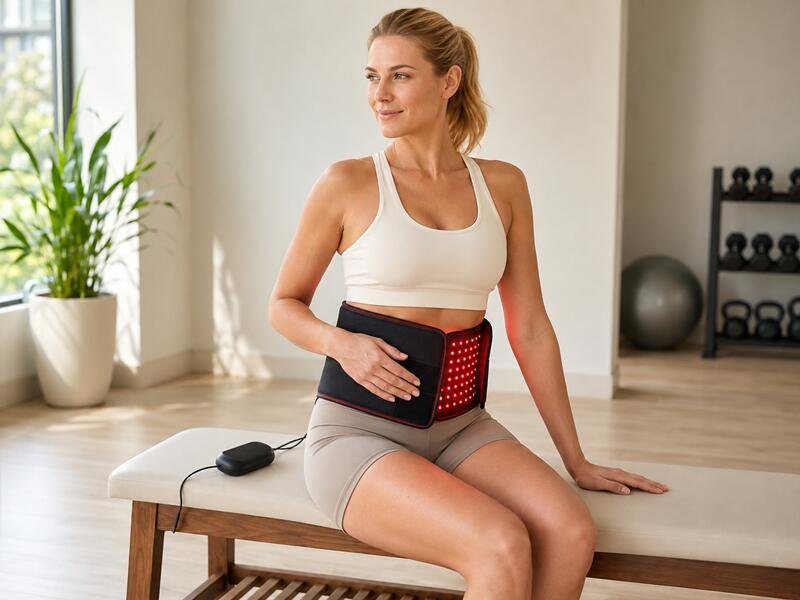
Somewhere between ancient sun worship and modern biohacking, humanity landed on a surprisingly sensible idea: what if you strapped a glowing belt around your waist and called it science? Here’s the thing — it actually is science, and fairly rigorous science at that. Red light therapy belts have quietly moved off the infomercial shelf and onto the treatment menus of physiotherapy clinics, MedSpas, and serious sports recovery programs around the world.
But for every well-engineered device delivering real photobiomodulation, there’s an army of look-alikes emitting just enough red glow to photograph well — backed by a warehouse full of optimistic spec sheets. The market has the enthusiasm of a wellness influencer and, occasionally, the technical rigour of one too. If you’re a brand owner, distributor, or procurement manager trying to figure out which side of that line a product actually lands on, your skepticism is already your most valuable sourcing tool.
This guide is here to help you tell the difference. We cover the science, the specs that actually matter, the use cases with real commercial legs, and the warning signs that separate credible OEM partners from very photogenic disappointments. By the end, you’ll know exactly what to ask, what to test, and what to walk away from.
What Is a Red Light Therapy Belt?
A red light therapy belt is a wearable device that delivers low-level LED light — typically in the red (630-700 nm) and near-infrared (NIR, 800-1100 nm) spectrum — directly to soft tissue through a flexible, body-conforming form factor. Unlike stationary therapy panels, belts wrap around targeted body parts: the lower back, waist, knees, shoulders, or hips, allowing hands-free treatment during daily activity or rest.
From a product perspective, these devices sit at the intersection of wearable wellness technology and clinical-grade photobiomodulation (PBM) therapy. They’re sold through medical spas, physiotherapy clinics, fitness studios, and direct-to-consumer wellness brands — making them a high-interest SKU for distributors and OEM buyers building out their product portfolios.
Wavelengths
Typically 630-850 nm red and near-infrared LEDs for tissue penetration
Form Factor
Flexible belt worn around joints, waist, back, or limbs
Use Mode
Hands-free, passive use — typically 10-20 min sessions
The Science Behind Red Light Therapy
The biological mechanism behind red light therapy is called photobiomodulation (PBM). When red and near-infrared light is absorbed by chromophores in mitochondria — particularly cytochrome c oxidase (CCO) — it sets off a chain of cellular responses:
Increased ATP Production
Light absorption enhances electron transport chain activity, boosting adenosine triphosphate (ATP) synthesis — the cell’s primary energy currency. This accelerates tissue repair, collagen synthesis, and metabolic activity.
Modulation of Reactive Oxygen Species (ROS)
At therapeutic doses, PBM produces a brief, signaling-level increase in ROS, activating anti-inflammatory and cytoprotective pathways — reducing pain and swelling without damaging tissue.
Nitric Oxide (NO) Release
PBM releases NO bound to CCO, improving local blood flow and oxygen delivery — critical for muscle recovery and reducing chronic pain tied to restricted circulation.
Collagen Stimulation & Tissue Remodeling
Fibroblast activation increases collagen and elastin production — relevant not just for skin rejuvenation, but also for connective tissue repair around joints and muscles treated by belts.
Research context: A 2019 systematic review in Photobiomodulation, Photomedicine, and Laser Surgery covering over 400 clinical studies confirmed PBM’s efficacy for musculoskeletal pain, wound healing, and inflammation. The deciding factor is whether a device delivers the correct irradiance and energy density (fluence) to the target tissue — not simply whether it emits red light.
Do Red Light Therapy Belts Actually Work?
The straightforward answer is: yes — but with important qualifications. The science of photobiomodulation is well-established. Whether a specific belt product delivers meaningful clinical results depends almost entirely on its engineering quality.
Here’s a practical breakdown of what the evidence supports and what it doesn’t:
What the Evidence Supports
- ✓Reduction of lower back pain with consistent use over 2-4 weeks
- ✓Faster muscle recovery post-exercise (DOMS reduction)
- ✓Improved joint mobility in knee and hip arthritis
- ✓Localized anti-inflammatory effects in soft tissue
- ✓Improved circulation in the treated area during and after sessions
Overstated or Unsupported Claims
- ⚠“Melts fat” from a single treatment — fat loss requires sustained, multi-session protocols
- ⚠Instant or permanent pain elimination without addressing root cause
- ⚠Results from devices with unverified power output (common in cheap consumer belts)
- ⚠Equivalent outcomes at any wavelength — wavelength selection is clinically significant
The single most important variable determining whether a belt “works” is irradiance at tissue level — measured in mW/cm². Research suggests effective therapeutic irradiance typically falls between 20-200 mW/cm², with total energy dose (fluence) of 3-60 J/cm² depending on the application. Many low-cost consumer belts emit well below this threshold — meaning they generate warmth and give the impression of activity, but don’t achieve the photon density needed to drive a meaningful cellular response.
Who Gets the Most Out of These Devices?
If you’re sourcing for a specific market segment, knowing which customer profiles are the best fit helps you position the product accurately and set realistic expectations from day one.
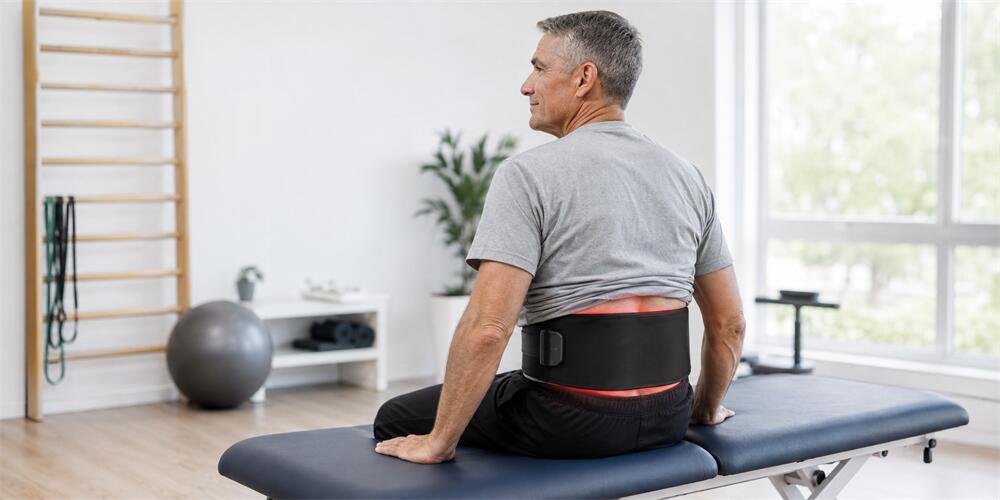
Pain Management
Chronic Back & Joint Pain
Lower back pain is one of the most researched PBM applications. Belts allow targeted, daily treatment at home or in clinic — a natural fit for physical therapy practices and pain clinics looking to extend their home-use product line.

Sports Recovery
Muscle Recovery & DOMS
Pre- and post-workout belt use is gaining traction in fitness and sports recovery brands. Multiple RCTs support PBM for reducing exercise-induced muscle damage and getting athletes back to training sooner.
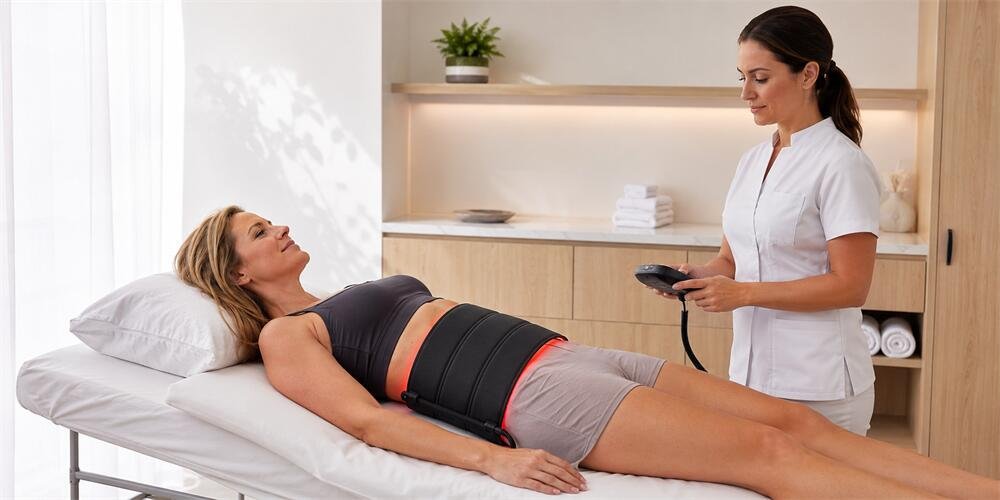
Body Contouring
Body Wrap & Fat Loss Programs
Widely used in medspas and slimming clinics as part of multi-session body wrapping protocols. Most effective when combined with exercise and nutrition — belts add a premium service layer with low therapist involvement.
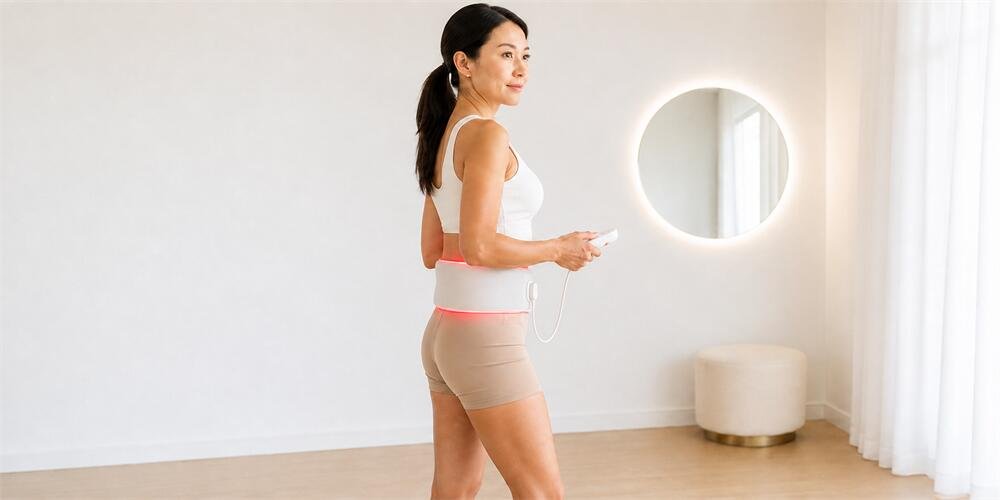
Aesthetics
Skin Tightening & Rejuvenation
Collagen stimulation from red-spectrum LEDs (630-660 nm) addresses loose skin and stretch marks on the abdomen, hips, and thighs — a practical add-on for post-pregnancy or post-weight-loss treatment programs.
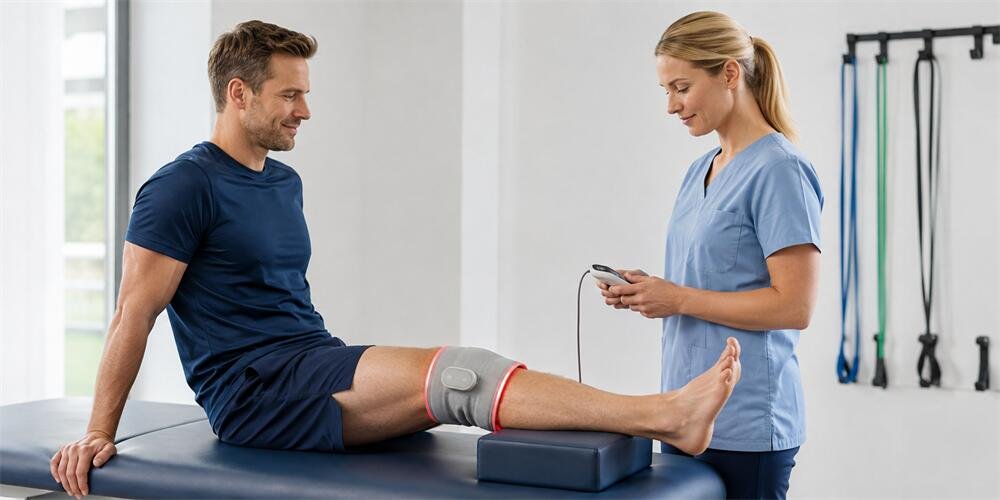
Rehabilitation
Post-Surgical & Injury Recovery
PBM is used in sports medicine for soft tissue repair. Wearable belts let patients continue treatment between clinical visits, extending contact time without adding in-clinic hours.

Wellness
Stress Relief & General Wellness
In spa and wellness settings, infrared warmth combined with PBM creates a relaxation and recovery treatment with strong perceived value — even for clients without a specific pain or aesthetic concern.
Technical Specifications Worth Paying Attention To
These are the parameters that determine whether a red light therapy belt is genuinely effective or just well-packaged. Get these right, and you’re building a product that earns repeat orders. Get them wrong, and you’re managing returns and reputation damage.
Wavelength Selection
Most quality belts use dual-wavelength LED arrays combining:
- 660 nm (Red): Penetrates 2-3 mm; targets skin, surface tissue, and cosmetic applications
- 850 nm (Near-Infrared): Penetrates 4-6 cm; reaches muscle, joint, and deep connective tissue
Some premium devices add 630 nm or 810/830/940 nm. Vague “red light” claims without any wavelength specification are a major indicator of low-quality products — walk away from those.
LED Count, Chip Quality & Power Density
LED chip quality (e.g., Epistar, Osram, CREE) determines actual output per watt. Surface irradiance should be independently measurable — request third-party irradiance testing data, not just manufacturer claims. Any credible manufacturer will have this. Belts using underpowered LEDs simply cannot reach therapeutic fluence, regardless of how long the session runs.
Flexibility, Fit & Coverage Area
Silicone substrate belts conform better to the body than rigid PCB modules. Coverage area determines how much tissue is treated per session — larger areas suit commercial and clinical use, while compact designs work better for portable consumer products. Pay attention to LED-to-skin contact uniformity, especially on contoured body areas.
Certifications & Compliance
Depending on your target market, confirm:
- CE marking (required for EU markets)
- FCC certification (required for US consumer electronics)
- FDA 510(k) or Class II status (for US clinical/medical claims)
- RoHS / REACH for material safety
- ISO 13485 manufacturing QMS for medical-grade sourcing
Control Interface & Session Management
Consumer-grade belts typically use simple button controllers with fixed timers (10/15/20 min auto-shutoff). Professional-grade and OEM-custom versions may offer app connectivity, pulsing frequency settings (important for specific neurological and anti-aging applications), and intensity adjustment. Think about your customer’s technical comfort level and what they actually need — don’t add complexity that creates support calls.
Quick Specification Reference: Consumer vs. Professional Grade
| Parameter | Budget Consumer | Mid-Range | Professional / OEM |
|---|---|---|---|
| Wavelengths | Often unspecified | 660 nm only | 660 + 850 nm (dual) |
| Irradiance | <10 mW/cm² | 10-50 mW/cm² | 50-200 mW/cm² |
| LED Chip Brand | Unknown | Generic | Epistar / Osram / CREE |
| Certifications | None / Claimed | CE / FCC basic | CE, FCC, RoHS, ISO 13485 |
| Pulsing Modes | No | Sometimes | Yes (configurable) |
| OEM / Branding | No | Limited | Full custom available |
What to Think Through Before You Commit to a Supplier
Whether you’re building your own brand or adding belts to a distribution portfolio, these are the strategic and operational questions worth resolving before you sign anything.
Start With Your End Market
Clinical channels — physio clinics, medspas — need higher-spec devices with certification documentation. Consumer wellness brands can lead with design and UX. Match the product spec to the customer expectation. Don’t over-engineer for consumers or cut corners for clinical buyers.
OEM vs. ODM — Know Which You Need
OEM: You provide design specifications; the manufacturer builds to your design. Requires stronger R&D input on your side. ODM: The manufacturer has an existing design you customize and rebrand. Faster to market, lower minimum investment — the better starting point for most first-time product launches.
Know Your Regulatory Position
For EU: CE marking under MDR or EMCD depending on your claims. For the US: consumer wellness claims avoid FDA classification; therapeutic or medical claims trigger a Class II device pathway. Figure out which category your marketing puts you in — then confirm your supplier can support the certification paperwork you’ll need.
Always Test Before You Commit
Request pre-production samples. Check irradiance with a calibrated light meter, heat output and thermal safety, LED uniformity across the belt surface, controller reliability, and how the materials hold up after repeated flex cycles. Don’t skip this step.
After-Sales & Warranty Support
LED device longevity is often rated at 50,000+ hours — but real-world failure rates depend on manufacturing quality. Confirm warranty terms (typically 1-2 years), spare part availability, and whether the manufacturer supports your end customers directly or just your inventory replenishment.
MOQ, Lead Time & Scalability
Established OEM manufacturers typically offer tiered pricing from 50-500 units for entry runs, with full production scale-up from a proven tooling set. Confirm sea and air freight options — bulk production orders from China typically run 30-60 days from order confirmation to delivery.
Warning Signs to Watch For When Sourcing
The red light therapy device market has a high noise-to-signal ratio. These are the patterns that tend to create downstream problems — for your brand and your customers:
No specific wavelength data
Vague “red and infrared” marketing without nm values points to poor technical transparency or a supplier who doesn’t really understand the product they’re selling.
Unverified certifications
CE or FDA logos on product pages without certificate numbers are common. Always request the actual certificate document and verify the issuing body independently.
Output claims that don’t add up
Some manufacturers advertise irradiance figures that physically exceed the device’s wattage. Ask for spectroradiometer measurement reports — not just stated specs on a datasheet.
No prototyping or customization process
A manufacturer who won’t provide samples or can’t explain their QC process is a production risk. Good OEM partners build testing into the workflow — it’s not optional.
No thermal management
High-density LEDs generate heat. Without proper dissipation, LEDs degrade faster, power output drops over time, and users can experience discomfort or safety issues.
Guaranteed “fat loss” or instant cure claims
These create customer disappointment and legal exposure in regulated markets. Work with suppliers who communicate outcomes within regulatory guidelines — not around them.
Questions We Hear a Lot
How long does it take to see results from a red light therapy belt?
Most users notice improvements in pain and muscle soreness within 1-2 weeks of consistent daily use (10-20 minute sessions). Clinical studies on musculoskeletal pain typically show statistically significant outcomes over 2-4 week treatment protocols. Skin rejuvenation and body contouring results take longer — usually 6-12 weeks — because they depend on cumulative collagen synthesis and metabolic changes.
The real variable here is consistency. Sporadic use rarely produces meaningful results, regardless of device quality.
What wavelength is best for a red light therapy belt — red or near-infrared?
It depends on the application:
- Red light (630-660 nm) penetrates 2-3 mm and works best for surface-level applications: skin rejuvenation, collagen stimulation, stretch marks, and superficial inflammation.
- Near-infrared (NIR, 810-850 nm) penetrates 4-6 cm and reaches muscle, joint, and deep connective tissue — more appropriate for pain relief, muscle recovery, and joint therapy.
For most belt applications — back pain, muscle recovery, body contouring — a dual-wavelength device combining 660 nm and 850 nm offers the broadest clinical utility and is the standard recommendation for professional-grade products.
How often should a red light therapy belt be used?
Standard clinical protocols recommend once daily sessions of 10-20 minutes for acute pain or recovery. For chronic conditions or aesthetic goals, a common approach is 5-7 sessions per week during an initial 4-6 week induction phase, followed by 3-4 maintenance sessions per week.
More is not always better. Photobiomodulation follows a biphasic dose-response curve — too much irradiation can inhibit rather than stimulate cellular activity. Follow the dosing guidelines from the device manufacturer, and allow at least 6-8 hours between sessions on the same treatment area.
Are red light therapy belts safe? Are there side effects?
At therapeutic doses, red and near-infrared light is considered non-ionizing and non-thermal at the cellular level, with a strong safety profile across thousands of published clinical studies. Unlike UV light, it doesn’t cause DNA damage or burns at recommended exposures.
Side effects are rare and mild — occasional temporary skin redness or mild warmth at the treatment site. That said, there are contraindications worth noting:
- Avoid use over active cancerous lesions
- Avoid direct eye exposure (use protective eyewear near the face)
- Exercise caution during pregnancy (limited safety data)
- Consult a physician if taking photosensitizing medications
For OEM buyers: make sure your product documentation clearly outlines contraindications — it reduces liability and sets the right expectations for users.
Can a red light therapy belt actually help with lower back pain?
Yes — lower back pain is one of the best-supported indications for PBM therapy. Multiple randomized controlled trials have shown statistically significant reductions in both acute and chronic lower back pain with consistent treatment. The mechanism involves reduced local inflammation, improved circulation through nitric oxide release, and modulation of pain signaling pathways.
The belt form factor suits this application well — it conforms to the lumbar region and allows extended hands-free treatment time. For clinical buyers in physiotherapy or pain management, this is a strong, evidence-based positioning argument for patient education and marketing.
Effective results require the device to deliver sufficient irradiance — generally ≥30-50 mW/cm² at tissue depth for musculoskeletal applications.
What’s the difference between a red light therapy belt and a far-infrared (FIR) sauna belt?
These are fundamentally different technologies that get confused in the consumer market more than they should:
- Red/NIR light therapy belts use specific LED wavelengths (630-850 nm) to trigger photochemical cellular responses (photobiomodulation). The therapeutic effect is photochemical — the goal is not to heat the tissue significantly.
- Far-infrared (FIR) sauna belts operate at much longer wavelengths (3,000-100,000 nm) and work through thermal mechanisms — generating heat to promote sweating, circulation, and relaxation.
Some devices combine both. But for clinical purposes, they’re distinct product categories with different mechanisms, different evidence bases, and different regulatory considerations. Conflating them in product marketing tends to confuse buyers and can create compliance problems.
Do red light therapy belts need to be used directly on skin, or can they work through clothing?
Direct skin contact is strongly recommended. Clothing attenuates light transmission — even thin fabrics can block 20-60% or more of visible and near-infrared light, depending on fiber type, weave density, and color. Dark or tightly woven fabrics are particularly absorptive.
For clinical use and accurate dosing, belts should always be applied to clean, dry skin. This matters from a product design standpoint too — instructional documentation for OEM-branded products should clearly specify skin-contact use so customers get the intended outcomes and you avoid unnecessary returns.
What certifications should a red light therapy belt have for sale in the US or EU?
Requirements vary by market and the claims being made:
- European Union: CE marking is mandatory. Depending on whether it’s marketed as a general wellness product or a medical device, it may fall under the Low Voltage Directive (LVD), Radio Equipment Directive (RED), or the Medical Device Regulation (MDR 2017/745). MDR classification brings more rigorous conformity assessment requirements.
- United States: FCC certification is required for electronic devices sold in the US. For medical claims, FDA 510(k) clearance or Class II device registration may be required. A consumer wellness positioning can sidestep the medical device pathway — but it constrains what you can legally say about the product.
- Additional: RoHS and REACH compliance for material safety, and ISO 13485 manufacturing certification for medical-grade sourcing credibility.
Always ask for the actual certificate documents with issuing body names and certificate numbers — not logos on a product listing page.
Can red light therapy belts be used for fat loss or body slimming?
There’s some evidence that red and near-infrared light can temporarily increase adipocyte permeability, making it easier for stored lipids to be released. But red light therapy alone doesn’t produce meaningful fat loss — those released lipids still need to be metabolized through physical activity.
In the medspa and wellness industry, belts are commonly used as part of multi-session body wrap or slimming protocols — combined with exercise, compression, lymphatic drainage, or nutritional support. Within that framework, they can contribute to measurable circumference reduction over a course of treatment.
For OEM buyers in the body contouring space: make sure your marketing reflects this honestly. Overstating fat loss efficacy is one of the fastest ways to erode customer trust and attract regulatory attention.
What should I look for when evaluating an OEM manufacturer for red light therapy belts?
When vetting an OEM partner, these are the things worth pushing on:
- Technical transparency: Can they provide spectral data, irradiance measurements, and LED datasheets? A credible manufacturer will have these ready without hesitation.
- Certification support: Do they have existing CE, FCC, and RoHS documentation? Can they support you through additional certification processes for your target market?
- Prototyping capability: Do they offer pre-production samples and iterative design support, or are they strictly selling catalog products?
- Manufacturing QMS: ISO 13485 certification indicates a quality management system aligned with medical device manufacturing — a meaningful signal of seriousness.
- MOQ and scalability: Check whether MOQ terms match your launch volume, and confirm they can scale production without quality slipping as orders grow.
- After-sales support: Understand their warranty terms, defect rate benchmarks, and how they handle failed units or replacement parts at scale.
The Bottom Line
Red light therapy belts work — when the device is properly engineered to deliver therapeutic-dose photobiomodulation, and when used consistently for the right applications.
The science is solid and the market demand is real and growing. For buyers, the question was never really whether the technology works — it’s whether the specific product you’re sourcing actually delivers on it. That comes down to verifiable specifications, credible manufacturing, and honest product positioning.
For brands, distributors, and clinic buyers, this device category has genuine commercial depth across pain management, recovery, aesthetics, and wellness. The opportunity is to stand out through product quality, education-led marketing, and clean regulatory compliance — not inflated claims that erode trust over time.
Partnering with a manufacturer who has documented engineering capabilities, verifiable certifications, and real OEM/ODM experience reduces your sourcing risk and gets you to market faster — with a product that can actually build the kind of customer loyalty that drives repeat business.