When evaluating a red light therapy device — whether as a buyer, brand owner, or OEM partner — the specification sheet rarely tells the full story. Two devices may both claim to emit “660 nm and 850 nm” light, yet deliver dramatically different clinical outcomes. The reason lies in how the wavelengths are distributed, weighted, and delivered across the full spectral output of the device.
This guide breaks down the science and engineering behind wavelength distribution, explaining what matters in a finished device and why it directly affects the performance your customers experience.
The Red and Near-Infrared Spectrum
Red and near-infrared (NIR) light therapy operates within a narrow but biologically significant window of the electromagnetic spectrum. The therapeutic range is generally accepted to span from 600 nm to 1100 nm, with two primary sub-bands:
- Red light (620-700 nm): Visible to the human eye as red. Primarily absorbed in superficial tissues, including the epidermis and upper dermis. Clinically associated with collagen stimulation, wound healing, and surface-level skin rejuvenation.
- Near-infrared light (700-1100 nm): Invisible to the naked eye. Penetrates deeper into subcutaneous tissue, muscle, and bone. Associated with pain relief, muscle recovery, inflammation reduction, and deep tissue repair.
Within these ranges, photons are absorbed by chromophores — light-sensitive molecules within cells. The primary chromophore in photobiomodulation (PBM) research is cytochrome c oxidase (CCO), a mitochondrial enzyme that absorbs specific wavelengths and initiates a cascade of cellular energy production. Different wavelengths activate different absorption peaks in CCO, which is why the specific wavelengths chosen — not just the general band — matter significantly.
Key Insight
The therapeutic window is not a flat range. Biological absorption varies at every nanometer. A device emitting light at 660 nm will have a measurably different cellular effect than one emitting at 680 nm, even though both are classified as “red light.”
Wavelength and Penetration Depth
One of the most misunderstood aspects of light therapy is the relationship between wavelength and tissue penetration. Longer wavelengths do not simply penetrate deeper in a linear fashion — the relationship is influenced by tissue composition, water content, hemoglobin concentration, and melanin density.
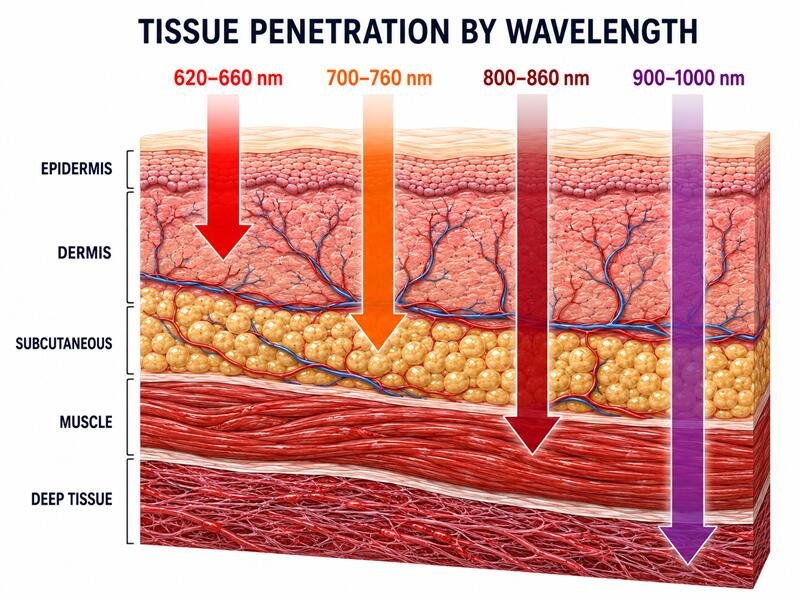
| Wavelength Range | Approximate Penetration | Primary Target Tissue |
|---|---|---|
| 620-660 nm (Red) | 1-3 mm | Epidermis, upper dermis |
| 700-760 nm (Far Red) | 3-6 mm | Dermis, superficial fascia |
| 800-860 nm (NIR) | 5-10 mm | Muscle, deep dermis, joints |
| 900-1000 nm (Deep NIR) | 8-20 mm | Deep muscle, bone, nerve tissue |
Tissue penetration is also affected by the optical properties of skin. Melanin absorbs strongly in the 400-700 nm range, meaning darker skin tones may absorb a greater proportion of red light before it reaches deeper targets. Water begins to absorb significantly above 900 nm, creating an upper boundary on effective NIR delivery.
For device manufacturers and OEM buyers, this means that the intended application should directly inform the wavelength selection. A facial rejuvenation mask designed for epidermal collagen stimulation has different spectral requirements than a full-body panel intended for deep muscle recovery.
Why Wavelength Count Is Not Enough
A common marketing pattern in the light therapy industry is to compete on the number of wavelengths a device emits. Devices advertised as “5-wavelength” or “7-wavelength” systems imply broader coverage, but this framing obscures the more important question: what proportion of total output does each wavelength contribute?
Consider two panels, both claiming to emit five wavelengths including 630 nm, 660 nm, 810 nm, 830 nm, and 850 nm. If one panel allocates 80% of its LED array to the 660 nm and 850 nm emitters, while the remaining three wavelengths each contribute less than 7%, the “5-wavelength” label is technically accurate but functionally misleading. The minority wavelengths deliver insufficient irradiance to produce a measurable biological response at therapeutic distances.
What to ask instead of “how many wavelengths?”
- ✦What is the irradiance (mW/cm²) at each individual wavelength at the specified treatment distance?
- ✦What percentage of total output power does each wavelength represent?
- ✦Has the spectral output been verified by third-party spectrometer measurement on the finished device?
- ✦What is the LED drive current, and how does it affect peak wavelength and spectral width?
For OEM buyers and brand owners, insisting on a spectral power distribution (SPD) report from the finished device — not just the LED component datasheet — is the only reliable way to evaluate true wavelength performance.
Primary and Supporting Wavelengths
In a well-designed multi-wavelength device, not all wavelengths play the same role. A useful framework distinguishes between primary wavelengths, which carry the majority of therapeutic dose, and supporting wavelengths, which modulate, extend, or complement the primary effect.
Primary Wavelengths
These are the wavelengths with the highest concentration of peer-reviewed research and the strongest absorption peaks in cytochrome c oxidase. The most commonly validated primary wavelengths are:
- 660 nm: Strong absorption in CCO, excellent for superficial skin applications, wound healing, and facial treatments.
- 850 nm: Deep NIR penetration, widely studied for muscle recovery, joint inflammation, and pain relief. The workhorse of full-body panels.
- 810 nm: Often cited as the single most effective wavelength for CCO activation, with strong research in neurological and musculoskeletal applications.
Supporting Wavelengths
Supporting wavelengths are selected to address gaps in the primary spectrum or to serve secondary biological targets:
- 630 nm: Shallow penetration, useful for epidermal conditions, acne treatment, and surface-level photochemical reactions.
- 730 nm: Bridges the red-NIR gap. Some research suggests it may reduce the inhibitory effects of high-dose red light on mitochondrial function.
- 940 nm: Targets water absorption bands and may enhance microcirculatory effects, though research is less extensive than for 850 nm.
- 1064 nm: Used in high-powered laser systems for deep tissue applications; less common in LED-based devices due to efficiency constraints.
When configuring an OEM device, the ratio of primary to supporting wavelengths should reflect the device’s primary clinical claim. A panel marketed for athletic recovery should prioritize 850 nm and 810 nm output. A facial mask for skin rejuvenation should weight 660 nm and 630 nm more heavily.
Understanding Spectral Power Distribution
Spectral Power Distribution (SPD) is the most complete representation of a device’s optical output. It plots radiant power (in watts or milliwatts) against wavelength (in nanometers), revealing not just which wavelengths are present, but how much energy is delivered at each point across the spectrum.
For LED-based therapy devices, each LED chip produces a characteristic emission peak with a spectral width known as the Full Width at Half Maximum (FWHM). Typical therapeutic LEDs have an FWHM of 15-30 nm, meaning a nominal “660 nm” LED actually emits light across a range from approximately 645 nm to 675 nm, with peak intensity at 660 nm.
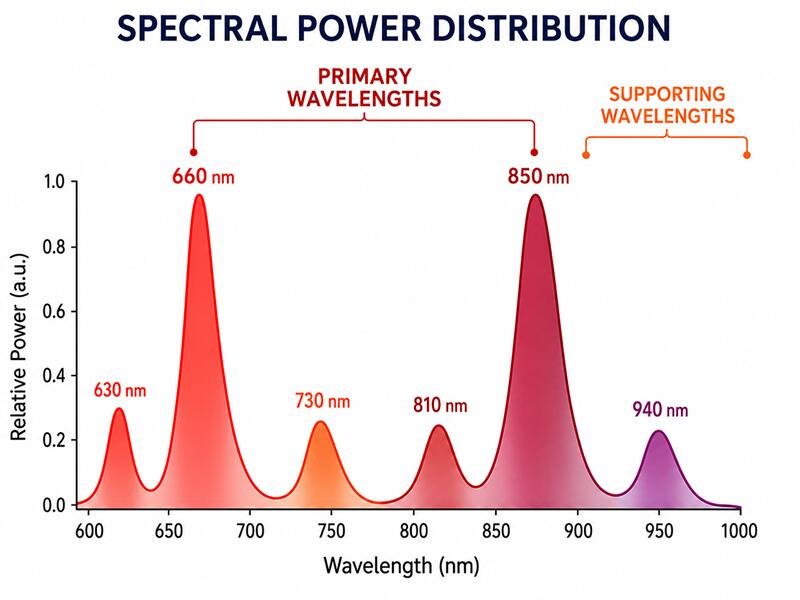
Illustrative SPD showing dual-peak emission from a 660 nm / 850 nm LED array. Note the spectral spread around each peak and the relative power ratio between the two channels.
Several factors influence the SPD of a finished device relative to the component LED spec:
- Drive current: Higher drive currents shift the peak wavelength slightly and broaden the spectral width. A 660 nm LED driven at 350 mA may peak at 663-665 nm.
- Junction temperature: As LEDs heat up during operation, their peak wavelength red-shifts by approximately 0.1-0.2 nm per degree Celsius. A device without adequate thermal management may drift 5-10 nm from its rated wavelength during a treatment session.
- Optical diffusers and lenses: Some devices use secondary optics that selectively attenuate certain wavelengths, altering the effective SPD at the treatment surface.
- LED binning tolerance: Component-level wavelength bins typically have a ±5 nm tolerance. A batch of “850 nm” LEDs may contain units ranging from 845 nm to 855 nm.
For these reasons, SPD measurement must be performed on the fully assembled, thermally stabilized device — not inferred from LED component datasheets alone.
Irradiance, Distance, and Dose
Even a device with an ideal wavelength distribution will underperform if irradiance — the power delivered per unit area — is insufficient at the treatment distance. Irradiance is measured in milliwatts per square centimeter (mW/cm²) and is the primary determinant of treatment time and dose.
The Inverse Square Law
Light intensity decreases with the square of the distance from the source. Doubling the treatment distance reduces irradiance to approximately one-quarter of its value at the original distance. This has direct implications for device positioning protocols and the accuracy of manufacturer-stated irradiance figures.
Many devices report irradiance at 6 inches (15 cm) or 12 inches (30 cm). Buyers should confirm at which distance irradiance is measured, and whether that distance is clinically practical for the intended application.
Calculating Treatment Dose
Dose (also called fluence) is calculated as:
Most photobiomodulation research uses doses in the range of 1-20 J/cm² for superficial applications and up to 60 J/cm² for deep tissue targets. A device with 100 mW/cm² irradiance at the treatment surface requires 10 minutes to deliver 60 J/cm². The same dose from a device with 50 mW/cm² requires 20 minutes.
| Irradiance at Surface | Time for 10 J/cm² | Time for 40 J/cm² |
|---|---|---|
| 30 mW/cm² | ~5.5 min | ~22 min |
| 60 mW/cm² | ~2.8 min | ~11 min |
| 100 mW/cm² | ~1.7 min | ~6.7 min |
| 150 mW/cm² | ~1.1 min | ~4.4 min |
For commercial applications such as MedSpas and clinics, higher irradiance reduces treatment time per client, directly impacting throughput and revenue per device. However, irradiance must be balanced against thermal safety — excessively high power densities at close range can cause tissue heating and patient discomfort.
Why Finished-Device Testing Matters
The gap between component-level specifications and finished-device performance is one of the most significant quality risks in the light therapy manufacturing industry. A device assembled from high-quality LEDs can still underperform if thermal management, electrical design, or optical configuration introduces inefficiencies.
Common Discrepancies Between Spec and Reality
- Wavelength drift under thermal load: Without proper heat sinking, LEDs operating at elevated temperatures will shift their emission peak by 5-15 nm, potentially moving outside the therapeutic window.
- Power supply regulation: Unstable drive currents cause fluctuating irradiance. A device that measures 120 mW/cm² at startup may drop to 85 mW/cm² after 10 minutes of operation.
- Beam uniformity: Poorly designed LED arrays create hot spots and dead zones. A panel may report a high average irradiance while delivering insufficient dose to portions of the treatment area.
- Lens and diffuser losses: Secondary optics can reduce total output by 10-30% while altering the effective SPD, particularly if the optical coating is not wavelength-neutral.
Testing Standards to Request
For OEM buyers and brand owners sourcing devices, the following tests should be performed or documented on the finished device:
- Spectroradiometric measurement of SPD at rated treatment distance, thermally stabilized
- Irradiance mapping across the full treatment area (beam uniformity report)
- Irradiance stability over a 20-minute continuous operation cycle
- Peak wavelength verification within ±5 nm of rated value
- CE and/or FCC electromagnetic compatibility testing
At MedLight, finished-device testing is a standard part of the production QC process. Each production batch undergoes spectral verification and irradiance measurement before shipping, with test reports available to OEM clients as part of the product documentation package.
Configuring a Spectrum for Different Applications
One of the primary advantages of OEM manufacturing is the ability to configure the spectral output of a device to match its intended clinical application. Rather than applying a generic “red + NIR” configuration to every product, a well-engineered device aligns its wavelength mix, LED ratio, and power density to the specific biological targets of its market.

Facial Rejuvenation & Skin Care
Primary wavelengths: 630 nm, 660 nm
Shallow penetration targets epidermal collagen synthesis, acne-causing bacteria, and surface pigmentation. High LED density over a contoured mask form factor. Lower irradiance (30-60 mW/cm²) for extended wear comfort.

Muscle Recovery & Sports Performance
Primary wavelengths: 810 nm, 850 nm
Deep NIR penetration targets muscle fiber repair, mitochondrial ATP production, and lactate clearance. Full-body panel format with high irradiance (80-150 mW/cm²) at 6-12 inch treatment distance.
Pain Management & Rehabilitation
Primary wavelengths: 660 nm, 850 nm, 940 nm
Combination of red and deep NIR targets both inflammatory mediators in superficial tissue and pain signaling in deeper neural and joint structures. Wearable belt or targeted pad format for localized application.
Hair Growth Stimulation
Primary wavelengths: 650 nm, 670 nm
Targets dermal papilla cells in the follicular bulge at 2-5 mm depth. Low-level laser therapy (LLLT) protocols require precise dose control. Helmet or cap form factor with scalp-contact or near-contact delivery.
For OEM clients developing a product line, MedLight’s engineering team works through a structured application brief to define the optimal wavelength configuration, LED mix, drive parameters, and form factor before prototyping begins. This process reduces iteration cycles and ensures the finished device is aligned with its clinical positioning from the start.
Frequently Asked Questions
1. What is the most important wavelength in red light therapy?
There is no single “most important” wavelength — it depends entirely on the target tissue and clinical application. That said, 810 nm and 850 nm are the most extensively researched wavelengths for deep tissue applications, while 660 nm has the strongest evidence base for superficial skin treatments. The key is matching wavelength selection to the specific biological target, not selecting a wavelength based on marketing claims.
2. Is a device with more wavelengths always better?
No. More wavelengths are only beneficial if each wavelength contributes a meaningful irradiance at the treatment surface. Adding wavelengths that each represent less than 5% of total output dilutes the dose of the primary therapeutic wavelengths without adding proportional benefit. A well-configured two-wavelength device (e.g., 660 nm + 850 nm) will typically outperform a poorly configured five-wavelength device where the primary wavelengths are underpowered.
3. How do I verify that a device’s wavelength claims are accurate?
Request a spectroradiometric test report from the manufacturer, measured on the finished device at the stated treatment distance after thermal stabilization. This report should show the full SPD curve, peak wavelengths, FWHM values, and irradiance at each wavelength. LED component datasheets alone are insufficient — they reflect ideal component performance, not the actual output of the assembled device under real operating conditions.
4. What irradiance level should I look for in a professional device?
For professional and clinical use, a minimum of 60-80 mW/cm² at the intended treatment distance is generally recommended to deliver therapeutic doses within practical session times (10-20 minutes). High-performance panels for fitness and recovery applications often target 100-150 mW/cm² at 6 inches. Always confirm the measurement distance and whether the figure represents total irradiance or per-wavelength irradiance.
5. Can I customize the wavelength configuration for my OEM product?
Yes. MedLight’s OEM process includes a spectral configuration stage where the LED mix, wavelength ratios, and drive parameters are defined based on your application requirements. Whether you need a single-wavelength device for a specific clinical protocol or a multi-wavelength system for a broad wellness market, the configuration is engineered to match your product’s intended use and regulatory positioning.
6. Does wavelength shift during operation affect treatment outcomes?
Potentially yes. A thermal wavelength drift of 5-10 nm during a session can move emission outside the optimal absorption band for cytochrome c oxidase. For devices without active thermal management, this drift is most pronounced in compact, high-power configurations where heat dissipation is limited. Devices with adequate aluminum heat sinking and temperature-regulated drive circuits maintain more stable spectral output throughout a full treatment session.
7. What is the difference between red light therapy and low-level laser therapy (LLLT)?
Both fall under the umbrella of photobiomodulation (PBM) and operate on the same biological mechanisms. The primary difference is the light source: LLLT uses coherent laser diodes, while LED-based red light therapy uses non-coherent broadband emitters. Research comparing the two modalities at equivalent doses and wavelengths generally shows comparable biological effects, though lasers can achieve higher irradiance at a point source. LED arrays are preferred for large-area treatments due to their lower cost, safety profile, and scalability.
8. What is the minimum order quantity (MOQ) for OEM light therapy devices?
MOQ varies depending on the product category and level of customization. For standard OEM configurations with existing tooling, MOQ typically starts at 50-100 units per SKU. Custom ODM projects with new tooling, unique form factors, or proprietary PCB designs generally require a higher initial order to offset tooling and engineering costs. MedLight works with clients to structure phased production plans that align with launch volumes and scale as demand grows.
9. How long does it typically take to go from concept to first production sample?
For OEM projects based on existing platform designs with custom branding and minor configuration changes, the first sample can typically be delivered within 3-5 weeks. Full ODM projects involving new industrial design, custom tooling, and original PCB development generally require 8-14 weeks from finalized brief to first engineering sample. Timelines depend on the complexity of the design, component lead times, and the number of revision cycles required during prototyping. MedLight provides a project timeline at the start of each engagement so clients can plan their launch schedule accordingly.
10. What certifications can MedLight support for devices entering the US and European markets?
MedLight supports certification processes for both the US and European markets. For the US market, this includes FCC Part 15 electromagnetic compatibility testing and FDA 510(k) pre-submission support for devices positioned as medical devices. For European market entry, MedLight assists with CE marking under the relevant directives (MDR for medical devices, LVD and EMC for general wellness devices) and can coordinate with accredited notified bodies. Documentation packages including technical files, test reports, and declaration of conformity are prepared as part of the OEM deliverables.
Wavelengths are a little like ingredients in a recipe. Saying a device has 660nm, 850nm, or even five different wavelengths is only the beginning. What really matters is how much of each wavelength is delivered, how evenly the light reaches the treatment area, and whether the finished device performs the same way after ten or twenty minutes of real use.
In other words, a good red light therapy device is not built by collecting wavelength names like souvenirs from an airport shop. It is built through proper spectrum design, stable irradiance, thermal control, distance planning, and finished-device testing.
For brands, distributors, and product teams, this is where smart sourcing begins. Do not stop at “How many wavelengths does it have?” Ask about SPD reports, wavelength ratios, irradiance maps, beam uniformity, and application-based configuration.
If you are developing red light therapy panels, masks, wearables, or full-body systems, MedLight can help you design the right wavelength distribution for your market, application, and product positioning.
Because in light therapy, the details are not decoration. They are the performance.