The red light therapy market has grown dramatically over the past decade. What was once confined to clinical dermatology labs and sports medicine facilities is now widely available in consumer electronics, wellness centers, and professional clinics. With hundreds of devices on the market — from handheld wands to full-body pods — choosing the right one can feel overwhelming.
This guide cuts through the noise. Whether you are a brand owner sourcing products for your private label, a procurement manager evaluating OEM suppliers, or a wellness professional equipping a new clinic, you will find a structured, practical framework here to make a confident, informed decision.
💡 The single most important principle: The best red light therapy device is not the most expensive one — it is the one precisely matched to your application, your target user, and your operational context.
Know the Science Before You Choose
Red light therapy (RLT), also referred to as photobiomodulation (PBM) or low-level laser therapy (LLLT), works by delivering specific wavelengths of light to biological tissue. These wavelengths are absorbed by chromophores — primarily cytochrome c oxidase in the mitochondria — triggering a cascade of cellular responses that include increased ATP production, reduced oxidative stress, modulation of inflammation, and promotion of tissue repair.
The key therapeutic window spans two primary ranges:
- Red light (620-700 nm): Primarily absorbed in superficial tissue layers (skin, subcutaneous fat). Ideal for skin rejuvenation, wound healing, acne treatment, and collagen stimulation.
- Near-infrared light (800-1100 nm): Penetrates deeper into muscle, joint, and bone tissue. Best suited for muscle recovery, pain relief, joint inflammation, and neurological applications.
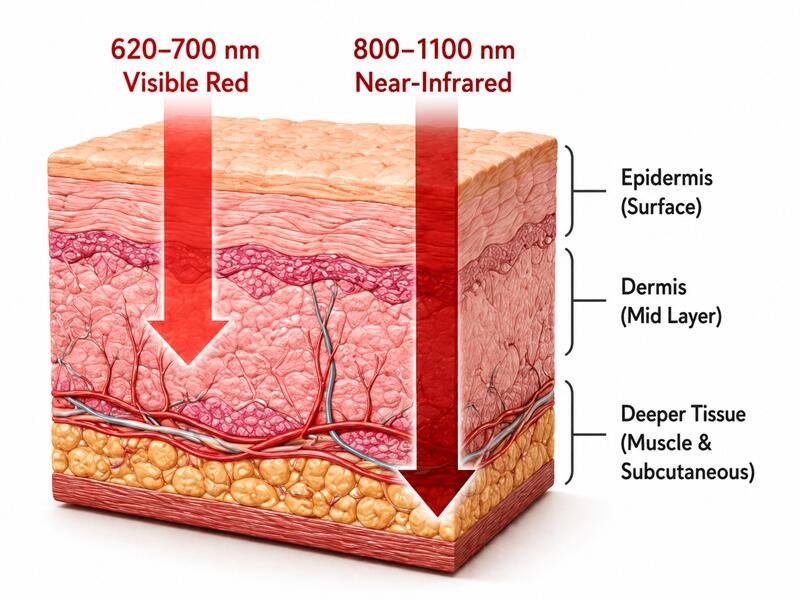
This difference is important. A device designed for facial skincare uses different settings and design priorities than one made for post-exercise muscle recovery. If the two are confused, the results may be limited, and the wrong device may be selected.
Define Your Application First
Before evaluating any device specification, clearly define the intended application. This single step eliminates the majority of unsuitable options and dramatically narrows your decision space.
Common Application Categories
| Application | Target Tissue Depth | Recommended Wavelengths | Typical Device Form Factor |
|---|---|---|---|
| Facial skincare & anti-aging | Superficial (1-3 mm) | 630-660 nm red | Masks, panels, wands |
| Muscle recovery & sports | Deep (5-20 mm) | 810-850 nm NIR | Full-body panels, pads, beds |
| Pain & joint relief | Deep (10-40 mm) | 830-880 nm NIR | Targeted panels, wearable wraps |
| Hair growth | Scalp / follicle (2-5 mm) | 650-670 nm red | Helmets, caps, handheld combs |
| Fat reduction & body contouring | Subcutaneous (5-15 mm) | 635-660 nm red + NIR | Full-body pods, wrap pads |
| Pet therapy | Varies by animal/condition | 630-850 nm | Handheld, wearable, mats |
Once you have identified your primary application, you can evaluate devices against a defined set of technical requirements rather than relying on marketing claims.
Key Technical Specifications to Evaluate
The specification sheet is where serious buyers separate credible manufacturers from those selling on aesthetics alone. Here are the critical parameters to scrutinize:
1. Wavelength Accuracy
Wavelength is the single most important parameter. A device marketed as “660 nm red” should deliver light within ±10 nm of that target. Variance beyond this range may shift the therapeutic effect significantly. Always request spectral data or third-party wavelength verification from the manufacturer.
Be particularly cautious of devices that list wavelengths as broad ranges (e.g., “600-900 nm”) without specifying the actual emission peaks. This is often a sign that the LEDs are low-grade or untested.
2. Irradiance (Power Density)
Irradiance, measured in milliwatts per square centimeter (mW/cm²), describes how much light energy is delivered to the tissue surface per unit area. This is arguably the most clinically meaningful specification.
- Minimum effective threshold: Most research indicates that ≥20 mW/cm² is needed for meaningful photobiomodulation at the tissue level.
- Practical clinical range: 50-200 mW/cm² at the recommended treatment distance.
- Measurement distance matters: Always verify at what distance the irradiance is measured. A device claiming 200 mW/cm² at 1 cm but only 20 mW/cm² at 15 cm is far less useful than one delivering 80 mW/cm² at 15 cm.
⚠️ Watch out for: Manufacturers who quote peak LED wattage instead of measured irradiance. A 1000W panel does not automatically deliver 200 mW/cm² — the LED array density, optics, and thermal management all affect real-world output.
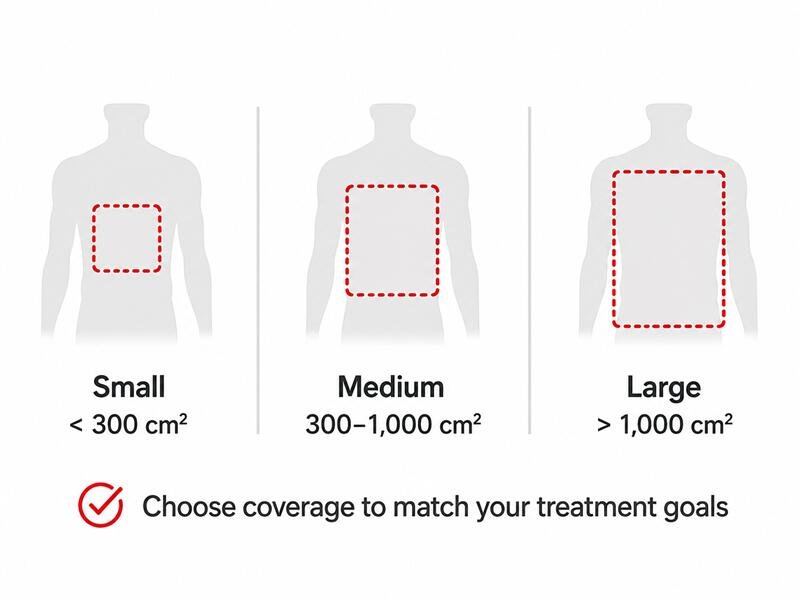
3. Treatment Area Coverage
Match the device’s effective treatment area to your use case. A facial mask needs only to cover the face (approximately 300-500 cm²), while a full-body panel must cover 10,000-20,000 cm² or more for systemic protocols. Larger coverage areas are especially important for:
- Wellness centers and spas offering full-body treatments
- Sports recovery clinics targeting large muscle groups
- Sauna and pod-style immersive sessions
4. LED Count, Type, and Array Density
The number and quality of LEDs directly affect both irradiance and treatment area uniformity. Higher LED density generally means more even light distribution across the treatment surface, reducing “hot spots” and ensuring consistent dosing.
Look for devices using medical-grade or high-power LEDs (typically 3W or 5W per chip) from reputable manufacturers. Ask for LED source documentation — credible OEM manufacturers will readily provide this.
5. Dual-Chip vs. Single-Chip LEDs
Many modern panels use dual-chip LEDs that emit both red and NIR wavelengths from a single diode. This allows for simultaneous multi-wavelength delivery, which is advantageous for applications requiring both superficial and deep tissue effects. However, dual-chip designs must be evaluated carefully — confirm the actual emission ratio and that both wavelengths are operating at therapeutic irradiance levels.
Matching Device Form Factor to Your Setting
Form factor is not merely an aesthetic choice — it determines treatment protocol, patient compliance, operational throughput, and total cost of ownership. Here is a breakdown of the major categories:
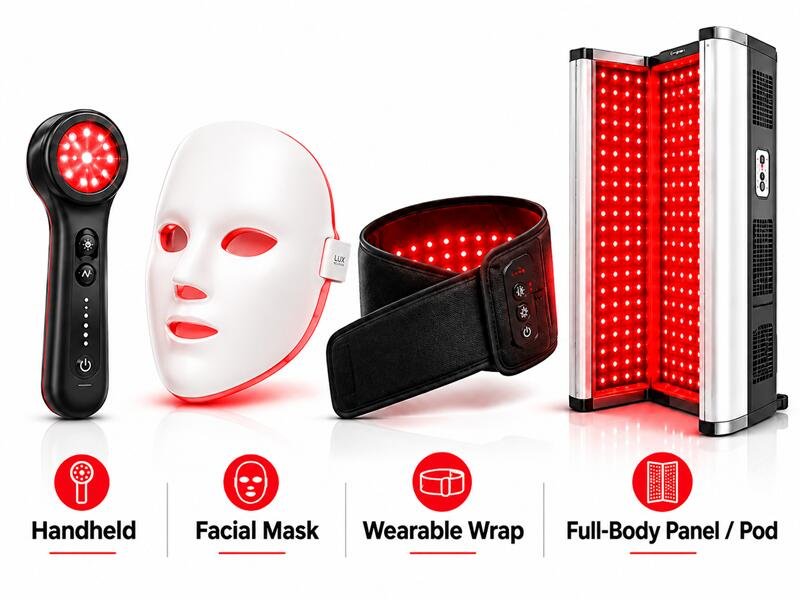
Handheld & Portable Devices
Best suited for targeted, localized treatment of small areas: joints, wounds, acne spots, or specific muscle groups. Portable devices are ideal for home use, mobile therapists, and travel. Their limitations include small treatment area, operator-dependent positioning, and lower total irradiance compared to larger panels.
Panel Devices (Wall-Mount & Freestanding)
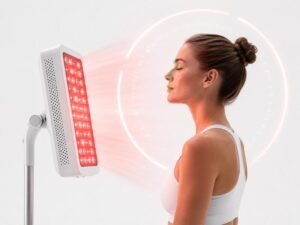
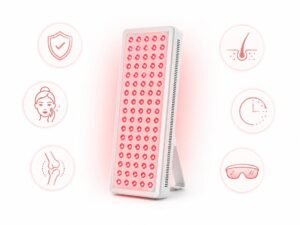
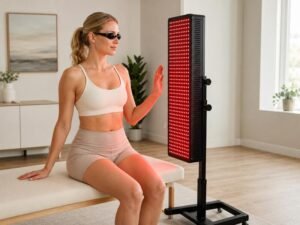
The most versatile category for professional settings. Panels range from compact units (e.g., 180-LED targeted panels) to large full-body arrays. They can be wall-mounted in treatment rooms or used freestanding. Key advantages include consistent, hands-free treatment delivery and the ability to treat large body areas simultaneously.
Wearable & Flexible Devices
Wearable pads, belts, and wraps deliver light therapy directly to the skin surface, eliminating the distance variable and enabling treatment during movement or rest. Ideal for pain management, joint therapy, and targeted recovery. The challenge is ensuring adequate irradiance through flexible substrates and maintaining consistent contact across body contours.
Full-Body Systems (Pods & Beds)
Designed for immersive, whole-body photobiomodulation sessions. These systems are the premium tier of the market, used in high-end spas, sports recovery centers, and medical wellness clinics. They offer the highest throughput for commercial operations and the most comprehensive systemic treatment. Investment cost and space requirements are significant, but so is the differentiation they provide.
Facial Masks
Purpose-built for facial skincare protocols. Available in both wired (higher power, clinic-grade) and wireless (consumer-friendly) configurations. Clinic-grade wired masks deliver higher irradiance and are better suited for professional treatment protocols, while wireless masks prioritize convenience and compliance for home use programs.
How to Evaluate a Manufacturer or Supplier
For brand owners and procurement managers, the manufacturer relationship is as important as the product specification. Here is a structured framework for supplier evaluation:
1. Certifications and Compliance
Regulatory compliance is non-negotiable for commercial products. Verify that the manufacturer can provide:
- CE marking (required for EU market access)
- FCC certification (required for US market access)
- ISO 13485 (medical device quality management — a strong indicator of process maturity)
- FDA 510(k) or registration support (for medical device classification in the US)
- RoHS compliance (restriction of hazardous substances)
Ask for copies of actual certificates, not just logos on a website. Verify certificate numbers with the issuing body when possible.
2. OEM and ODM Capability
Understand the difference between OEM (Original Equipment Manufacturer, where you brand an existing design) and ODM (Original Design Manufacturer, where the supplier develops a custom design to your specifications). Both models have their place:
- OEM is faster to market and lower risk, ideal for testing a new product line or entering a new segment.
- ODM enables true product differentiation and IP ownership, but requires more upfront investment in development time and tooling costs.
A capable manufacturer should offer both paths and guide you toward the right model based on your volume, timeline, and differentiation goals.
3. Minimum Order Quantities and Scalability
Understand MOQ requirements at both prototype and production stages. A good manufacturing partner will accommodate small initial runs for market validation, with clear pricing tiers as volume scales. Be wary of suppliers who demand large MOQs before any product validation has occurred.
4. Quality Control Processes
Ask specifically about incoming material inspection, in-line quality checks during production, and final product testing protocols. Request sample QC reports or test data from previous production runs. Consistent product performance over time depends entirely on the rigor of these processes.
5. After-Sales and Technical Support
For commercial buyers, after-sales support is a critical but often overlooked factor. Evaluate:
- Warranty terms and what is covered
- Availability of replacement parts and components
- Technical documentation quality (user manuals, service guides)
- Responsiveness of the technical support team
Dosing, Protocols, and Treatment Time
Even the best device will underperform if used incorrectly. Dosing in photobiomodulation follows a biphasic dose-response curve — too little light has no effect, the right amount produces the desired therapeutic outcome, and too much can actually inhibit the response. This is known as the Arndt-Schulz law applied to photobiology.
Key Dosing Variables
- Irradiance (mW/cm²): Power density at the tissue surface
- Treatment duration (seconds/minutes): How long the session lasts
- Energy dose (J/cm²): The product of irradiance × time. This is the primary therapeutic variable.
- Treatment frequency: How often sessions are conducted (typically daily to 3× per week)
- Distance from device to skin: Directly affects irradiance received
Most clinical research protocols use energy doses in the range of 4-60 J/cm² depending on the application and tissue target. Devices should come with clear protocol guidance, and manufacturers should be able to provide dosing calculations based on their device’s measured irradiance.
📋 Practical tip: When evaluating a device, ask the manufacturer to provide a sample treatment protocol for your specific application, including recommended distance, session duration, and frequency. Their ability to answer this question accurately tells you a great deal about their technical depth.
What To Avoid
The red light therapy market has a significant number of low-quality products and misleading claims. Here are the most common warning signs:
- No irradiance data provided. Any credible manufacturer should provide irradiance measurements at multiple distances, ideally verified by a third party.
- Wavelength claims without spectral documentation. Wavelength is easy to claim and difficult to verify without proper testing. Request spectrophotometer data.
- Exaggerated wattage claims. “3000W equivalent” panels often refer to the theoretical maximum draw of all LEDs at full capacity, not actual optical output. Ask for measured optical power, not electrical input wattage.
- No certifications or unverifiable certificates. Especially important for any product sold in regulated markets.
- Unrealistic medical claims. Devices that claim to cure diseases or guarantee specific medical outcomes are almost certainly overstating their capabilities and may be in violation of regulatory guidelines.
- No return policy or warranty. Legitimate manufacturers stand behind their products.
- Pressure to buy before testing. Reputable suppliers will offer samples or demonstration units for evaluation.
The Real Cost Beyond the Purchase Price
For commercial buyers, the purchase price of a red light therapy device is only one component of its true cost. A comprehensive evaluation should include:
Operational Costs
- Energy consumption: Full-body systems can draw 500-2000W. Calculate annual electricity costs based on your expected usage volume.
- Consumables: Some devices require replacement components (bulbs in older systems, flexible pad replacements for wearables).
- Maintenance: LED panels generally require minimal maintenance, but cooling fans and control electronics may need periodic servicing.
Revenue Potential
For clinic and spa operators, calculate the revenue per session, sessions per day, and device utilization rate to determine payback period. A high-quality full-body system that enables premium pricing and high client retention will have a far better ROI than a cheaper device that underperforms and generates refund requests.
Brand and Liability Risk
For brand owners, the hidden cost of a poorly manufactured device includes returns, warranty claims, negative reviews, and potential regulatory action. Investing in a properly certified, well-manufactured device from a reputable OEM partner is risk mitigation, not just a quality choice.
Questions to Ask Before You Buy
Use this checklist when evaluating any red light therapy device or manufacturer:
- What are the exact emission wavelengths, and can you provide spectral data?
- What is the measured irradiance (mW/cm²) at 5 cm, 10 cm, and 15 cm from the device surface?
- What certifications does the device hold, and can I verify them?
- What is the rated LED lifespan, and how does irradiance degrade over that lifespan?
- What treatment protocols do you recommend for my specific application?
- What is the warranty, and what does it cover?
- Do you offer OEM/ODM customization, and what are the MOQ requirements?
- Can I receive a sample unit for evaluation before placing a production order?
- What quality control documentation can you provide from the production line?
- How do you support compliance with FDA, CE, or other market-specific regulations?
Summary: A Decision Framework
Choosing the right red light therapy device is a structured decision, not an intuitive one. Follow this sequence:
Define Application
Identify the target tissue, therapeutic goal, and user context before evaluating any device.
Verify Specifications
Demand irradiance data, wavelength documentation, and LED specifications — not just marketing claims.
Evaluate the Manufacturer
Check certifications, QC processes, OEM/ODM capability, and after-sales support depth.
Calculate Total Cost
Factor in operational costs, revenue potential, and brand/liability risk — not just purchase price.
Test Before You Scale
Request samples or pilot units. Validate performance, user experience, and protocol outcomes before committing to production volume.
Choosing a red light therapy device should not feel like buying a mystery box with LEDs inside.
The best device is not always the biggest panel, the highest wattage, or the one with the most impressive product photo. It is the one that fits your application, delivers verified wavelengths and irradiance, comes with clear protocols, and is built by a manufacturer who can actually answer technical questions without hiding behind marketing words.
So before you buy, slow down a little. Ask for spectral data. Check irradiance at real treatment distances. Review certifications. Confirm warranty terms. Test a sample before scaling. Your future customers, your after-sales team, and probably your inbox will thank you later.
For brands, clinics, wellness centers, and distributors, the right red light therapy device is not just a product choice. It is a long-term business decision.
If you are evaluating panels, masks, wearable devices, full-body systems, or custom OEM/ODM projects, MedLight can help you compare options, review specifications, and build a device line that makes sense for your market.
Because choosing better now is much cheaper than explaining problems later.