Imagine 750 million people walking around with a private concert they never asked for — a relentless symphony of ringing, buzzing, and hissing that no one else can hear. That’s tinnitus. And no, turning down the volume isn’t an option, because the DJ lives inside their head. Conventional medicine’s best response has essentially been, “Have you tried… ignoring it?” Patients deserve better. So do the brands smart enough to serve them.
Enter red light therapy — the wellness world’s quietly overachieving multitasker. It’s already turning heads in pain relief, skin rejuvenation, and muscle recovery. Now researchers are pointing those photons toward ears, cochleae, and auditory nerves, asking a genuinely exciting question: can light actually quiet the noise? The early science says possibly yes, the market says definitely interested, and your competitors haven’t figured this out yet.
This guide is your unfair advantage. Whether you’re a brand owner building a product line, a distributor hunting for the next breakout category, or a procurement manager tired of sourcing the same panels everyone else sells — you’re in the right place. Let’s break down the biology, the business case, and everything in between.
What Is Tinnitus — and Why It Matters for Your Market
Tinnitus is the perception of sound — most commonly a ringing, buzzing, hissing, or clicking — without an external acoustic source. It affects an estimated 750 million people worldwide, according to the World Health Organization, making it one of the most prevalent sensory disorders globally.
For brand owners and distributors in the wellness, medical aesthetics, and rehabilitation space, this represents a massive underserved market. Tinnitus sufferers are actively seeking non-pharmacological, non-invasive solutions. Conventional medicine offers limited relief — sound masking, cognitive behavioral therapy, and hearing aids are the primary options — leaving a significant gap that wellness technology can address.
Key demographics experiencing tinnitus include:
- Adults over 50 (highest prevalence group)
- Veterans and military personnel (noise-induced hearing damage)
- Musicians and audio professionals
- Post-COVID patients (tinnitus is a documented long-COVID symptom)
- Fitness and sports recovery clients (high-decibel environments)
These demographics align closely with the customer bases of wellness centers, spas, rehabilitation clinics, and fitness recovery facilities — exactly the channels where your products land.
What Is Red Light Therapy and How Does It Work?
Red light therapy (RLT), also known as photobiomodulation (PBM) or low-level laser/light therapy (LLLT), uses specific wavelengths of light — typically in the 630-700 nm (red) and 800-1100 nm (near-infrared) ranges — to stimulate biological processes at the cellular level.
The primary mechanism involves the absorption of photons by cytochrome c oxidase, a mitochondrial enzyme. This triggers a cascade of cellular responses:
ATP Production
Increased cellular energy supports tissue repair, nerve function, and metabolic activity.
Reduced Inflammation
Modulation of inflammatory cytokines reduces chronic inflammation in tissues.
Improved Circulation
Enhanced microcirculation delivers more oxygen and nutrients to damaged tissues.
Neuroprotection
Protective effects on neurons may support auditory nerve health and function.
These mechanisms are well-documented across dozens of applications — pain relief, muscle recovery, skin rejuvenation, and hair growth — and are now being studied in the context of auditory health and tinnitus management.
The Science: What Research Says About RLT and Tinnitus
As a buyer making sourcing decisions, you need an honest read of the evidence. Here is a balanced summary:
Supportive Evidence
Animal Studies (Cochlear Protection)
Multiple animal studies have demonstrated that near-infrared light applied to the cochlea (inner ear) can reduce noise-induced hearing loss and protect hair cells from damage. A 2012 study published in Photomedicine and Laser Surgery showed significant protection of cochlear hair cells in guinea pigs exposed to noise trauma when treated with 808 nm NIR light.
Human Clinical Observations
A clinical study by Wilden and Ellerbrock (1998) reported improvements in tinnitus, hearing loss, and ear noise in patients treated with low-level laser therapy applied near the ear canal. While the study design had limitations, patient-reported outcomes were notable.
Transcranial Photobiomodulation
Emerging research on transcranial PBM — applying NIR light through the skull to reach brain tissue — shows effects on auditory cortex activity, which may be relevant for central tinnitus (tinnitus originating in the brain rather than the ear).
Inflammation and Vascular Mechanisms
For tinnitus caused by inflammation or poor cochlear blood flow, RLT’s established anti-inflammatory and vasodilatory effects provide a plausible therapeutic pathway supported by broader PBM literature.
Limitations and Honest Caveats
- Limited large-scale RCTs: The majority of human studies are small, lack control groups, or rely on self-reported outcomes. Large, double-blind randomized controlled trials are still lacking.
- Heterogeneous tinnitus causes: Tinnitus has multiple etiologies (noise damage, vascular, neurological, drug-induced). RLT may work better for some causes than others.
- Inconsistent protocols: Studies vary widely in wavelength, power density, treatment duration, and application site, making direct comparisons difficult.
- No FDA-cleared tinnitus indication: No red light therapy device is currently FDA-cleared specifically for tinnitus treatment in the United States.
Bottom line for buyers: The evidence is promising and growing, but not yet definitive by pharmaceutical-grade standards. This positions RLT for tinnitus firmly in the wellness and supportive care category — appropriate for clinics, spas, and wellness centers, with careful marketing language that avoids medical claims.
Proposed Biological Mechanisms: Why RLT Might Help Tinnitus
Understanding the biological rationale helps you communicate product value to your downstream customers — clinic owners, wellness directors, and end consumers.
Cochlear Hair Cell Regeneration Support
Tinnitus is frequently associated with damage to cochlear hair cells from noise exposure or aging. NIR light’s ability to stimulate mitochondrial activity and reduce oxidative stress may support the survival and function of remaining hair cells, potentially reducing tinnitus signals generated by damaged auditory pathways.
Improved Cochlear Microcirculation
The cochlea is highly sensitive to blood flow changes. Vascular insufficiency is a known contributor to tinnitus. RLT’s vasodilatory effects — mediated through nitric oxide release — may improve cochlear perfusion, addressing a root cause in vascular-type tinnitus.
Reduction of Neuroinflammation
Chronic tinnitus often involves neuroinflammatory processes in the auditory cortex. Photobiomodulation has demonstrated anti-inflammatory effects on neural tissue, which may reduce the hyperactivity of auditory neurons that generates the phantom sound perception.
Modulation of Auditory Cortex Activity
Transcranial NIR application may directly influence auditory cortex excitability. For central tinnitus — where the problem lies in brain processing rather than the ear itself — this represents a distinct and potentially powerful mechanism.
Stress and Sleep Improvement (Indirect Pathway)
Tinnitus severity is strongly correlated with stress and sleep quality. RLT’s documented effects on cortisol reduction and sleep improvement may reduce tinnitus distress indirectly, even if the underlying sound perception is unchanged — a meaningful quality-of-life outcome for users.
Device Types Relevant to Tinnitus Applications
For procurement managers and brand owners, device selection is critical. Not all red light therapy devices are appropriate for tinnitus-adjacent applications. Here’s what to consider:
| Device Type | Wavelength | Application Method | Tinnitus Relevance |
|---|---|---|---|
| Handheld / Targeted Device | 630-850 nm | Applied near ear canal, mastoid bone, or temple | High |
| Ear Canal Insert / Intranasal | 630-810 nm | Inserted into ear canal or nasal passage for proximity to cochlea | High |
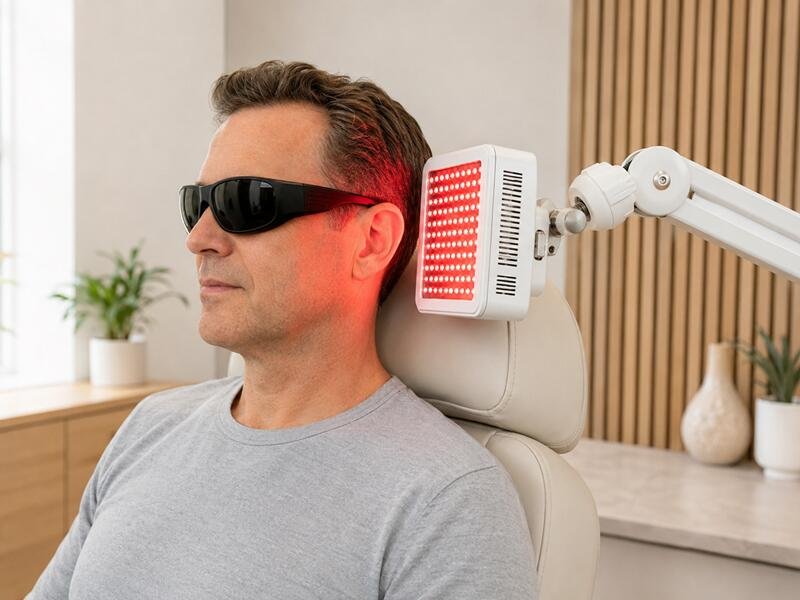
| Head / Helmet Device | 810-1064 nm NIR | Transcranial application targeting auditory cortex | High (central tinnitus) |
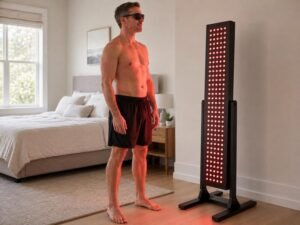
| Full-Body Panel | 660 nm + 850 nm | Systemic treatment for inflammation, stress, circulation | Moderate (indirect) |
| Wearable Belt / Wrap | 660-850 nm | Neck/cervical area for vascular support | Moderate |
Buyer Note: Wavelength Matters
For tinnitus applications, near-infrared wavelengths (810-850 nm) are generally preferred over visible red light because NIR penetrates deeper into tissue — reaching the cochlea and auditory nerve structures more effectively than 630-660 nm red light. Ensure your OEM supplier can configure devices with the appropriate wavelength range for this application.
Buyer Considerations: What to Evaluate Before Sourcing
Whether you’re a brand owner developing a tinnitus-specific product or a distributor adding RLT to your wellness catalog, these are the critical evaluation criteria:
Wavelength Configuration
Verify that the device outputs wavelengths in the 810-850 nm NIR range (for deep tissue penetration) or 630-660 nm red (for surface/vascular effects near the ear). Request spectral output data from the manufacturer.
Power Density (Irradiance)
Therapeutic photobiomodulation requires adequate irradiance (typically 10-100 mW/cm²) at the target tissue. Too low yields no effect; too high may cause thermal damage. Confirm mW/cm² at the treatment distance.
Application Design
For tinnitus, the device must be ergonomically designed to position LEDs accurately near the ear canal, mastoid process, or temple. Evaluate the physical design for user compliance and comfort during 10-20 minute sessions.
Clinical Protocol Support
Ask your OEM supplier whether they can provide suggested treatment protocols (session duration, frequency, course length) based on published PBM research. This supports your customers’ confidence and compliance.
Safety Profile
Red light therapy for tinnitus is generally considered safe when protocols are followed. Confirm that devices have appropriate eye safety measures (especially for devices near the face/head) and overheat protection.
OEM Customization Flexibility
Can the manufacturer adjust LED count, wavelength mix, power output, and form factor to match your brand positioning? Flexibility is essential if you’re targeting different customer segments (clinical vs. consumer).
Regulatory and Compliance Considerations
This is where many buyers get tripped up. Regulatory positioning directly affects how you can market the product, which channels you can sell into, and your liability exposure.
No RLT device is currently FDA-cleared specifically for tinnitus. Devices marketed for general wellness, relaxation, or as Class II medical devices for other cleared indications (e.g., pain relief) may be sold, but tinnitus-specific medical claims require FDA clearance.
Practical approach: Market as a wellness/relaxation device. Avoid claims like “treats tinnitus” or “cures ringing in ears.” Use language like “supports auditory wellness” or “promotes relaxation and stress relief.”
Under the EU Medical Device Regulation (MDR 2017/745), devices making therapeutic claims must be classified and certified accordingly. CE marking for wellness devices (Class I) is achievable, but medical claims elevate classification requirements.
Practical approach: Work with an OEM that has CE certification support. Confirm whether the device can achieve CE marking as a Class I wellness device or if higher classification is needed for your target claims.
Health Canada, the TGA (Australia), and various Asian regulatory bodies have their own classification frameworks. Engage your OEM supplier early about which certifications they can support for your target markets. A capable OEM partner should be able to assist with documentation for CE and FCC at minimum.
⚠️ Critical Compliance Note for Brand Owners
The single most common compliance mistake is making therapeutic claims on marketing materials without corresponding regulatory clearance. Work with your legal team and OEM supplier to define claim boundaries before launching any tinnitus-adjacent product. This protects your brand and your customers.
Market Opportunity for Brand Owners and Distributors
Beyond the science, let’s talk business. Here’s why tinnitus is a smart application to include in your RLT product strategy:
Channel Fit Analysis
Wellness Centers & Spas
High client interest in non-invasive therapies. Tinnitus treatment adds a differentiated service offering alongside existing RLT treatments.
Physical Therapy & Rehabilitation Clinics
Already using PBM for pain and recovery. Tinnitus protocols extend the device’s ROI and patient application scope.
Audiology & ENT Adjacent Practices
Growing interest in adjunctive therapies. RLT positions as a non-pharmacological complement to existing tinnitus management protocols.
Direct-to-Consumer (Online / DTC)
High search volume for tinnitus remedies. At-home RLT devices for tinnitus are an emerging DTC category with strong SEO and content marketing potential.
Veterans & Military Health Programs
Tinnitus is the #1 service-connected disability among U.S. veterans. Programs serving this demographic represent a significant institutional procurement opportunity.
Competitive Positioning Advantage
The tinnitus RLT market is still early-stage, with few established brands and limited consumer awareness. This creates a first-mover advantage for brands that invest in education-driven marketing, clinical partnerships, and well-designed products now — before the category becomes commoditized.
Brands that combine credible scientific communication, proper regulatory positioning, and quality OEM-manufactured devices will be well-positioned as mainstream adoption grows.
Frequently Asked Questions
How long does red light therapy take to show results for tinnitus?
Is red light therapy safe to use near the ear?
What wavelength is most effective for tinnitus?
Can I make tinnitus treatment claims when selling RLT devices?
What MOQ should I expect for a tinnitus-specific RLT device?
Does RLT work for all types of tinnitus?
How does red light therapy actually affect the inner ear in tinnitus?
Can red light therapy be combined with other tinnitus treatments?
What power density and dosage parameters should a tinnitus RLT device deliver?
What form factors are best suited for red light therapy targeting tinnitus?
Conclusion: Should You Add a Tinnitus RLT Product to Your Line?
The evidence for red light therapy in tinnitus is promising, biologically plausible, and supported by a growing body of research — even if large-scale clinical trials are still forthcoming. For brand owners and distributors in the wellness and medical aesthetics space, this represents a genuine market opportunity with favorable timing.
The key is to enter this category thoughtfully:
- Source devices with the right specifications — NIR wavelengths, adequate power density, appropriate form factor for ear-adjacent application.
- Position within wellness, not medicine — until regulatory clearance is obtained, maintain compliant marketing language.
- Educate your channel partners — provide clinical background, protocol guides, and customer-facing materials that build credibility.
- Work with a capable OEM partner — one that supports product development, certification, and scalable production as your brand grows.
The tinnitus market is large, underserved, and increasingly receptive to non-pharmacological solutions. Red light therapy, backed by credible science and delivered through well-manufactured devices, is positioned to become a meaningful part of this market. The brands that invest now will be the ones leading the category when mainstream adoption arrives.