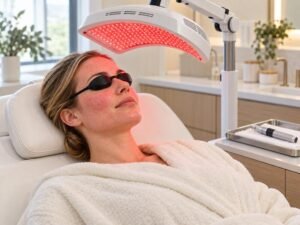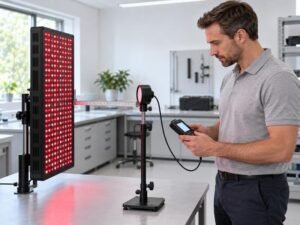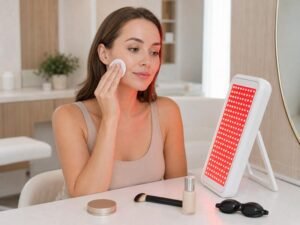
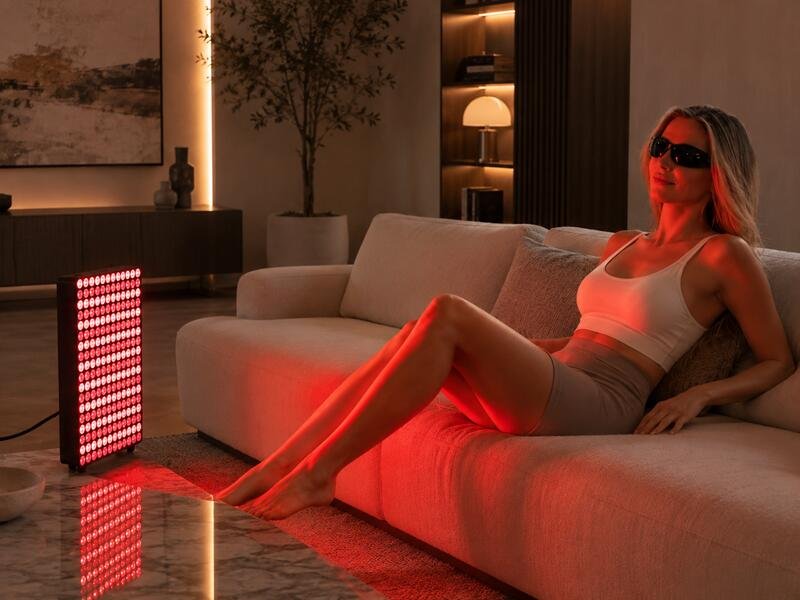
A red light therapy panel is easy to describe from the outside.
A metal body.
Rows of LEDs.
A control screen.
A power cable.
Maybe a stand, a remote, and a pair of goggles.
That is what people see first.
But anyone who has sourced, tested, or sold these devices knows one simple truth: a reliable red light therapy panel is not made by appearance alone. It is built through stable light output, proper electronic design, heat control, clear product positioning, careful testing, and consistent production.
In this industry, many products may look similar in photos. The real difference is often hidden inside the panel.
A bright panel is not always a good panel.
A high wattage number is not always a stable product.
A long LED list does not always mean better treatment experience.
So, what really makes a red light therapy panel reliable?
Let’s open the box, not with a screwdriver, but with a little manufacturing logic.
More Than Bright LEDs
Many buyers start by comparing LED quantity.
This is understandable. LED count is easy to see and easy to compare. A panel with 300 LEDs may sound stronger than one with 150 LEDs. A higher wattage number may also sound more attractive.
But red light therapy is not a simple brightness competition.
A good panel needs to deliver controlled red and near infrared light to the target area within a practical treatment time. This means the light should be stable, evenly distributed, and supported by proper electrical and thermal design.
Here are the key areas that should be checked:
| Area | Why It Matters |
|---|---|
| Wavelength | Decides the basic application direction |
| Irradiance | Shows light intensity at a certain distance |
| Treatment distance | Affects real user experience |
| LED driving method | Controls output stability |
| Cooling system | Protects LEDs and internal parts |
| Housing structure | Affects durability and heat release |
| Testing process | Confirms whether performance is repeatable |
| Packaging | Reduces transport damage |
Buyer Tip:
Do not judge a panel only by how bright it looks when turned on. Your eyes are not a testing instrument, although they may be very honest when the fan sounds like a small airplane.
A reliable red light therapy panel should perform well after 10 minutes, 20 minutes, and many repeated sessions, not only during the first 30 seconds of a product demo.
LED Is Not Laser
Red light therapy is sometimes confused with laser therapy because both use light. From a product and market point of view, they are quite different.
Red light therapy panels usually use LEDs. They emit non-coherent, broad-area light. This makes them suitable for larger treatment areas and easier daily operation.
Laser therapy uses coherent, focused light with much higher energy density. It is usually more targeted, more technical, and often requires stricter safety control and trained operation.
| Item | Red Light Therapy Panel | Laser Therapy Device |
|---|---|---|
| Light source | LEDs | Laser diodes |
| Light type | Broad-area light | Focused beam |
| Coverage | Larger surface area | Targeted point or area |
| Typical use | Wellness, recovery, beauty, general care | Professional or clinical settings |
| Design focus | Coverage, ease of use, stability | Precision, safety control, training |
| Market path | Easier to scale | More complex |
This difference matters.
A wellness product should not try to sound like a medical laser device just to appear more advanced. That may create confusion, compliance pressure, and unnecessary risk.
Clear positioning is always better.
Factory Note:
A red light therapy panel does not need to pretend to be a laser. It has its own value: broader coverage, easier operation, and better scalability for wellness, beauty, fitness, and recovery markets.
The Dose Window
Red light therapy is not simply “more light, better result.”
There is a useful dose range. Too little light may not deliver the expected effect. Too much light may reduce efficiency or create an uncomfortable experience. This is why session time, distance, and irradiance should work together.
For a panel, the dose is mainly affected by:
| Factor | Meaning |
|---|---|
| Irradiance | Light intensity reaching the body |
| Time | Length of each session |
| Distance | Space between panel and treatment area |
| Stability | Whether output stays consistent during use |
This is where many cheap or poorly designed panels struggle.
A product may show a strong irradiance number at the beginning, but if the output drops because of heat, the actual user experience changes. On the other hand, unstable current may push LEDs too hard, creating more heat and shortening product life.
A reliable panel should not only be powerful. It should be predictable.
Buyer Tip:
Ask how irradiance is measured, at what distance, and whether the device remains stable during continuous operation.
Peak data may sell the product once. Stable performance brings the customer back.
Constant Current Matters
One of the most important but often ignored parts of a red light therapy panel is the LED driving method.
LEDs are current-sensitive components. Their brightness is closely related to the current flowing through them. When current changes, light output changes too.
There are two common approaches:
| Driving Method | Main Feature | Practical Result |
|---|---|---|
| Constant Current | Keeps current stable | More stable light output |
| Constant Voltage | Keeps voltage stable | Current may change as LEDs heat up |
Constant current driving helps keep the LED current at a set level. This supports more stable brightness and more consistent irradiance during the session.
Constant voltage driving is less ideal for professional red light therapy panels. As LEDs heat up, their electrical behavior changes. If the circuit cannot control the current properly, the product may suffer from unstable light output, extra heat, faster LED aging, or reduced reliability.
In simple words, constant current is not just an electronic detail. It is part of dose control.
Quality Check:
If a panel claims high power but does not explain its driving design, the specification sheet is only telling half the story.
A good constant current design can support:
- More stable irradiance
- Longer LED life
- Better heat control
- More consistent user experience
- Lower after-sales risk
This feature is not as exciting as a shiny product photo, but it is the kind of detail that separates a serious panel from an ordinary one.
Wavelength And Irradiance
Most red light therapy panels use red light and near infrared light.
Common wavelengths include 660nm red light and 850nm near infrared light. Red light is often used for more surface-level applications, while near infrared light can reach deeper areas.
Some brands may choose other wavelength combinations to create a more differentiated product. That can be useful, but only when the product has a clear reason for it.
More wavelengths do not automatically mean a better device. The real question is whether the configuration supports the product’s intended use.
| Specification | What To Check |
|---|---|
| Wavelength | Is it suitable for the product position? |
| Irradiance | Is the data measured at a practical distance? |
| Beam angle | Is the coverage balanced? |
| LED layout | Is the light evenly distributed? |
| Session guide | Is the usage instruction clear? |
Irradiance is usually measured in mW/cm². It tells buyers how much light energy reaches a surface at a certain distance.
But the testing distance matters a lot.
A very high number measured extremely close to the panel may not reflect normal use. For product evaluation, data at practical distances is more useful.
Buyer Tip:
Ask for irradiance data at realistic distances, such as 15cm, 30cm, or the recommended working distance for that product.
Good data should help users understand the product. It should not be used only to decorate a sales page.
Heat Is The Quiet Test
Heat is one of the most honest tests for a red light therapy panel.
When the device is running, LEDs, power supplies, PCBs, control boards, and internal wiring all generate heat. If heat is not handled properly, many problems may appear.
- LED brightness may become unstable
- Internal components may age faster
- Fan noise may increase
- Housing temperature may become uncomfortable
- Product lifespan may be reduced
- After-sales complaints may rise
A reliable panel needs a complete heat dissipation design.
| Heat Control Area | Purpose |
|---|---|
| Aluminum housing | Helps release heat |
| Internal heat sink | Supports LED and PCB cooling |
| Fan system | Moves hot air away |
| Ventilation design | Improves airflow |
| PCB layout | Reduces heat concentration |
| Constant current driver | Helps avoid current-related heat issues |
Good cooling is not only about adding more fans. The fan position, air path, housing design, and internal layout must work together.
A fan that is too weak cannot protect the device.
A fan that is too loud may disturb the user.
A blocked airflow path makes even a good fan less useful.
Factory Note:
A panel should be tested after continuous operation, not only when it is freshly turned on and still feeling young and energetic.
For wellness centers, gyms, beauty salons, recovery studios, and frequent-use environments, heat control is especially important. A device may run several times a day. It needs to stay stable, not just survive one short test.
Design For Real Use
A reliable panel should match the way it will be used.
A small tabletop panel should be easy to move and simple to operate. A large full-body panel should have a stable structure and strong cooling. A panel used in a spa or wellness room should look clean, professional, and easy to maintain.
Different application scenes require different product priorities.
| Application | Product Focus |
|---|---|
| Home wellness | Compact size, simple control, quiet operation |
| Fitness recovery | Larger coverage, stronger output, durable structure |
| Beauty and spa | Clean appearance, comfortable experience, easy cleaning |
| Wellness center | Stable performance, professional design, easy setup |
| Private label | Logo, packaging, manual, and product positioning |
| Distribution | Consistent quality, safe packaging, clear specifications |
This is why product design should not begin only with a factory catalog.
The better question is:
Where will this product be used, and who will use it every day?
A panel for home use should not feel like complicated lab equipment. A panel for professional rooms should not feel like a fragile consumer gadget.
Buyer Tip:
Good product design feels natural. Users may not notice every detail, but they will quickly notice when something is awkward.
That includes button logic, screen brightness, cable position, fan noise, stand stability, and even how easy it is to put the product back into the carton.
Before You Place An Order
Before placing an order, it is wise to check more than price.
Price matters, of course. Everyone has a budget. But a very low price may become expensive later if the product creates complaints, returns, unstable performance, or brand damage.
Here is a practical checklist:
| Checkpoint | Key Question |
|---|---|
| Wavelength | Does the configuration fit the product purpose? |
| Irradiance | Is the data tested at a realistic distance? |
| Driving method | Does the panel use constant current design? |
| Heat control | Has continuous operation been tested? |
| Housing | Is the structure strong enough? |
| Control system | Is operation clear and simple? |
| Certifications | Are documents available for the target market? |
| Packaging | Is it safe for international shipping? |
| Consistency | Can the supplier repeat sample quality? |
| Customization | Can logo, manual, plug, carton, and specs be adjusted? |
A sample order should not only be used to check appearance.
It should be tested like a real product:
- Does it become too hot?
- Is the light distribution even?
- Is the fan noise acceptable?
- Is the screen easy to understand?
- Are accessories complete?
- Is the packaging strong enough?
- Does the manual make sense?
- Does the product feel ready for market?
Factory Note:
A sample is not a souvenir. Test it seriously. Put it on the table, turn it on, move it, pack it again, and imagine your customer using it.
That is often when the truth appears.
A Supplier Should Explain
A serious supplier should do more than send a price list.
They should be able to explain the product clearly.
For example:
- What LED driving method is used?
- How is irradiance tested?
- What is the recommended treatment distance?
- What heat control design is used?
- How long is the aging test?
- What certifications are available?
- Can the product support private label packaging?
- How is final inspection done?
- What can be customized?
- What should not be customized?
The last question is also important.
Not every customization is a good idea. Some changes may increase cost, delay production, reduce stability, or create compliance issues. A responsible supplier should not say yes to everything just to close an order.
Sometimes the best support is a professional “this may not be the best choice.”
That sentence may not sound exciting, but it can save a customer from real problems later.
Built For The Market
A reliable red light therapy panel is not created by one single feature.
It comes from many controlled details:
Stable wavelengths.
Practical irradiance.
Constant current driving.
Good heat dissipation.
Strong housing.
Clear operation.
Safe electrical design.
Consistent production.
Careful inspection.
Protective packaging.
When these details work together, the product becomes easier to sell, easier to explain, and easier to trust.
The red light therapy market is growing, but it is also getting crowded. Many panels look similar online. Customers may compare photos, prices, LED counts, and wattage numbers.
But after the product is delivered, the real test begins.
Does it work consistently?
Does it feel reliable?
Does it reduce complaints?
Does it support repeat orders?
Does it protect the brand behind it?
That is where product quality becomes more than a specification.
It becomes reputation.
A Small Word Before You Source
Choosing a red light therapy panel is a little like choosing a business partner.
A shiny appearance is nice.
A powerful first impression helps.
But long-term stability matters more.
The best panel is not always the one shouting the loudest on the specification sheet. Sometimes, it is the one quietly doing its job, session after session, without creating trouble.
And honestly, that is already a very attractive quality.
For anyone planning to develop, import, or launch red light therapy panels, take a closer look at what is inside the product. Ask about the driving circuit. Check the heat design. Review the test data. Open the carton. Read the manual. Listen to the fan. Touch the housing after 20 minutes.
If everything still feels right, you may have found a good panel.
And if not, well, better to find out before your customers do.