Red light therapy limitations matter whenever a buyer expects one wavelength, one impressive specification, or one study to guarantee commercial results. That expectation can lead to the wrong configuration, weak claims, returns, and compliance trouble. I prefer a less glamorous but more useful approach: define the task, verify dose delivery, and test the actual product.
Red light therapy cannot promise the same outcome for every user, application, or device. Results depend on the intended use, wavelength, irradiance, exposure time, coverage, treatment distance, product design, user behavior, production consistency, and relevant supporting evidence.1 Buyers should evaluate the complete product and protocol rather than rely on one attractive technical number.

I do not treat these limitations as proof that the technology lacks value. I treat them as boundaries around responsible product development. A wavelength label may begin the discussion, but it cannot finish it—rather like choosing a delivery truck based only on its paint color.
What Do Red Light Therapy Limitations Mean for Buyers?
Buyers often ask whether red light therapy “works” before defining what work means. That broad question creates a problem because skin-care positioning, muscle recovery, hair applications, and professional wellness services involve different products, protocols, evidence, and market rules.
Red light therapy limitations mean that no supplier should promise results without connecting the intended task to a defined device, dose, protocol, user population, and body of evidence. I recommend turning broad efficacy questions into measurable procurement questions about output, coverage, use conditions, testing, quality consistency, and permitted product claims.

I start with the intended task
During requirement discussions, I sometimes receive a specification that lists two wavelengths and then requests claims covering pain, skin appearance, hair, recovery, and body contouring. The specification may look complete because it includes numbers. In practice, it leaves the most important commercial questions unanswered.
I usually ask buyers to define:
- The target market: Which country or region will receive the product?
- The intended user: Will a consumer, clinic, MedSpa, or recovery operator use it?
- The intended application: Which body area and commercial use case matter?
- The product form: Will the device be a panel, mask, belt, mat, bed, cap, or handheld unit?
- The proposed claims: What will the packaging, website, manual, and sales team say?
- The use protocol: What distance, session time, and frequency will be recommended?
- The evidence plan: Which studies, product tests, or professional reviews support the positioning?
These questions reveal red light therapy limitations early, when design changes are still manageable.
I separate technical capability from promised outcome
A device can emit light at a specified wavelength without proving a particular health outcome. Likewise, an acceptable laboratory sample cannot establish that every production unit will perform identically.
| Procurement question | What it helps verify |
|---|---|
| What is the intended application? | Whether the product form and optical design fit the task |
| Where was irradiance measured? | Whether the headline output reflects actual use |
| What exposure time is proposed? | The estimated delivered energy |
| How uniform is the treatment area? | Whether coverage extends beyond a central hot spot |
| What evidence supports the claim? | Whether marketing exceeds the available support |
| How is output checked in production? | Whether batches can remain close to the approved sample |
I am a manufacturing and product-development practitioner, not a clinician. I therefore ask buyers to obtain qualified clinical, safety, and regulatory review for application-specific decisions. That boundary protects users and gives the brand a firmer commercial foundation.
Can Wavelength Alone Prove Device Fit?
A correct wavelength can create false confidence. Buyers may assume that two devices using nominally similar LEDs are interchangeable. However, weak coverage, unsuitable geometry, poor thermal management, or an unrealistic treatment distance can change the delivered exposure significantly.
No. Wavelength is an essential specification, but it cannot prove device suitability by itself. Buyers should also verify spectral measurement data, irradiance under stated conditions, treatment distance, exposure time, coverage, optical uniformity, product geometry, thermal behavior, controls, and the relationship between those factors and the intended use.

I treat wavelength as one part of a system
Nominal wavelength commonly refers to a peak value, such as 660 nm or 850 nm. However, LEDs emit across a spectral band rather than at one perfectly narrow line.2 Component tolerances, temperature, drive current, optical covers, and measurement equipment can affect recorded data.3
For procurement, I suggest requesting:
- A spectral test report for the proposed configuration
- The instrument model and calibration information
- The measurement position and operating mode
- The permitted wavelength tolerance
- Confirmation that production components match the approved bill of materials
- A change-control process for LED or driver substitutions
A supplier should not quietly substitute an emitter because the catalog description still says “red” or “near-infrared.”
I connect irradiance to time
A simple energy-density estimate is:
Dose in J/cm² = irradiance in W/cm² × exposure time in seconds4
For example, a measured average irradiance of 0.050 W/cm² over 300 seconds gives a calculated incident energy density of 15 J/cm² at that measurement point. This calculation does not prove a clinical result. It simply shows why wavelength alone cannot define exposure.
The calculation also requires care. A central reading does not describe the entire treatment area.5 A reading taken directly against the lens does not represent use at 15 or 30 centimetres.6 Pulsed output may require both peak and time-averaged values. Reflective surroundings, angle, body contours, and movement can also influence actual exposure.
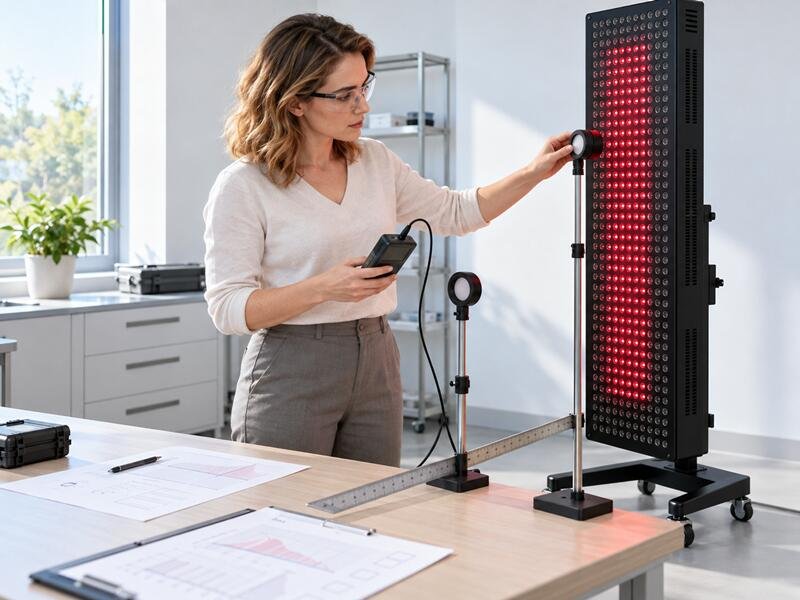
When I review prototypes, I prefer a measurement map across a stated grid rather than one maximum number. Red light therapy limitations become much easier to manage when buyers know what reaches the target area instead of what appears in the brightest spot.
Do Red Light Therapy Limitations Include Irradiance?
A large irradiance number looks impressive on a product page. It may also be measured at an unusually short distance, at one central point, or with an unsuitable method. Without context, the number can confuse procurement teams rather than help them.
Yes. Red light therapy limitations include the way irradiance is measured, reported, distributed, and maintained during use. Higher peak output is not automatically better.7 Buyers should compare average output, spatial uniformity, distance, measurement equipment, operating mode, exposure time, heat, comfort, and production tolerance.

I ask where the number came from
In one anonymized configuration discussion, a buyer requested that a new panel exceed a competitor’s advertised irradiance. The competitor did not state its distance or measurement method. Matching that number would therefore have meant chasing an unknown target.
I recommended defining the following conditions first:
- Measurement distance: At the surface, 5 cm, 15 cm, or the intended working distance
- Measurement grid: Centre only or multiple points across the active area
- Reported value: Peak, minimum, or area average
- Operating state: Continuous or pulsed mode
- Warm-up period: Immediate reading or thermally stabilised output
- Instrument: Calibrated spectroradiometer, optical power meter, or another suitable device
- Tolerance: The acceptable range for samples and production units
The buyer could then compare products on equivalent terms.
I do not assume that more is always better
Higher output can shorten the calculated exposure time, but it may introduce other design questions. The device may need improved heat dissipation, different spacing, additional user controls, or a longer working distance. A face mask and a full-body panel also create very different contact, comfort, geometry, and thermal conditions.
| Irradiance presentation | Buyer risk | Better request |
|---|---|---|
| Maximum value only | A hot spot may represent the full device | Request an area map and average |
| No stated distance | Products cannot be compared fairly | Specify the working distance |
| Peak pulsed value only | Average exposure may be unclear | Request peak and time-averaged output |
| Sample result only | Production variation remains unknown | Set batch acceptance limits |
| No instrument details | The method cannot be reviewed | Request equipment and calibration data |
These red light therapy limitations do not make irradiance irrelevant. They make measurement discipline essential. I would rather approve a realistic, repeatable specification than a spectacular number that disappears when the ruler comes out.
Can One Study Support Every Product Claim?
Research can become detached from the product it originally evaluated. A study may use a particular device, population, dose, treatment schedule, and outcome measure. A commercial team may then stretch that result across unrelated devices and applications.
No. Evidence for one application, population, protocol, or research device cannot automatically support every commercial red light therapy product.8 Buyers should compare the study’s wavelength, output, dose, treatment area, schedule, users, controls, and measured outcomes with the proposed device and claim.

I use an evidence-to-product comparison
I once reviewed a request that paired a small wearable prototype with broad claims drawn from studies involving different equipment and treatment protocols. The prototype could be tested and refined, but the documents did not establish that it reproduced those research conditions.
I use a simple comparison table during claim review:
| Evidence factor | Questions I ask |
|---|---|
| Device | Was the tested device equivalent to the commercial model? |
| Spectrum | Do the wavelengths and spectral ranges correspond? |
| Output | Was irradiance measured under comparable conditions? |
| Dose | Does the proposed protocol deliver a comparable exposure? |
| Treatment area | Does the product cover the same target area? |
| Population | Were the study participants relevant to the target users? |
| Outcome | Does the study measure the result used in marketing? |
| Schedule | Are session duration and frequency comparable? |
| Market | Do local rules permit the proposed wording? |
A “yes” in one row cannot compensate for unanswered questions in all the others.
I keep product categories separate
Pain-related positioning, cosmetic skin claims, hair applications, muscle recovery, and body-contouring claims should not share one evidence bucket merely because every device emits red or near-infrared light. Each intended use needs its own technical and claim review.
Red light therapy limitations also include the distinction between scientific discussion and legally permitted promotion. Classification and claim requirements can depend on the product, intended use, sales market, and wording.9 CE, FCC, FDA, ISO, or other references should never be treated as universal badges. Buyers should verify the document issuer, scope, model number, standards, dates, test reports, and current applicability with qualified specialists.
I can help align product specifications, prototypes, test documentation, and production controls. I cannot replace independent clinical judgment, laboratory testing, or market-specific regulatory advice.
How Do Use Conditions Affect Red Light Therapy Limitations?
A laboratory specification assumes defined conditions. Real users may stand farther away, shorten sessions, miss treatment areas, place a wearable incorrectly, or stop using an uncomfortable device. The technically available output and the practically delivered exposure can therefore differ.10
Use conditions shape red light therapy limitations because distance, angle, body contour, coverage, session time, frequency, fit, heat, controls, and user compliance influence exposure. Buyers should evaluate the complete use workflow and confirm that the proposed instructions are practical, testable, and compatible with the product design.

I evaluate the physical product, not only the LED list
Different formats solve different engineering problems:
- Panels require suitable working distance, stand stability, coverage, and uniformity.
- Masks require facial fit, eye-area design, comfort, cleaning, and controlled spacing.
- Belts and wraps require repeatable positioning, flexibility, skin contact decisions, and cable durability.
- Mats and beds require broad-area consistency, thermal control, loading considerations, and serviceability.
- Caps require internal geometry, fit variation, ventilation, and coverage mapping.
- Handheld devices require positioning guidance and manageable treatment time.
I have seen promising specifications become awkward prototypes because the requested LED count left too little space for heat management or because a wearable looked neat on a drawing but shifted during use. Prototyping exposed those problems before tooling and mass production.
I include usability in procurement testing
A buyer can add several practical checks to sample evaluation:
- Ask several representative users to fit or position the product.
- Record the actual treatment distance and covered area.
- Measure surface and enclosure temperatures under intended operation.
- Check whether timers, intensity levels, and controls reduce operating errors.
- Review cleaning instructions and material compatibility.
- Test cables, connectors, stands, straps, hinges, and moving parts.
- Confirm that the manual reflects the tested configuration.
- Have qualified professionals review safety and use instructions.
The final point matters. I do not recommend assuming that a device is “completely safe” because it uses LEDs or because a similar model has been sold elsewhere. Electrical, photobiological, thermal, material, and application-specific considerations need product-specific evaluation.11 Applicable standards and test plans should be confirmed for the target market.
Do Red Light Therapy Limitations Extend to Production?
An approved prototype can perform well, yet later units may vary if components, assembly, calibration, or inspection are not controlled. That gap creates one of the least visible red light therapy limitations until customers begin reporting inconsistent experiences.
Yes. Red light therapy limitations extend to production consistency. Buyers should verify whether wavelength, irradiance, uniformity, electrical performance, controls, thermal behaviour, appearance, and accessories remain within approved limits across batches. A clear specification, golden sample, inspection plan, test records, and change control can reduce variation.

I convert the sample into measurable requirements
The phrase “same as sample” is not a complete quality standard. Samples can age, become damaged, or leave room for subjective interpretation. I prefer to combine an approved sample with drawings, bills of materials, parameter ranges, workmanship criteria, packaging requirements, and test methods.
A production quality plan may include:
| Checkpoint | Example verification |
|---|---|
| Incoming LEDs | Part number, spectrum, appearance, supplier batch |
| Drivers and controls | Output mode, timer, dimming, firmware version |
| Optical assembly | LED placement, lens or cover condition, alignment |
| Output inspection | Defined points, distance, method, and tolerance |
| Thermal operation | Temperature checks under specified conditions |
| Electrical testing | Tests required by the design and target market |
| Mechanical inspection | Fasteners, stands, straps, connectors, enclosure |
| Packaging | Label, manual, accessories, protection, carton marks |
| Final records | Serial or batch traceability and inspection results |
The exact plan should reflect product risk, order size, application, and applicable requirements.
I insist on change control
A component substitution can alter output, heat, electromagnetic behaviour, reliability, or documentation. Even a visually similar LED may have a different spectral distribution or electrical characteristic. Buyers should therefore ask:
- Which changes require written approval?
- Will the supplier provide an updated sample?
- Which tests will be repeated?
- How will affected batches be identified?
- Will certificates and technical files still cover the revised model?
During production-quality follow-up, I have found that small documented controls often prevent large commercial arguments. A signed specification is not exciting, but neither is a container of products that no longer matches the approved unit.
Production control cannot promise identical outcomes for every end user. It can, however, provide evidence that production units consistently meet agreed technical and workmanship criteria. That is a realistic promise and a valuable one.
Frequently Asked Questions
1. Do red light therapy limitations mean the technology never works?
No. Red light therapy limitations mean that outcomes are conditional rather than automatic. The intended use, device design, delivered exposure, protocol, user population, and evidence all matter. Buyers should avoid both blanket rejection and blanket efficacy claims.
2. Is 660 nm or 850 nm enough to confirm product quality?
No. These nominal wavelengths do not confirm irradiance, uniformity, dose, thermal performance, electrical design, reliability, or production consistency. I recommend requesting spectral data, measurement conditions, output mapping, component controls, sample testing, and relevant compliance documents.
3. Is higher irradiance always better?
No. A higher peak reading may come from one central point or a very short distance. Buyers should compare average output, coverage, working distance, exposure time, operating mode, temperature, comfort, and measurement method before deciding which level suits the application.
4. Can a supplier guarantee user results?
A responsible supplier should not guarantee individual therapeutic or cosmetic results. A supplier can commit to agreed product specifications, manufacturing controls, inspection criteria, packaging, and documentation. Clinical outcomes require appropriate evidence and can still vary with users and usage conditions.
5. Can I use published studies in my marketing?
You should first confirm that the studies are relevant to your device, protocol, users, outcomes, and claims. You should also obtain market-specific legal or regulatory review. Publication alone does not automatically authorise a commercial claim.
6. How should I compare irradiance between suppliers?
You should request readings taken at the same distance, operating mode, warm-up condition, grid positions, and units. You should also ask for the instrument type, calibration status, area average, minimum and maximum values, and permitted production tolerance.
7. What documents should I verify before ordering?
I suggest verifying specifications, drawings, test reports, certificates, declarations, manuals, labels, bills of materials, quality plans, and inspection records. Buyers should confirm that names, model numbers, standards, dates, issuers, and scope match the actual product and target market.
8. Does a CE or FCC document prove treatment effectiveness?
No. Such documents do not automatically prove clinical effectiveness.12 Their relevance also depends on product scope, market, testing, and documentation. Buyers should verify each document and seek qualified advice about applicable safety, electromagnetic, medical-device, and market-entry requirements.
9. How can I check whether production matches the sample?
You can define a golden sample, measurable specifications, inspection methods, tolerances, component controls, and approval rules for changes. Pre-shipment inspection and batch test records can provide further evidence, although the inspection plan should reflect product and order risk.
10. When should I involve clinical or regulatory professionals?
I recommend involving them early, especially when defining intended use, user instructions, contraindication language, clinical claims, safety testing, or market classification. Early review usually costs less than redesigning packaging, documentation, and hardware after production has started.
Conclusion
Red light therapy limitations are not a verdict against the technology. They are a reminder that wavelength, output, dose, coverage, evidence, product design, real-world use, and batch consistency must work together. I recommend asking what was measured, where it was measured, how the device will be used, whether production matches the sample, and what evidence supports each claim.
If you are planning an OEM, ODM, or private-label product, MedLight can help you translate your market requirements into a prototype, test plan, production specification, and quality-control process. Sensible promises may sound less dazzling, but they tend to produce fewer returns—and far fewer uncomfortable Monday-morning emails.
Footnotes
"Review of light parameters and photobiomodulation efficacy", https://pmc.ncbi.nlm.nih.gov/articles/PMC8355782/. Reviews of photobiomodulation describe treatment response as dependent on interacting optical, dosimetric, anatomical, and protocol variables rather than on wavelength alone; however, the relative importance of each variable differs by indication and device. Evidence role: expert_consensus; source type: research. Supports: A review or consensus source should identify wavelength, irradiance, exposure duration, treatment geometry, protocol, and patient or user factors as relevant determinants of photobiomodulation outcomes.. Scope note: General reviews establish parameter dependence but do not prove the performance of any specific commercial device. ↩
"Overview of Excitation and Emission Fundamentals", https://micro.magnet.fsu.edu/primer/lightandcolor/fluoroexcitation.html. Semiconductor LEDs produce a spectral distribution with a measurable peak and bandwidth, rather than monochromatic emission at one exact wavelength. Evidence role: mechanism; source type: education. Supports: An optics or semiconductor source should explain that LED output is distributed over a wavelength band characterized by measures such as peak wavelength and spectral width.. ↩
"A Critical Review on the Junction Temperature Measurement ...", https://pmc.ncbi.nlm.nih.gov/articles/PMC9611508/. LED metrology guidance identifies junction temperature, electrical drive conditions, optical configuration, and instrument calibration or spectral response as sources of variation in measured optical output; the magnitude of each effect depends on the component and test setup. Evidence role: mechanism; source type: research. Supports: A metrology source should document how LED operating conditions, optical paths, and instrument characteristics influence measured spectrum or radiant output.. Scope note: The source would establish measurement sensitivity generally, not the uncertainty of an untested product report. ↩
"Traveling tunable laser projector for UV-blue disinfection ...", https://tsapps.nist.gov/publication/get_pdf.cfm?pub_id=933993. In radiometry, radiant exposure is the time integral of irradiance; for constant irradiance, it is calculated by multiplying irradiance by exposure duration. Evidence role: definition; source type: education. Supports: A radiometry or photomedicine source should define radiant exposure as the time integral of irradiance and show the constant-irradiance form of the equation.. ↩
"The dark art of light measurement: accurate radiometry for low ...", https://pmc.ncbi.nlm.nih.gov/articles/PMC4851696/. Spatial measurements of LED-array output show that irradiance can vary across the illuminated field, so a center-point reading does not by itself characterize area-average exposure or edge coverage; the degree of nonuniformity is device-specific. Evidence role: mechanism; source type: paper. Supports: A measurement study should show that LED arrays can produce spatially nonuniform irradiance and that center-point values may differ from area averages or peripheral values.. Scope note: Evidence from measured arrays supports the need for mapping but cannot determine the uniformity of a particular device without testing it. ↩
"Radiation and the Inverse Square Law", https://learn.k20center.ou.edu/lesson/1328. Optical measurements show that irradiance at a target changes with source-to-target distance and emitter geometry, making a lens-contact reading unsuitable as a substitute for output at the intended working distance; simple inverse-square behavior may not apply in the near field of an extended array. Evidence role: mechanism; source type: paper. Supports: An optical measurement source should demonstrate that irradiance and spatial distribution change with source-to-target distance, particularly for extended LED arrays.. Scope note: The direction of the effect is general, but its magnitude must be measured for the specific optical geometry. ↩
"Biphasic Dose Response in Low Level Light Therapy - PMC", https://pmc.ncbi.nlm.nih.gov/articles/PMC2790317/. Photobiomodulation literature reports biphasic dose-response patterns in which insufficient and excessive exposure may produce smaller effects than an intermediate range; however, the optimal range varies by tissue, endpoint, wavelength, and protocol. Evidence role: mechanism; source type: paper. Supports: A review should describe the biphasic dose response reported in photobiomodulation and explain why greater irradiance or radiant exposure does not invariably produce a greater biological effect.. Scope note: A general biphasic-dose model does not identify the ideal irradiance for a particular commercial application. ↩
"General/Specific Intended Use - Guidance for Industry", https://www.fda.gov/regulatory-information/search-fda-guidance-documents/generalspecific-intended-use-guidance-industry. Clinical research guidance treats generalizability as contingent on correspondence between the studied intervention, population, protocol, setting, and outcomes and those of the proposed use; accordingly, evidence from one photobiomodulation configuration is not direct proof for a materially different product. Evidence role: general_support; source type: research. Supports: A clinical-methodology source should explain that external validity depends on similarity between the studied intervention, population, setting, comparator, and outcome and the proposed use.. Scope note: External-validity principles establish the need for comparison but do not determine whether any particular product difference is clinically material. ↩
"General/Specific Intended Use - Guidance for Industry", https://www.fda.gov/regulatory-information/search-fda-guidance-documents/generalspecific-intended-use-guidance-industry. Regulatory authorities determine product obligations in part from intended use or intended purpose as expressed through labeling, instructions, and promotional claims, while classification rules and permitted wording differ across jurisdictions. Evidence role: general_support; source type: government. Supports: Official regulatory guidance should establish that intended use or intended purpose, including labeling and promotional claims, affects whether and how a product is regulated.. Scope note: General guidance cannot establish the classification or lawful claims of a specific device in every target market. ↩
"Photobiomodulation LED Devices for Home Use - PMC - NIH", https://pmc.ncbi.nlm.nih.gov/articles/PMC11853966/. Device-use and optical-dosimetry research indicates that source distance, angle, fit, coverage, session duration, and adherence can alter delivered exposure relative to nominal test conditions; the size of the discrepancy depends on the product and user behavior. Evidence role: mechanism; source type: paper. Supports: A usability or dosimetry study should show that treatment geometry and adherence influence the exposure actually received during real-world use.. Scope note: Evidence from other devices or use settings provides contextual support and does not quantify the gap for the product under review. ↩
"Laser Surgical Instrument - accessdata.fda.gov", https://www.accessdata.fda.gov/cdrh_docs/pdf18/K180900.pdf. International optical-radiation guidance and lamp-safety standards recognize potential retinal, blue-light, and thermal hazards from LED products and require assessment based on spectrum, radiance or irradiance, exposure duration, and viewing geometry; they do not imply that every red-light device presents the same level of risk. Evidence role: expert_consensus; source type: institution. Supports: An international safety standard or exposure guideline should identify photobiological hazards from lamp and LED systems and the need to assess exposure under defined product conditions.. Scope note: Optical-radiation guidance addresses only part of the broader product-safety assessment, which may also require electrical, thermal, biocompatibility, and use-specific testing. ↩
"Equipment Authorization – RF Device", https://www.fcc.gov/oet/ea/rfdevice. Official guidance describes CE marking as an assertion of conformity with applicable EU requirements and FCC equipment authorization as addressing radio-frequency compliance; neither designation, standing alone, constitutes clinical evidence that a light-therapy product produces a claimed health outcome. Evidence role: definition; source type: government. Supports: Official EU and FCC sources should define CE marking as a conformity mechanism and FCC equipment authorization as relating primarily to radio-frequency compliance, rather than as universal proof of therapeutic efficacy.. Scope note: Some regulated medical devices may require clinical evidence through separate conformity or authorization pathways, so the evidentiary significance must be assessed from the specific product, claim, and regulatory route. ↩