
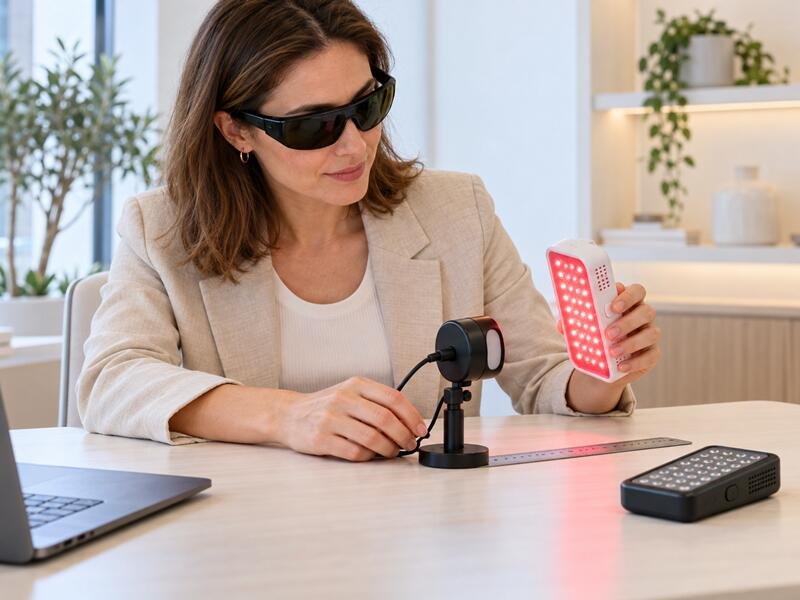
I am an Italian buyer looking for a handheld red and near-infrared light therapy panel for a new beauty-tech brand in the EU market.
My objective was practical. I did not want to develop a new panel from the ground up or begin by changing the circuit board, optical system, or battery. I wanted an established production platform that could retain its technical configuration while allowing logo, packaging, and minor cosmetic customization. For a new brand, this made the first launch easier to manage and kept the verification work focused.
Once I started sourcing, I found that product sheets were very good at displaying numbers and less good at explaining them. I needed to know what those figures meant for each model: the wavelengths, measurement distance, dose calculation, IEC 62471 coverage, and the battery used in production.
Instead of ordering a sample immediately, I compared two existing models and used several rounds of email to work through the questions one by one. This article explains what the supplier confirmed, what differed between HP001 and HP002, and how each answer affected my purchasing decision.
This article focuses on a rechargeable handheld red light therapy panel. Masks, wearables, full-size panels, and therapy beds may have different designs, uses, and applicable requirements, so this case should not be treated as a guide to every red light therapy device.
Defining the Purchasing Brief Before Comparing Models
In my first email, I set out the product brief. I wanted an existing production platform with red and near-infrared output, multiple intensity levels, a timer, rechargeable operation, low heat, and a format suitable for facial skincare. I was interested in 630 nm, 660 nm, and 850 nm, and I also asked whether the supplier had an existing 830 nm version.
I also made one commercial priority clear. The first launch had to remain manageable, so a low starting MOQ mattered more than extensive technical modification.
MedLight recommended HP001 and HP002. Both use 660 nm red light and 850 nm near-infrared light in their standard configurations, but their controls and output profiles differ. HP001 became the main technical case in my email review because its lower starting MOQ suited the launch plan. HP002 remained on the shortlist because it offered more control options and a larger illuminated area.
| Comparison item | HP001 | HP002 |
| Images |  |
 |
| Wavelength and LEDs | 660 nm + 850 nm, tolerance ±5 nm; 12 dual-chip LEDs | 660 nm + 850 nm, tolerance ±5 nm; 13 dual-chip LEDs |
| Combined irradiance levels | L1 >75; L2 >120; L3 >180 mW/cm²; listed peak 180 mW/cm² | L1 >40; L2 >56; L3 >72; L4 >99; L5 >120 mW/cm²; listed peak 120 mW/cm² |
| Illuminated area | 15 × 10 cm at the recommended distance | 17 × 10 cm at the recommended distance |
| Timer | 30-minute countdown | 5, 10, 15, 20, 25, or 30 minutes |
| Light and emission modes | Red and near-infrared together; continuous wave | Red and near-infrared separately or together; continuous wave or 10 Hz pulsed |
| Battery and charging | 5000 mAh; USB Type-C | 6000 mAh; USB Type-C |
| Water resistance | Not waterproof | Not waterproof |
| Commercial checkpoint | Standard 20 units; logo 50; packaging or finish changes 100 | MOQ and lead time not stated in the supplied sheet; confirm separately |
The comparison stopped me from treating “more” as a complete buying argument. HP001 offered the simpler operating pattern and the higher listed peak. HP002 offered five intensity levels, separate or combined light channels, 10 Hz pulsing, flexible timers, a larger illuminated area, and a larger battery. Neither model was automatically better. The right choice depended on the intended protocol, user experience, document coverage, and commercial terms. For HP002, I would confirm the MOQ and lead time separately because they were not stated in the supplied product sheet.
To learn more about the two handheld panels, please check below links:
Handheld Red Light Therapy Panel Wholesale 660nm 850nm – HP001
Red + Near-Infrared Handheld Device For Premium Skincare And Beauty-tech Brand – HP002
Why I Did Not Chase 830 nm
Both standard models used 660 nm and 850 nm. MedLight explained that an 830 nm version could be discussed, but PCB compatibility and the supporting documentation would first need to be confirmed.
My decision was straightforward. For the first evaluation, I would compare the mature 660 nm and 850 nm versions of HP001 and HP002 rather than request an 830 nm change.
I understand why 830 nm may look attractive in marketing material, but sourcing is not a wavelength-collecting contest. Changing the light source may affect the drive parameters, output distribution, photobiological safety evidence, and existing compliance documents. For a new brand, validating a mature configuration is more sensible than reopening an entire verification programme for a difference of 10 or 20 nm.
This exchange settled the optical decision. I would validate the two established standard platforms before considering wavelength customization.
What HP001’s 180mW/cm² Actually Meant
For HP001, the specification listed three combined red and near-infrared output levels above 75, 120, and 180 mW/cm². It also stated a dose of approximately 85 J/cm² for a ten-minute session.
Read on their own, these figures could suggest that 180 mW/cm² represented the average output across the entire treatment area. I therefore asked three direct questions. Were these peak or area-average readings? Which level corresponded to 85 J/cm²? Did that dose represent the full illuminated area?
MedLight gave a specific answer. The 75, 120, and 180 mW/cm² figures were peak readings. At a distance of 3 cm, the meter could read as high as 180 mW/cm² directly in front of an LED. In the metal area between two LEDs, the reading was approximately 60 mW/cm². At 6 cm, the maximum reading was about 80 mW/cm² and the minimum about 65 mW/cm², which indicated a more even distribution.
They also explained that the 85 J/cm² figure was associated with the highest level and was based on a ten-minute session at 3 cm with the sensor directly in front of an LED. When considered on an average irradiance basis, the supplier estimated the ten-minute dose at approximately 35 to 40 J/cm².
That reply gave me something more useful than the headline figure of 180 mW/cm². It showed that the specification described a local peak, not an output received equally at every point across the treatment area. A longer distance reduced the peak but improved uniformity. For a handheld facial panel, that distinction matters more than simply chasing the highest number.
I also checked the basic arithmetic. Under continuous output, 180 mW/cm² multiplied by 600 seconds equals 108 J/cm², not 85 J/cm². I did not try to invent an explanation on the supplier’s behalf. Instead, I set a clear boundary for the data. The 85 J/cm² figure could remain in the original supplier material, but I would not present it as a verified full-area dose or use it in consumer-facing claims without a reproducible finished-device measurement method and calculation record.
This resolved the HP001 decision. The 180 mW/cm² value was a peak reading, while 35 to 40 J/cm² was the supplier’s explanation of the ten-minute area-average dose. Any customer-facing dose claim would still need a defined finished-device test method. HP002 had to be treated separately: its sheet listed five combined levels above 40, 56, 72, 99, and 120 mW/cm², but no dose figure. I would not copy HP001’s dose explanation onto HP002 simply because both models use 660 nm and 850 nm.
Core Formula:
Dose (J/cm²) = Irradiance (mW/cm²) × Time (s) ÷ 1000
Example: 50 mW/cm² × 120 seconds ÷ 1000 = 6 J/cm² — a standard mid-range therapeutic dose for muscle recovery.
Turning Specifications Into a Usable Facial Protocol
For HP001, I did not want customers to assume that a higher level and a longer session must always be better, so I asked how the supplier intended the panel to be used on the face, jawline, and neck.
For HP001, MedLight recommended P3 intensity at a distance of 6 cm for five minutes per session.
This answer linked intensity, distance, and time. It also matched the earlier measurement explanation: at 6 cm, the supplier’s stated output range was narrower, indicating more even coverage. That gave me a repeatable starting point for the HP001 sample.
I would use that protocol as the HP001 sample starting point rather than build a more aggressive routine around the highest peak. HP002 offers more operating choices, so it needs its own defined combination of light channel, intensity, emission mode, distance, and time. Flexibility is useful only when the instructions make it repeatable.
What a Meter Photo Can and Cannot Prove
For HP001, I also asked what instrument had been used, whether the test distance was 3 cm, and whether the supplier could provide a measurement record.
| Comparison Photos | Location | Irradiance (Measured) |
 |
Directly in front of an LED (3cm) | 1823 W/m² |
 |
Between the two LEDs (3cm) | 657.9 W/m² |
* 1 W/m² = 0.1 mW/cm²
MedLight confirmed that a solar power meter had been used at a distance of 3 cm and provided photographs of the measurement.
Those photographs were useful during purchasing review. I could see the sensor position and understand why a reading taken directly in front of an LED differed from one taken between LEDs. However, I would not describe the photographs as an independent laboratory report. They showed that the supplier had performed the measurement, but they did not by themselves establish the meter’s spectral response, calibration status, or the average output over the full illuminated area.
I therefore treated the evidence as two levels of support. The supplier’s in-house record was enough to understand HP001 and decide whether to move to a sample. A public irradiance or dose claim would require a more complete, reproducible finished-device test record. If HP002 moved to sample approval, I would request equivalent model-specific records rather than reuse HP001 photographs.
Separating Compliance Documents by Purpose
My original document request covered the EU Declaration of Conformity, EMC and RoHS documentation, an IEC 62471 report, a UN 38.3 report, and the battery MSDS. I also explained that documents issued under the supplier’s existing company and model details were acceptable for the initial technical review.
The supplier confirmed what could be provided, what each document covered, and at which project stage it would be available.
| Document | Supplier Response | My Purchasing Conclusion |
| IEC 62471 | The existing material covered the 660 nm and 850 nm LED chips rather than the fully assembled panel | Useful at light-source level, but not a completed photobiological safety assessment of the finished panel |
| Finished-panel IEC 62471 assessment | A device-level assessment can be arranged; scope and lead time should be confirmed for the selected model and final configuration | Make the assessment model-specific and include its document-delivery milestone in the project plan |
| UN 38.3 and battery MSDS | HP001 documents were supplied and matched to cell 656090. HP002 lists 6000 mAh, but its cell model is not stated in the sheet | HP001 was traceable; HP002 requires its own cell and document match before approval |
| EU Declaration of Conformity, EMC, and RoHS | The supplier confirmed availability at the bulk-order stage; exact model and configuration coverage still needs checking | Write the document-delivery and approval conditions into the order process and complete review before shipment |
This exchange taught me why it is not enough to ask whether a supplier “has certificates.” I need to know whether the document exists, exactly what it covers, and when I will be allowed to review it.
IEC 62471 is a good example. An LED-chip report can describe the light source, but drive current, optical layout, LED spacing, lenses, operating modes, and use distance all affect the light reaching the user. The supplier’s willingness to arrange a device-level assessment, with its scope and timing agreed in advance, turned it into a defined project step rather than a vague promise.
CE also needs to be understood accurately. CE marking is not a general certificate purchased from an institution. The manufacturer must identify the applicable EU legislation, complete the conformity assessment, prepare the technical documentation, sign the EU Declaration of Conformity, and affix the CE marking where required. EU guidance also explains that a company that has a product manufactured for it and markets that product under its own name or trademark may assume the manufacturer’s responsibilities.
Adding a logo is easy. The legal role does not become simpler with it. Before launch, I would therefore confirm who acts as the manufacturer, importer, and responsible economic operator in the EU, and ensure that the product label, instructions, technical documentation, and online information remain consistent.
The intended purpose and marketing claims also need to be decided before launch. Calling a handheld red light therapy panel a beauty product does not automatically settle every classification question. Annex XVI of the EU Medical Device Regulation and its common specifications address certain high-intensity infrared and visible-light equipment intended for treatment of human skin. I would ask an EU compliance professional to assess the final configuration, output, intended purpose, and claims before approving the packaging and marketing text. I would make that assessment separately for HP001 and HP002 because model names, operating modes, and output profiles matter.
Matching HP001 Battery Documents to the Production Cell
After the supplier sent the battery MSDS and UN 38.3 report, I compared the documents line by line rather than stopping at the filenames.
Both documents referred to the same polymer lithium-ion cell: model 656090, rated at 3.7 V, 5000 mAh, and 18.5 Wh, manufactured by Guangdong Cvasun New Energy Technology Co Ltd. The MSDS also referenced the same UN 38.3 report number, S03A22110836U00201.
Once the documents matched each other, I asked one final question. Did the current HP001 production model actually use this 656090 cell, and would future orders continue to use the same battery specification?
The supplier’s final reply was unambiguous. Current HP001 production uses exactly the 656090 battery cell covered by the MSDS and UN 38.3 documents, and future HP001 orders will use the same battery specification.
At that point, the battery review was complete. The model, electrical rating, manufacturer, and report number were consistent across the documents, and the supplier had linked them in writing to both current production and future orders.
This gave me a practical purchasing rule. For any rechargeable product, I will confirm four things in sequence: whether the MSDS and UN 38.3 report refer to the same cell, whether the report numbers are consistent, whether the cell is actually used in current production, and whether future orders are committed to the same specification. I would then record the cell model, manufacturer, capacity, and report number in the controlled bill of materials and require written notice before any substitution.
UN 38.3 mainly addresses transport testing of lithium cells and batteries; it is not a complete EU conformity assessment of the finished device. The HP002 sheet confirms a 6000 mAh battery but does not state the cell model. That did not leave me guessing. It gave me a precise next request: the HP002 MSDS, UN 38.3 report, cell identity, and a written commitment linking them to production.
Comparing Practical Details Beyond the Headline Numbers
Beyond technical and compliance documents, I needed to know whether each panel was genuinely suitable for handheld use, packaging, and routine charging. I therefore compared the details already confirmed and marked the remaining items for sample inspection.
For HP001, the supplier confirmed overall dimensions of 13 × 8.5 × 3 cm, a net weight of 0.5 kg, up to approximately 90 minutes of operation at the highest setting, and a charging time of about three to four hours. The product sheets added a useful cross-model view: HP001 has a 15 × 10 cm illuminated area and a 5000 mAh battery, while HP002 has a 17 × 10 cm illuminated area and a 6000 mAh battery. Both use USB Type-C charging and neither is waterproof.
The HP002 sheet did not state its overall dimensions, weight, operating time, or charging time. A blank field does not fill itself in just because a buyer needs it; it becomes a sample-check item. That is normal purchasing verification. The documents tell me what should arrive, and the sample shows whether the physical product matches the written description.
What the Email Exchange Ultimately Confirmed
After several rounds of communication, I had a set of conclusions that I could act on.
- HP001 and HP002 both use the mature standard 660 nm and 850 nm configuration; I would not request an 830 nm change for the first evaluation.
- HP001 uses 12 dual-chip LEDs, three intensity levels, simultaneous red and near-infrared output, continuous wave, a 15 × 10 cm illuminated area, and a 5000 mAh battery.
- HP002 uses 13 dual-chip LEDs, five intensity levels, separate or simultaneous light channels, continuous wave or 10 Hz pulsing, multiple timer settings, a 17 × 10 cm illuminated area, and a 6000 mAh battery.
- For HP001, the confirmed starting quantities were 20 units for the standard product, 50 units for logo customization, and 100 units for custom packaging or finish changes. HP002 quantities and lead time should be confirmed separately.
- HP001’s 75, 120, and 180 mW/cm² figures were peak readings, not the average irradiance across the complete treatment area. Its dose explanation should not be transferred to HP002.
- The supplier’s HP001 facial starting point was P3 intensity at 6 cm for five minutes. The in-house meter photographs supported technical review but did not replace a reproducible finished-device report.
- Every IEC 62471, EU Declaration of Conformity, EMC, and RoHS document must be matched to the exact model and configuration. Evidence for HP001 should not automatically be treated as evidence for HP002.
- HP001’s MSDS, UN 38.3 report, current production cell, and future-order specification were linked in writing to cell 656090. HP002 needs the same model-specific battery check.
- The confirmed physical and operating details can enter the sample plan, while any field missing from the product sheet should be measured or documented during sample review.
- The approved sample for the selected model should become the production reference, supported by a controlled bill of materials and advance change notification.
That was the result I wanted. The emails did not need to sound impressive; each answer needed to support a purchasing decision.
How I Would Inspect the Sample
If one or both models proceed to the sample stage, I would check more than whether the LEDs switch on. I would create a written inspection record for each model, using its own confirmed configuration and use conditions.
| Sample Check | What I Would Verify | Question Resolved After Approval |
| Identity and configuration | HP001 or HP002 model, wavelengths, LED layout, intensity levels, timers, light-channel controls, and emission modes | Is the sample the exact version reviewed in writing |
| Output performance | Reading distribution at the stated distance and, where relevant, across the illuminated area and another distance; output stability and heat | Can the model-specific supplier data be reproduced under comparable conditions |
| Intended use | HP001: P3, 6 cm, five minutes. HP002: confirm and test the selected channel, intensity, mode, distance, and timer | Is the model-specific protocol practical and repeatable |
| Battery and charging | HP001 cell 656090; HP002 cell identity; capacity, operating time, charging time, and interface | Do the documents, battery, and physical sample match for each model |
| Appearance and packaging | Overall dimensions, weight, illuminated area, surface finish, logo position, accessories, and packaging space | Is the selected platform suitable for branding and transport |
| Document matching | Report model, configuration, product photographs, key components, and version information | Can production remain consistent with the approved model and sample |
Once a model was approved, I would keep that sample as the production reference and include configuration control and advance change-notification requirements in the purchasing documents. The next order would then rely on a specific record, not the easily misunderstood phrase “same as last time.”
A Purchasing Checklist for Other EU Buyers
If you are also sourcing a handheld red light therapy panel, I recommend including the following questions in the first or second email round. The supplier does not need to answer each one at great length, but every answer should correspond to a specific model and configuration.
- For each model, what are the exact wavelengths, LED configuration, intensity levels, timer options, light-channel controls, and emission modes?
- Is the published irradiance a peak, minimum, or area-average value, and where and at what distance was it measured?
- Which irradiance value, exposure time, and calculation method were used for the stated dose?
- What intensity, distance, session time, channel setting, and emission mode does the supplier recommend for the intended use of each model?
- Which measurement instruments, in-house records, and third-party reports are available?
- Does the IEC 62471 material cover the LED component or the complete device, and what are the scope and lead time for a model-specific finished-device assessment?
- Which exact model and configuration are covered by the EU Declaration of Conformity, EMC, and RoHS documentation, and when can the buyer review them?
- Which battery cell is covered by the UN 38.3 report and MSDS for each model, and will current production and future orders use the same specification?
- What are the separate MOQs and lead times for the standard product, logo customization, custom packaging, and color changes?
- Which technical or cosmetic changes would affect the existing tests, technical documentation, or EU Declaration of Conformity?
- Who will act as manufacturer, importer, and responsible economic operator in the EU, and how will their details appear on the product and packaging?
- How will the approved sample, bill of materials, and change-notification process be controlled before mass production?
Sourcing a handheld red light therapy panel begins with the exact model. I compare specifications, ask how the data were measured, match every document and battery record to that model, and then verify the sample. HP001 and HP002 can share the same wavelengths without sharing the same evidence. Once the supplier’s commitments are written into the order, the approved sample becomes a useful production reference and the brand has a responsible route to the EU market.
Official EU Sources
- European Commission guidance on CE marking and economic operator responsibilities
- Your Europe guidance on CE marking and the conformity process
- European Commission guidance for importers and distributors
- General Product Safety Regulation EU 2023 988
- Medical Device Regulation EU 2017 745
- Commission Implementing Regulation EU 2022 2346
- United Nations Manual of Tests and Criteria Revision 8
This article records a real purchasing exchange and the decisions that followed. It does not replace product-specific EU classification, conformity assessment, laboratory testing, or legal advice.
To Be Continued…
This sourcing journey is not over yet. MedLight remains in contact with the Italian buyer featured in this article, and we will continue to share updates as the project moves forward.
If you are also sourcing red light therapy devices for your local market, please use the right **Send Inquiry** form on this page to tell us about your target market and the devices you are interested in. Our team will respond within 24 hours with suitable product recommendations and a solution tailored to your sourcing needs.